The highest point in County Limerick is Galtymore, standing at 917.9 meters (3,011 feet). Located in the Galty Mountains (or Galtee Mountains) on the border with County Tipperary, Galtymore is one of Ireland’s most prominent peaks, often considered the “king” of the Galtys. It is a challenging but rewarding destination for hikers, offering stunning views and a rugged mountain experience.
- Geological and Cultural Significance: Galtymore is part of the Galty Mountains, a range of Old Red Sandstone hills formed during the Devonian period, characterized by steep ridges, deep corries, and blanket bogs. Its name, derived from Irish Gaibhlte Mór (“great Galty”), reflects its dominance in the range. The mountain holds cultural significance in local folklore, with tales of Fionn MacCumhaill and the Fianna, and is near historical sites like the Glen of Aherlow, a strategic pass in medieval times. Galtymore is also one of Ireland’s 13 “Munros” (peaks over 3,000 feet), making it a bucket-list hike for peak baggers.
- Scenic Beauty: The summit offers panoramic views across Limerick, Tipperary, and beyond, including the Golden Vale, the Knockmealdown Mountains, and, on clear days, the Comeraghs, Slieve Blooms, and even the distant Kerry mountains. The dramatic corrie lakes, like Lough Diheen and Lough Curra, add to the mountain’s rugged allure.
Approaching Galtymore
- Access Points: Galtymore is most commonly approached from the Glen of Aherlow in County Tipperary, as the main trailheads are closer to Tipperary’s side, but Limerick hikers access it via the same routes. The primary starting point is the Clydagh Valley car park (Grid Ref: R 878 238), near Lisvarrinane, off the R664 between Tipperary town and Cahir. Another option is from the Kings Yard near Kilbehenny, on Limerick’s side (Grid Ref: R 885 185). Both are remote, with no public transport, so a car is essential. The nearest bus routes (e.g., Bus Éireann to Cahir) require a drive or taxi to the trailhead.
Trail Options:
- Clydagh Valley Route (Black Road): The most popular route is a 10–12km round-trip hike (4–6 hours) starting at the Clydagh Valley car park. Hikers follow the “Black Road,” a clear farm track, into the mountains, then ascend Galtymore’s northern slopes via a steep, grassy ridge to the summit, marked by a white cross and trig pillar. The route passes Lough Diheen and offers views of the corrie. This is a strenuous hike due to the 700m elevation gain and exposed terrain, suitable for intermediate to experienced hikers.
- Kings Yard Route: A slightly longer 12–14km round-trip hike (5–7 hours) starts at Kings Yard, near Kilbehenny, on Limerick’s southern slopes. Hikers follow a track through farmland, join the Galty Wall (a dry-stone boundary), and ascend via a gentler but boggy southern approach. This route is less crowded but requires navigation across open moorland. It’s also strenuous, with significant elevation gain.
- Extended Loop Routes: Experienced hikers may opt for a 15–20km loop (6–8 hours), combining Galtymore with Galtybeg (799m) and other peaks like Cush or Slievecushnabinnia. These loops use the Galty Wall and ridge paths, offering a full day’s challenge but requiring strong navigation, especially in fog.
- Navigation and Preparation: The Black Road route is clear initially but becomes less defined on the upper slopes, while the Kings Yard route crosses open, boggy terrain. Hikers should carry a map (Ordnance Survey Ireland, Discovery Series Sheet 74), compass, or GPS, as fog and low visibility are common. Waterproof hiking boots, gaiters, rain gear, and layered clothing are essential due to wet bog and Limerick’s frequent rain. Bring water, snacks, and a first-aid kit, as there are no facilities. Dogs are allowed but must be leashed to protect livestock. Check weather forecasts, as the summit is exposed to strong winds and sudden changes.
Hiking Experience:
- The Clydagh Valley route is the most direct, with a steady climb along the Black Road, transitioning to a steep, grassy ascent. The corrie and Lough Diheen add scenic drama, but the final push to the summit is challenging, especially in wet or windy conditions.
- The Kings Yard route offers a quieter, more gradual approach but involves boggy terrain and less-defined paths, requiring confidence in navigation. Both routes reward hikers with a sense of achievement at the summit’s white cross.
- The summit is a broad, rocky plateau with a trig pillar and cross, offering a windswept, exhilarating atmosphere. Galtymore’s prominence and exposure make it feel grander than its height suggests, though it sees moderate crowds due to its Munro status.
- Views and Photography: On clear days, the summit provides breathtaking views over Limerick’s Golden Vale, Tipperary’s farmlands, and surrounding ranges. The corrie lakes, like Lough Diheen, are photogenic, especially with mist or reflected light. Sunrise or sunset hikes enhance the dramatic interplay of light and shadow, making Galtymore a favorite for landscape photography.
- Wildlife and Nature: The Galty Mountains support blanket bogs with heather, sphagnum moss, and cotton grass, alongside flora like bilberries. Wildlife includes red deer, mountain hares, and birds such as ravens, peregrine falcons, and red grouse. The corrie lakes and streams add to the area’s ecological richness. Grazing sheep are common, reflecting the region’s pastoral use.
- Cultural and Historical Context: Galtymore is linked to Fianna mythology, with legends of Fionn MacCumhaill hunting in the Galtys. The nearby Glen of Aherlow was a historical hideout for rebels, adding intrigue. The area’s market towns, like Mitchelstown or Tipperary, preserve Limerick’s agricultural heritage, with festivals like the Cahir Traditional Music Festival offering cultural immersion.
- Amenities: The Clydagh Valley and Kings Yard trailheads have no facilities, so hikers must be self-sufficient. The nearest amenities are in Lisvarrinane or Kilbehenny (small shops or pubs) or larger towns like Cahir (15km) or Mitchelstown (10km), offering cafés, pubs (e.g., The Old Convent in Cahir), and accommodation. Tipperary town, 20km away, is a good base for supplies.
- Seasonal Considerations: Spring (April–May) and autumn (September–October) offer vibrant heather and mild weather (8–15°C / 46–59°F), ideal for hiking. Summer (June–August) is warmest (15–20°C / 59–68°F) but busier, with wetter trails. Winter (November–March) brings mud, occasional snow, and shorter days, requiring extra caution. Limerick’s 1,200–1,400 annual sunshine hours allow for clear views, but rain is frequent, so waterproof gear is a must.
- Guided Tours: Local operators, like those listed on visitlimerick.ie or galteewalkingclub.ie, offer guided hikes of Galtymore, providing navigation support and insights into the area’s geology and folklore. These are ideal for novices or those tackling longer loops.
- Safety: Galtymore’s exposed summit and steep ridges pose risks in poor weather, with fog or wind disorienting hikers. The Black Road simplifies navigation, but other routes require skill. Inform someone of your plans, avoid hiking alone in bad conditions, and check for trail updates, as heavy rain can make streams hazardous. Mobile signal is patchy, so offline maps are recommended.
- Accessibility: Galtymore is strenuous, suitable for intermediate to experienced hikers due to its elevation gain and exposure. The Black Road is the most accessible route, but the summit is not wheelchair-accessible due to uneven, boggy terrain.
Galtymore is a challenging yet exhilarating hike in County Limerick, offering stunning views, rugged terrain, and a taste of the Galty Mountains’ wild beauty. Its prominence, corrie lakes, and cultural significance make it a standout destination for hikers, with nearby attractions like the Glen of Aherlow enhancing a visit. Proper preparation is key due to the mountain’s exposure and demanding trails, but the reward is one of Ireland’s finest summit experiences. For more details, visit visitlimerick.ie or consult Kieron Gibbons’ Ireland’s County High Points – A Walking Guide.
Highest point in county
Antrim – Armagh – Carlow – Cavan – Clare – Cork – Derry – Donegal – Down – Dublin – Fermanagh – Galway] – Kerry – Kildare – Kilkenny – Laois – Leitrim – Limerick – Longford – Louth – Mayo – Meath – Monaghan – Offaly – Roscommon – Sligo – Tipperary – Tyrone – Waterford – Westmeath – Wexford – Wicklow
County Limerick:
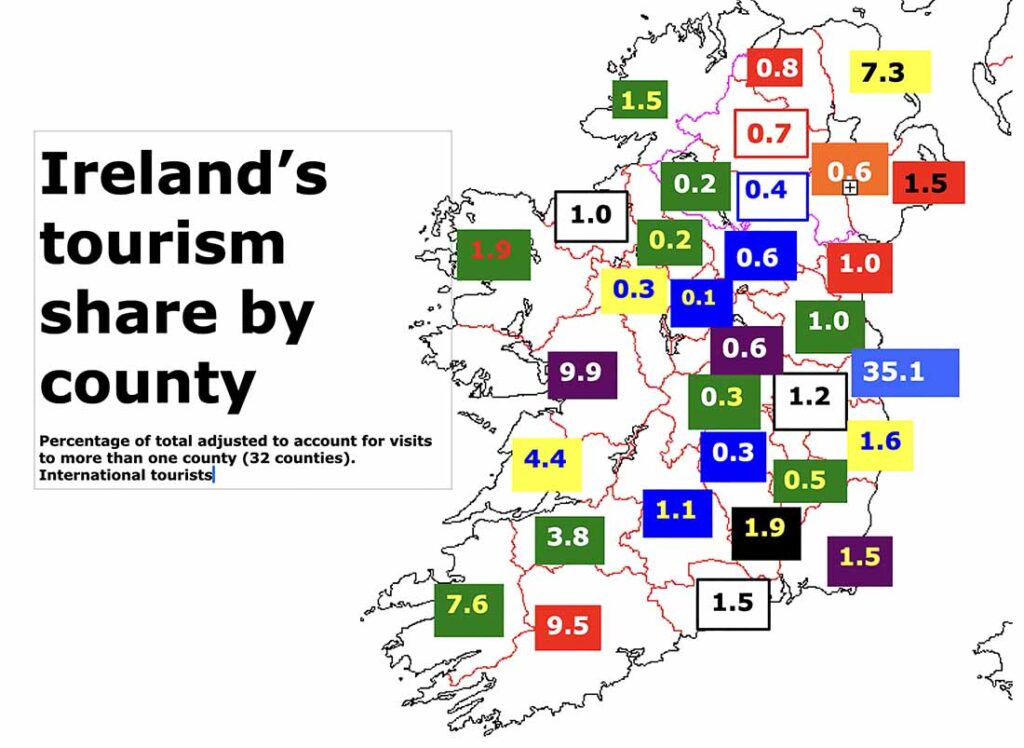
Ireland’s county Limerick combines historic landmarks with riverside charm, with Limerick City’s King John’s Castle offering insights into medieval history along the Shannon. The Hunt Museum showcases an eclectic art collection, while Adare’s thatched cottages and historic manor add picturesque appeal. Other attractions include the nearby Ballyhoura Mountains’ cycling trails. Limerick is Ireland’s tenth largest county by size (2,686 sq km), and ninth largest by population (209,536). Population peaked at 330,029 in 1841 and reached its lowest point, 133,339 in 1971. In terms of hospitality, Limerick is Ireland’s seventh most visited tourist county with around 420,000 international visitors per year.
Introduction – Adventure – Anthem – Archaeology – Attractions – Awards – Birdwatching – Camping – Castles – Churches – Contact list – Cycling – Dining – Equestrian – Festivals – Fishing – Folklore – Gardens – Golf – Graveyards – Happening – Haunted – Highest – Hiking – History – Holy Wells – Hotels – Hotels top 8 – Hunting & shooting – Instagrammable – Itineraries – Largest town – Luxury – MICE – Movies – Music – Name – New – Novelists – Off the beaten track – Poets – Pubs – Quotes – Random Facts – Restaurant Awards – Sacred Places – Saints – Songs – Spas – Sports – Sunsets – Sustainable – Things to do – Towns – Video – Villages – Walking – Wanderlist – Weddings – Wild swimming – Writers – 1837 – 1846 – 1852 – 1909 – 1955 – 1980 –