Pre-1000 The Gaelic Nation
County Limerick’s pre-1000 history is rooted in its role within the kingdom of Thomond (Tuamhain), part of Munster under the Dál gCais dynasty. Archaeological evidence, such as the ringforts at Cush and the Lough Gur complex (Neolithic to Iron Age), indicates early settlement. The Dál gCais, emerging in the 5th century, laid the foundations for later prominence under Brian Boru. Christianity arrived early, with monasteries founded at Mungret by Saint Nessan (c. 6th century) and at Killeedy by Saint Ita. The Annals of Ulster (record Viking raids on Limerick’s Shannon Estuary from the 9th century, with the Norse establishing a longphort at Limerick city by 845, making it a trading hub. Ecclesiastical sources dominate, potentially exaggerating Christian influence while marginalising pre-Christian Gaelic culture.
1000–1100: Dál gCais Ascendancy and Viking Limerick
In the 11th century, Limerick was a key centre for the Dál gCais under Brian Boru (d. 1014), born near Killaloe. His victory at Clontarf (1014) weakened Viking control, though Limerick remained a Norse-Gaelic port. The Annals of Inisfallen (detail Brian’s campaigns, portraying him as a unifying figure, though idealised. Limerick city, with its walls and St. Mary’s Cathedral (founded c. 1111), emerged as a religious and political hub. The O’Briens, Brian’s descendants, consolidated power in Thomond. Viking influence declined, but Limerick’s strategic Shannon location kept it exposed to raids.
1100–1200: Norman Incursions and Gaelic Resistance
The Norman invasion (1169–1171) reached Limerick by 1175, with the city briefly captured by Raymond le Gros. The O’Briens, under Domnall Mór O’Brien (d. 1194), resisted, maintaining Thomond’s autonomy. The Annals of the Four Masters (record O’Brien victories, such as the Battle of Thurles (1174), keeping Limerick largely Gaelic. The Normans built King John’s Castle (c. 1200) to secure the city. Mungret and Killeedy monasteries aligned with Roman reforms post-Synod of Cashel (1172).
1200–1300: Anglo-Norman Settlement and O’Brien Power
In the 13th century, Limerick was formally shired, with boundaries close to modern definitions. The Anglo-Normans, under families like the Fitzgeralds, strengthened their hold on Limerick city, which received a charter in 1197, fostering trade with England and France. The O’Briens retained rural control, with castles like Carrigogunnell. The Annals of Loch Cé (mention O’Brien conflicts with Normans. The establishment of Dominican and Franciscan friaries in Limerick city enhanced its ecclesiastical status. The county’s fertile lands supported agriculture, while the Shannon facilitated trade. Norman records overemphasise their control, requiring balance with Gaelic sources.
1300–1400: Gaelic Revival and Anglo-Norman Decline
The 14th century saw a Gaelic revival in rural Limerick, as Anglo-Norman power weakened post-Black Death (1348–1350). The O’Briens, under Brian O’Brien (d. 1370), regained influence in west Limerick. The Statute of Kilkenny (1366) had little impact outside Limerick city, where Anglo-Norman control persisted. The Fitzgeralds of Desmond exerted influence in south Limerick, creating tensions with the O’Briens. The Annals of the Four Masters record O’Brien campaigns. Limerick city’s walls and King John’s Castle reinforced its strategic role. English sources portray Gaelic lords as threats, necessitating critical interpretation.
1400–1500: O’Brien Autonomy and Anglo-Irish Influence
The 15th century saw Limerick under mixed Gaelic and Anglo-Irish control. The O’Briens, under Turlough O’Brien (d. 1459), maintained Thomond’s autonomy, while the Fitzgeralds of Desmond dominated south Limerick. The Wars of the Roses (1460–1485) distracted English authorities, allowing local power to flourish. Limerick city thrived as a port, with its merchant elite, including the Arthurs, gaining prominence. St. Mary’s Cathedral and friaries remained ecclesiastical hubs. Limerick’s rural isolation preserved Gaelic culture, but urban records dominate, marginalising Gaelic perspectives.
1500–1600: Tudor Reconquest and Desmond Rebellions
The 16th century brought Tudor efforts to control Limerick. The O’Briens, under Conor O’Brien (d. 1540), accepted English titles via surrender and regrant, becoming Earls of Thomond. The Fitzgeralds of Desmond, under Gerald Fitzgerald (d. 1583), resisted during the Desmond Rebellions (1569–1583), with Limerick as a battleground. Limerick city, loyal to the crown, was besieged in 1570 but held firm. The Reformation had limited impact, as Limerick remained Catholic. Early plantations targeted Desmond lands in south Limerick. The annals document resistance, while English records portray rebels as traitors, requiring balance.
1600–1700: Plantations, Sieges, and Confederate Wars
The 17th century saw Limerick transformed by plantation and war. The Munster Plantation confiscated Desmond lands, with English settlers arriving in south Limerick. The 1641 Rebellion saw Limerick join the Catholic Confederacy, with the city a key Confederate base under Patrick Purcell. The Cromwellian conquest (1649–1653) besieged Limerick in 1651, leading to massive land confiscations. The Williamite War (1689–1691) saw two sieges of Limerick (1690–1691), with the Treaty of Limerick ending Catholic resistance. The Annals of the Four Masters document Catholic losses, while English sources vilify rebels, necessitating critical interpretation. Limerick city declined post-war, but its strategic role persisted.
1700–1800: Protestant Ascendancy and Economic Challenges
The 18th century saw Limerick under the Colonial/Protestant Ascendancy, with Anglo-Irish landlords dominating. The Penal Laws marginalized Catholics, who formed the majority in rural Limerick. Limerick city’s trade declined, though its port supported butter and beef exports. The 1798 Rebellion saw minimal activity in Limerick, with local unrest subdued. The Act of Union (1800) strengthened English control. Rural Limerick relied on agriculture, with Adare and Newcastle West as market centres. The English narratives tend to downplay Catholic grievances.
1800–1900: Famine, Reform, and Nationalism
The 19th century brought hardship to Limerick. The Great Famine (1845–1849) reduced the population from 330,000 in 1841 to 262,000 in 1851, with rural west Limerick hit hardest. Limerick city’s port facilitated emigration. Railways (1850s) and markets aided recovery. The Gaelic Revival saw the Gaelic League promote Irish culture, with limited traction in urban Limerick. The GAA, founded in 1884, established strong hurling clubs, with Limerick winning early titles. The Land League and Home Rule movement gained Catholic support, led locally by figures like William Abraham. English famine records tend to understate suffering,.
1900–2025: Independence, Industry, and Tourism
The 20th and 21st centuries saw Limerick play a key role in Ireland’s independence. The War of Independence (1919–1921) saw intense IRA activity, with figures like Seán Hogan active. The Civil War (1922–1923) saw fighting in Limerick city, a pro-treaty stronghold. Post-independence, Limerick’s economy diversified with industries like Shannon Airport (1940s) and Dell (1990s–2000s). The county’s GAA tradition flourished, with All-Ireland hurling titles in 1918, 1934, 1936, 1940, 1973, 2018, and 2020–2023. Tourism grew around King John’s Castle, Adare, and the Shannon. Official narratives tend to overemphasise progress, overlooking urban poverty. Limerick is one of 24 Irish counties that still has a smaller population than it did in 1841.
History
Antrim – Armagh – Carlow – Cavan – Clare – Cork – Derry – Donegal – Down – Dublin – Fermanagh – Galway – Kerry – Kildare – Kilkenny – Laois – Leitrim – Limerick – Longford – Louth – Mayo – Meath – Monaghan – Offaly – Roscommon – Sligo – Tipperary – Tyrone – Waterford – Westmeath – Wexford – Wicklow
County Limerick:
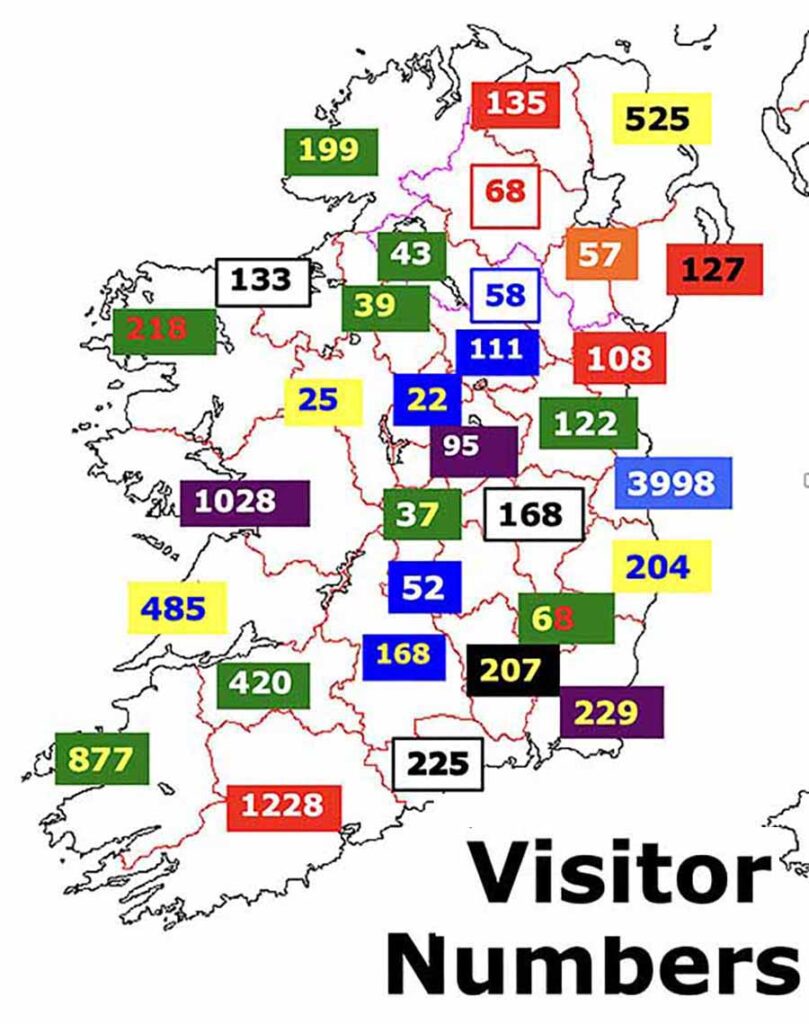
Ireland’s county Limerick combines historic landmarks with riverside charm, with Limerick City’s King John’s Castle offering insights into medieval history along the Shannon. The Hunt Museum showcases an eclectic art collection, while Adare’s thatched cottages and historic manor add picturesque appeal. Other attractions include the nearby Ballyhoura Mountains’ cycling trails. Limerick is Ireland’s tenth largest county by size (2,686 sq km), and ninth largest by population (209,536). Population peaked at 330,029 in 1841 and reached its lowest point, 133,339 in 1971. In terms of hospitality, Limerick is Ireland’s seventh most visited tourist county with around 420,000 international visitors per year.
Introduction – Adventure – Anthem – Archaeology – Attractions – Awards – Birdwatching – Camping – Castles – Churches – Contact list – Cycling – Dining – Equestrian – Festivals – Fishing – Folklore – Gardens – Golf – Graveyards – Happening – Haunted – Highest – Hiking – History – Holy Wells – Hotels – Hotels top 8 – Hunting & shooting – Instagrammable – Itineraries – Largest town – Luxury – MICE – Movies – Music – Name – New – Novelists – Off the beaten track – Poets – Pubs – Quotes – Random Facts – Restaurant Awards – Sacred Places – Saints – Songs – Spas – Sports – Sunsets – Sustainable – Things to do – Towns – Video – Villages – Walking – Wanderlist – Weddings – Wild swimming – Writers – 1837 – 1846 – 1852 – 1909 – 1955 – 1980 –