- Dublin Castle: Dame Street, Dublin 2, Co. Dublin, D02 YN63. Built in 1204 by King John on a Viking settlement (c. 9th-10th century), this Norman castle served as the seat of English and British rule in Ireland. Excavations revealed Viking defences and a moat. Managed by the OPW, it offers guided tours of state apartments and medieval undercroft, reflecting Dublin’s Viking and Norman heritage.
- Christ Church Cathedral (Dublinia): Christchurch Place, Dublin 8, Co. Dublin, D08 TF98. Founded c. 1030 by Sitric Silkenbeard, a Norse king, and rebuilt by Normans in the 12th century, this cathedral sits on a Viking-era site. The crypt, one of Ireland’s largest, contains artefacts like a 17th-century mummified cat and rat. The adjacent Dublinia exhibition explores Viking and medieval Dublin. Managed by the Church of Ireland, it’s accessible with guided tours.
- St. Mary’s Abbey: Meetinghouse Lane, Dublin 7, Co. Dublin, D07 YX58. A Cistercian abbey founded in 1139, one of Ireland’s wealthiest medieval monasteries. Its chapter house, the only surviving structure, dates to the 12th century and hosted the 1217 parliament. Excavations revealed monastic features. Managed by the OPW, it’s accessible via guided tours, reflecting Dublin’s monastic history.
- Drimnagh Castle: Long Mile Road, Drimnagh, Dublin 12, Co. Dublin, D12 Y677. A 13th-century Norman castle, one of Ireland’s few with a flooded moat, built by the de Barnewall family. Restored in the 20th century, it features a great hall and 17th-century gardens. Privately managed, it offers guided tours, showcasing Dublin’s medieval feudal past.
- Howth Castle (Prehistoric and Medieval Remains): Howth, Co. Dublin, D13 EH79. The castle, built c. 1235 by the St. Lawrence family, incorporates a 15th-century keep on a possible Viking-era site. Nearby, a Neolithic portal tomb (Aideen’s Grave, c. 3000 BC) lies in the castle grounds. The estate, still privately owned, allows limited public access to the grounds and tomb, reflecting multi-period use.
- Lusk Round Tower and Church: Church Road, Lusk, Co. Dublin, K45 W527. An early Christian monastic site, c. 9th-10th century, with a well-preserved round tower and medieval church ruins. Three high crosses and a 9th-century grave slab highlight its ecclesiastical role. Managed by the OPW, it’s accessible via public paths, offering insight into Dublin’s early Christian heritage.
- Bremore Passage Tomb Complex: Near Balbriggan, Co. Dublin, K32 XH29. A Neolithic passage tomb cemetery, c. 3500-3000 BC, with five visible mounds, potentially rivaling Brú na Bóinne in scale. Excavations suggest ritual use, possibly linked to maritime trade. A state-care monument, it’s accessible via public paths on private land, showcasing Dublin’s prehistoric coastal significance.
- Swords Castle: Bridge Street, Swords, Co. Dublin, K67 P2K7. A 12th-century Norman castle, likely built by John Comyn, Archbishop of Dublin, with a pentagonal bawn and chapel. It served as an archiepiscopal residence until the 14th century. Managed by Fingal County Council, it offers guided tours, reflecting Dublin’s Norman ecclesiastical power.
- Clondalkin Round Tower: Tower Road, Clondalkin, Co. Dublin, D22 H520. An early Christian round tower, c. 8th-9th century, part of a monastic site founded by St. Mochua. At 27.5m, it’s one of Ireland’s tallest, with a unique stepped base. The adjacent church and graveyard contain medieval slabs. A state-care monument, it’s accessible via public paths, highlighting Dublin’s monastic tradition.
Archaeological sites
Antrim – Armagh – Carlow – Cavan – Clare – Cork – Derry – Donegal – Down – Dublin – Fermanagh – Galway – Kerry – Kildare – Kilkenny – Laois – Leitrim – Limerick – Longford – Louth – Mayo – Meath – Monaghan – Offaly – Roscommon – Sligo – Tipperary – Tyrone – Waterford – Westmeath – Wexford – Wicklow
County Dublin:
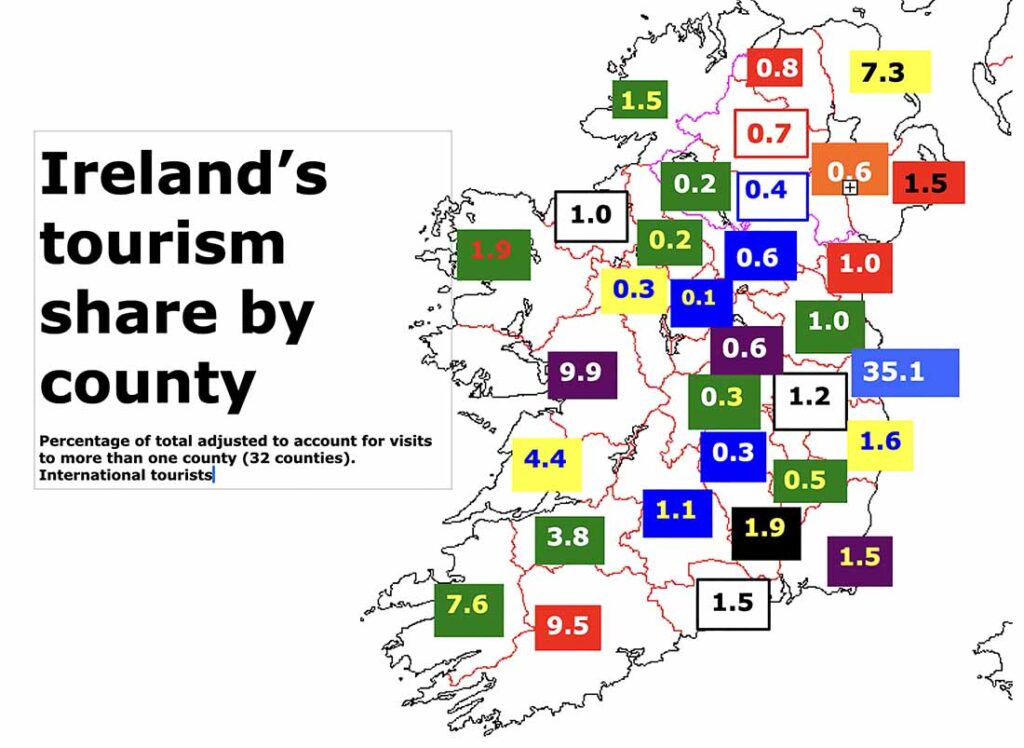
Ireland’s county Dublin combines cultural heritage with urban appeal, with Trinity College’s Book of Kells and Dublin Castle offering historical depth. The Guinness Storehouse provides a journey through Ireland’s iconic stout, while Phoenix Park’s vast green spaces are ideal for cycling. The River Liffey’s scenic walks and Kilmainham Gaol’s historical tours make Dublin a versatile destination for culture and history. Dublin is Ireland’s third smallest county by size (922 square km) and largest by population (1,458,154). Dublin is also Ireland’s most visited tourist county by a margin, with around four million international visitors per year. In terms of hospitality,
Introduction – Adventure – Anthem – Archaeology – Attractions – Awards – Birdwatching – Camping – Castles – Churches – Contact list – Cycling – Dining – Equestrian – Festivals – Fishing – Folklore – Gardens – Golf – Graveyards – Happening – Haunted – Highest – Hiking – History – Holy Wells – Hotels – Hotels top 8 – Hunting & shooting – Instagrammable – Itineraries – Largest town – Luxury – MICE – Movies – Music – New – Name – Novelists – Off the beaten track – Poets – Pubs – Quotes – Random Facts – Restaurant Awards – Sacred Places – Saints – Songs – Spas – Sports – Sunsets – Sustainable – Things to do – Towns – Video – Villages – Walking – Wanderlist – Weddings – Wild swimming – Writers – 1837 – 1846 – 1852 – 1909 – 1955 – 1980 –