County Dublin’s sporting history is a rich blend of Gaelic games, soccer, rugby, and more, with clubs, facilities, and personalities shaping a proud tradition. As Ireland’s capital county, Dublin’s athletic achievements reflect its deep passion for competition.
Gaelic Games: The Heart of Dublin
Dublin GAA oversees 91 clubs, with Gaelic Football and hurling central to the county’s identity. Croke Park, opened in 1884 and redeveloped in 1995, serves as the primary venue, hosting county and national matches. The Dublin senior football team won 31 All-Ireland Senior Football Championships, with victories from 1891 to 2020, including a historic six-in-a-row from 2015 to 2020.
The county also secured 63 Leinster Senior Football Championships, most recently in 2024, and 13 National Football League titles (1953, 1955, 1958, 1976, 1977, 1987, 1991, 1993, 2013, 2014, 2015, 2016, 2018). Kilmacud Crokes leads club football with 11 Dublin Senior Football Championships and three All-Ireland club titles (1995, 2009, 2023). St Vincent’s has 28 county titles and two All-Ireland club titles (1976, 2014), while Ballymun Kickhams won the 2012 county title.
In hurling, Dublin won six All-Ireland Senior Hurling Championships (1889, 1917, 1920, 1924, 1927, 1938) and three National Hurling League titles (1929, 1939, 2011). Cuala dominates club hurling with 11 Dublin Senior Hurling Championships and two All-Ireland club titles (2017, 2018). Camogie and ladies’ football thrive, with Dublin’s ladies’ team winning six All-Ireland Senior Ladies’ Football Championships (2010, 2017–2020, 2023). Legends include Kevin Heffernan, a 1974 All-Ireland player-manager, Brian Fenton, a nine-time All-Ireland winner, and Con O’Callaghan, a dual-code star.
- Stephen Cluxton (Parnell’s): Widely regarded as the greatest goalkeeper in GAA history, innovating the kickout and captaining the team to numerous titles.
- Brian Fenton (Raheny): A legendary midfielder who went years without losing a championship match, earning multiple Footballer of the Year awards.
- Ciarán Kilkenny (Castleknock): Renowned for his exceptional point-scoring ability, consistency, and work rate, a key playmaker.
- Diarmuid Connolly (St Vincent’s): A uniquely talented forward known for his incredible skill, long-range point scoring, and game-changing ability.
- James McCarthy (Ballymun Kickhams): A versatile, relentless leader, holding a record-equalling number of All-Ireland medals.
- Bernard Brogan (St Oliver Plunkett’s/Eoghan Ruadh): One of the most prolific forwards of his generation, winning Footballer of the Year in 2010.
- Jack McCaffrey (Clontarf): Known for his blistering pace and attacking runs from defence, won Footballer of the Year in 2015.
- Brian Mullins (St Vincent’s): A giant of the 1970s/80s, one of Dublin’s most iconic midfield powerhouses.
- Jimmy Keaveney (St Vincent’s): A legendary 1970s forward famous for his accuracy from frees and open play, a key scorer in the 1977 final.
- Alan Brogan (St Oliver Plunkett’s/Eoghan Ruadh): A stylish forward and leader, named Footballer of the Year in 2011.
Soccer: Dominance of League of Ireland
Dublin’s soccer scene is robust, with clubs like Shamrock Rovers, Bohemians, and St Patrick’s Athletic leading the League of Ireland. Shamrock Rovers, based at Tallaght Stadium since 2009, won 21 League of Ireland Premier Division titles, including a four-in-a-row from 1984 to 1987 and 2020 to 2024, and eight FAI Cups (1962, 1964–1969, 2019). Bohemians, at Dalymount Park since 1901, claimed 11 league titles (1935–36, 1974–75, 1977–78, 2001, 2003, 2008, 2009) and seven FAI Cups (1935, 1970, 1976, 1992, 2001, 2008, 2021).
St Patrick’s Athletic, playing at Richmond Park, won nine league titles (1951–52, 1954–55, 1955–56, 1989–90, 1995–96, 1998–99, 2006, 2013, 2023) and five FAI Cups (1961, 2014, 2021, 2023, 2024). Shelbourne, at Tolka Park, secured 13 league titles (1943–44, 1946–47, 1952–53, 1961–62, 1991–92, 1999–2000, 2001–02, 2003, 2004, 2006, 2024) and three FAI Cups (1960, 2000, 2011). Croke Park and the Aviva Stadium, opened in 2010, host international matches. Paul McGrath, a St Patrick’s Athletic and Ireland legend, and Damien Duff, a Shelbourne coach and former Ireland star, are key figures.
The soccer square mile
Between the 1930s and the 1960s, at a time soccer was very much a minority sport in Ireland, an incredible one third of our soccer internationals came from within a square mile of northside Dublin. They included Jackie Carey, Con Martin, Paddy Moore, Tommy Eglinton and John Giles (and the sport’s clown prince Eamon Dunphy). Dunphy was in the same class as Noel Shaw, later involved with Celbridge Town soccer club, in St Patrick’s NS.
Soccer’s square mile produces more internationals when you extend to Cabra (Terry Conroy, Jimmy Conway and Liam Whelan) or Beaumont (Paddy Mulligan). Gerry Daly and Ashley Grimes even came from the same street. IN recent time Troy Parrott has been the best known played from Dublin’s soccer square mile.
Rugby: Leinster’s Home
Rugby thrives through clubs like St Mary’s College RFC, Lansdowne FC, and Old Belvedere, with Leinster Rugby representing Dublin in the United Rugby Championship. Leinster, based at the RDS Arena and Aviva Stadium, won four European Rugby Champions Cups (2009, 2011, 2012, 2018) and eight Pro14/URC titles (2001–02, 2007–08, 2012–13, 2013–14, 2017–18, 2018–19, 2019–20, 2020–21). Lansdowne FC, at Lansdowne Road, won three All-Ireland League titles (2013, 2015, 2018). St Mary’s College RFC, based at Templeville Road, claimed the 2012 All-Ireland League title. Old Belvedere, at Anglesea Road, won the 2011 All-Ireland League. Brian O’Driscoll, with 133 Ireland caps, and Johnny Sexton, Ireland’s record points scorer, are Dublin’s rugby icons.
The sport’s premier nursery, Blackrock College, have won two of every three Leinster senior schools cups since the competition was established. Current prominent rugby players form Dublin include Jack Boyle, Harry Byrne, Ross Byrne, Thomas Clarkson, Tom Farrell, Hugo Keenan, Rónan Kelleher, Tommy O’Brien, Garry Ringrose, James Ryan, Dan Sheehan, Nick Timoney and Jeremy Loughman and Joe McCarthy, both USA born but Dublin raised.
Olympic tradition
Olympic gold medalists from Dublin include John Pius Boland (Tennis singles and doubles, Athens 1896), Joshua Millner (Free rifle shooting, London 1908), Noel Purcell (Water Polo team, Antwerp 1920), Michael Carruth (Welterweight boxing, Barcelona 1992), Michelle Smyth (born in Rathcoole 400m, three swimming medals at Atlanta 1996, 400m freestyle, 200m individual medley, 400m individual medley), Kellie Harrington (two medals, Women’s lightweight boxing, Tokyo 2020, Women’s lightweight boxing, Paris 2024).
Silver medals were won by Fred Tiedt (born in Beggar’s Bush, Welterweight boxing, Melbourne 1956), David Wilkins and Jamie Wilkinson (Flying Dutchman sailing, Moscow 1980), Ken Egan (Light heavyweight boxing, Beijing 2008) and Annalise Murphy (Women’s Laser Radial sailing, Rio 2016).
Bronze was won by Henry Brown, Walter Campbell, William Graham, Richard Gregg, Henry Murphy, Jack Peterson, Walter Peterson, Charles Power, Frank Robinson and Edward Allman-Smith (hockey team, London 1908), Tony Byrne (Lightweight boxing, Melbourne 1956; Ireland), Michelle Smyth in the 200m butterfly at Atlanta 1996 and Eimear Lambe (Women’s coxless four rowing; Tokyo 2020).
Other Sports and Facilities
Frank Stoker, an Irish rugby international and cousin of Dracula author Bram Stoker, was Wimbledon Men’s Doubles Champion in 1890 and 1893, partnering Joshua Pim from Bray.
Golf flourishes at courses like Portmarnock Golf Club, founded in 1894, and The K Club, which hosted the 2006 Ryder Cup. Athletics thrives through Clonliffe Harriers, while sailing and rowing are supported by Dublin Bay clubs. Croke Park, Aviva Stadium, and local grounds like Morton Stadium in Santry ensure strong community access. Boxing, cycling, and basketball further enrich Dublin’s sporting landscape.
Dublin’s sporting culture shines through clubs like Kilmacud Crokes, Shamrock Rovers, and Leinster Rugby, supported by venues like Croke Park and Tallaght Stadium.
Sports in the county
Antrim – Armagh – Carlow – Cavan – Clare – Cork – Derry – Donegal – Down – Dublin – Fermanagh – Galway – Kerry – Kildare – Kilkenny – Laois – Leitrim – Limerick – Longford – Louth – Mayo – Meath – Monaghan – Offaly – Roscommon – Sligo – Tipperary – Tyrone – Waterford – Westmeath – Wexford – Wicklow
County Dublin:
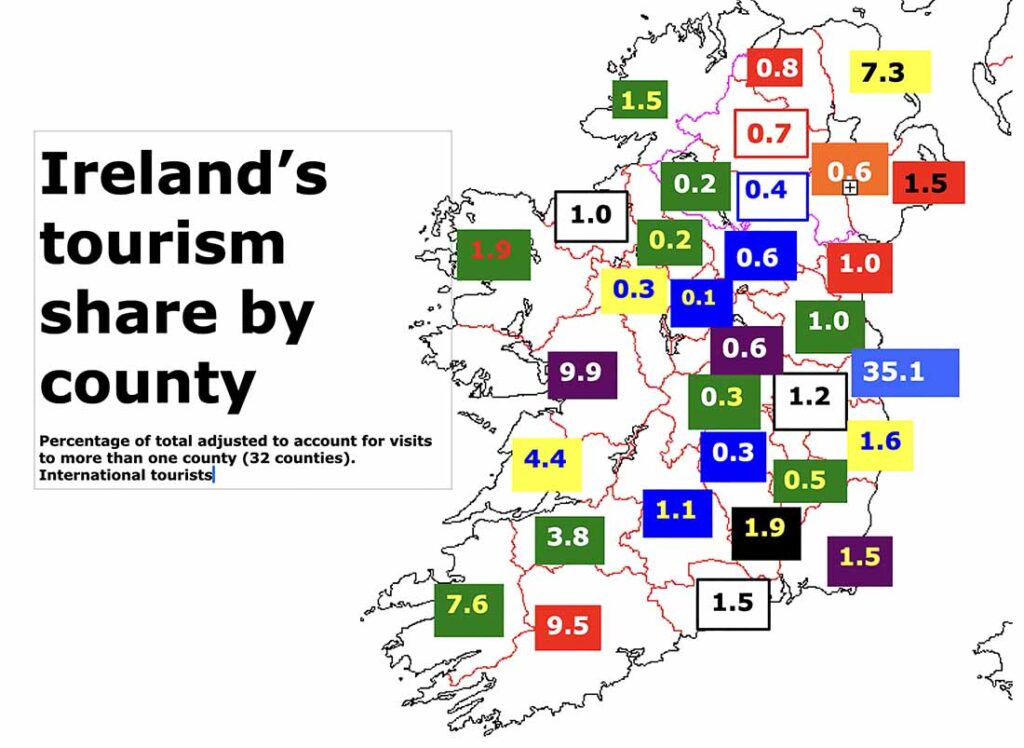
Ireland’s county Dublin combines cultural heritage with urban appeal, with Trinity College’s Book of Kells and Dublin Castle offering historical depth. The Guinness Storehouse provides a journey through Ireland’s iconic stout, while Phoenix Park’s vast green spaces are ideal for cycling. The River Liffey’s scenic walks and Kilmainham Gaol’s historical tours make Dublin a versatile destination for culture and history. Dublin is Ireland’s third smallest county by size (922 square km) and largest by population (1,458,154). Dublin is also Ireland’s most visited tourist county by a margin, with around four million international visitors per year. In terms of hospitality,
Introduction – Adventure – Anthem – Archaeology – Attractions – Awards – Birdwatching – Camping – Castles – Churches – Contact list – Cycling – Dining – Equestrian – Festivals – Fishing – Folklore – Gardens – Golf – Graveyards – Happening – Haunted – Highest – Hiking – History – Holy Wells – Hotels – Hotels top 8 – Hunting & shooting – Instagrammable – Itineraries – Largest town – Luxury – MICE – Movies – Music – New – Name – Novelists – Off the beaten track – Poets – Pubs – Quotes – Random Facts – Restaurant Awards – Sacred Places – Saints – Songs – Spas – Sports – Sunsets – Sustainable – Things to do – Towns – Video – Villages – Walking – Wanderlist – Weddings – Wild swimming – Writers – 1837 – 1846 – 1852 – 1909 – 1955 – 1980 –