- Benbulben: Sligo’s iconic flat-topped mountain, part of the Dartry range, immortalized in Yeats’ poetry. Visitors can expect scenic hikes on trails like the Benbulben Forest Walk (5.5km, moderate), with stunning views of its limestone cliffs and Sligo Bay. The surrounding area offers photography opportunities and a sense of the region’s mystical allure.
- Drumcliffe and Yeats’ Grave: A historic village where W.B. Yeats is buried, featuring St. Columba’s Church and the Yeats Memorial Building. Visitors can expect to visit the poet’s simple grave under Benbulben, explore a small exhibition on his life, and enjoy the tranquil churchyard. The nearby café and poetry trail add a literary touch to the experience.
- Carrowmore Megalithic Cemetery: One of Ireland’s largest Neolithic cemeteries, near Sligo Town, with tombs dating back to 4000 BC. Visitors can expect guided or self-guided tours through 30+ visible monuments, including passage tombs and dolmens, with a visitor center offering exhibits on prehistoric life. The Knocknarea hill and Queen Maeve’s Cairn are visible nearby.
- Knocknarea and Queen Maeve’s Cairn: A 327-meter hill near Carrowmore, topped by a large Neolithic cairn said to be the burial site of mythical Queen Maeve. Visitors can expect a 1-hour hike to the summit for panoramic views of Sligo’s coastline and Benbulben. The trail is accessible, but the unexcavated cairn is best viewed externally to preserve the site.
- Lissadell House and Gardens: A 19th-century estate near Drumcliffe, linked to Yeats and the Gore-Booth family. Visitors can expect guided tours of the Greek Revival mansion, showcasing its history and Constance Markievicz’s role in the Irish Revolution. The walled gardens, alpine nursery, and coastal walks offer scenic beauty, with a tearoom for refreshments.
- Strandhill Beach and Village: A vibrant coastal village known for its surfing and Atlantic views. Visitors can expect to surf or watch waves at Strandhill Beach, dine at acclaimed spots like Mammy Johnston’s ice cream parlor, or explore the Strandhill People’s Market (weekends). The nearby Voya Seaweed Baths offer a unique spa experience.
- Sligo Abbey: A 13th-century Dominican friary in Sligo Town, with well-preserved Gothic and Renaissance features. Visitors can expect self-guided tours of the cloisters, altar, and carved tombs, with interpretive signs detailing its history. The abbey’s atmospheric ruins are a short walk from Sligo’s bustling streets and cafés.
- Lough Gill: A scenic lake southeast of Sligo Town, featured in Yeats’ poem “The Lake Isle of Innisfree.” Visitors can expect boat tours to Innisfree Island, kayaking or paddleboarding, and walking trails like the Hazelwood Forest loop with lake views. The surrounding Parke’s Castle in County Leitrim is a nearby historical bonus.
- Mullaghmore Head: A coastal village with a sandy beach and dramatic cliffs, part of the Wild Atlantic Way. Visitors can expect coastal walks, surfing, or boat trips to spot marine life like dolphins. The Classiebawn Castle (private, visible from a distance) and nearby seafood restaurants add to the area’s charm.
- Glencar Waterfall: A 15-meter waterfall near Glencar Lough, immortalized in Yeats’ “The Stolen Child.” Visitors can expect a short, accessible walk to the waterfall, surrounded by lush woodland, with picnic areas and scenic views. The nearby Glencar Tearooms offer a cozy stop, and the site is ideal for families and nature lovers.
Attractions
Antrim – Armagh – Carlow – Cavan – Clare – Cork – Derry – Donegal – Down – Dublin – Fermanagh – Galway – Kerry – Kildare – Kilkenny – Laois – Leitrim – Limerick – Longford – Louth\ – Mayo – Meath – Monaghan – Offaly – Roscommon – Sligo – Tipperary – Tyrone – Waterford – Westmeath – Wexford – Wicklow
County Sligo:
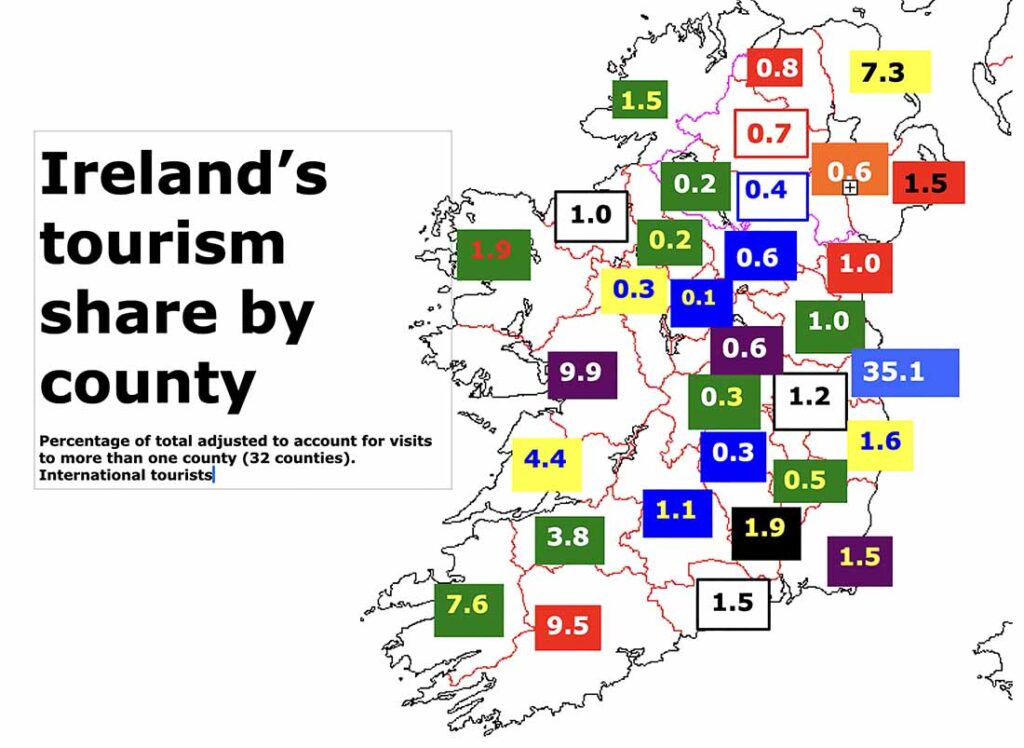
Ireland’s county Sligo is renowned for its poetic heritage and coastal scenery, with the Carrowmore Megalithic Cemetery offering one of Europe’s oldest prehistoric sites. The Benbulben mountain provides striking hiking trails, while Strandhill’s beaches are ideal for surfing. Other attractions include the historic Lissadell House and its gardens. Sligo is Ireland’s 22nd largest county by size (1,796 square km) and seventh smallest by population (70,198). Population peaked at 180,886 in 1841 and reached its lowest point, 50,275 in 1971. In terms of hospitality, Sligo is Ireland’s 17th most visited tourist county with around 133,000 international visitors per year.
Introduction – Adventure – Anthem – Archaeology – Attractions – Awards – Birdwatching – Camping – Castles – Churches – Contact list – Cycling – Dining – Equestrian – Festivals – Fishing – Folklore – Gardens – Golf – Graveyards – Happening – Haunted – Highest – Hiking – History – Holy Wells – Hotels – Hotels top 8 – Hunting & shooting – Instagrammable – Itineraries – Largest town – Luxury – MICE – Movies – Music – Name – New – Novelists – Off the beaten track – Poets – Pubs – Quotes – Random Facts – Restaurant Awards – Sacred Places – Saints – Songs – Spas – Sports – Sunsets – Sustainable – Things to do – Towns – Video – Villages – Walking – Wanderlist – Weddings – Wild swimming – Writers – 1837 – 1846– 1852 – 1909 – 1955 – 1980 –