The highest point in County Sligo is Knocknarea (Irish: Cnoc na Riabh), standing at 327 meters (1,073 feet). Located just west of Sligo town, this iconic limestone hill is renowned for its historical significance, striking profile, and the large cairn at its summit, believed to be the legendary tomb of Queen Maeve (Medb). Part of the Ox Mountains’ northern edge, Knocknarea is a popular and accessible destination offering stunning views and a rich cultural experience.
- Geological and Cultural Significance: Knocknarea is a solitary limestone hill, formed during the Carboniferous period, rising sharply from Sligo’s coastal plain. Its name, meaning “hill of the stripes” or “smooth hill,” may refer to its distinctive shape or geological features. The summit is crowned by Miosgán Meadhbha (Maeve’s Cairn), a massive Neolithic passage tomb (circa 3,500–3,000 BC), one of Ireland’s largest unexcavated cairns, measuring 55 meters wide and 10 meters high. Local legend ties it to Queen Maeve, a figure from the Táin Bó Cúailnge, though archaeological evidence suggests it predates her. The hill is steeped in mythology, with nearby sites like Carrowmore Megalithic Cemetery reinforcing Sligo’s ancient heritage.
- Scenic Beauty: Knocknarea’s summit offers panoramic views over Sligo Bay, the Atlantic Ocean, Benbulben’s dramatic plateau, and the Dartry Mountains. On clear days, the Donegal hills and even Mayo’s Croagh Patrick are visible. The hill’s prominence, coastal proximity, and lush surroundings make it a visual highlight of Ireland’s northwest.
Approaching Knocknarea
- Access Points: The primary access point is the Knocknarea car park (Grid Ref: G 614 346), off the R292 road, about 5km southwest of Sligo town. This well-maintained car park, near the village of Strandhill, is the starting point for the main trail. An alternative approach is from the Rathcarrick side, using minor roads off the R287, though this is less common. Public transport is limited, with buses (e.g., Bus Éireann 566 to Strandhill) stopping 2–3km from the trailhead, so a car is recommended for convenience.
Trail Options:
- Queen Maeve Trail (Main Route): The most popular route is a 4–5km round-trip hike (1–1.5 hours) starting at the Knocknarea car park. This well-marked trail, part of the Sligo Way, ascends steadily through a forested path, then opens to grassy slopes leading to the summit cairn. The route is short and moderately easy, suitable for beginners and families, with a gentle gradient but some rocky or muddy sections. The trail is maintained by the National Parks and Wildlife Service (NPWS), with boardwalks in wetter areas to protect the terrain.
- Rathcarrick Route: A less common 5–6km round-trip hike (1.5–2 hours) starts from a lay-by near Rathcarrick, following farm tracks and grassy slopes to the summit. This route is quieter but less defined, crossing private land, so permission from landowners may be needed. It’s suitable for those seeking a less busy approach.
- Extended Routes: Hikers can combine Knocknarea with nearby trails, such as the Sligo Way (78km long-distance trail) or a visit to Carrowmore Megalithic Cemetery (4km away), creating a 7–10km day hike. Exploring the southern slopes or nearby Knocknashee offers additional low hills for a longer outing.
- Navigation and Preparation: The Queen Maeve Trail is well-marked with NPWS signs, making navigation straightforward. The Rathcarrick route requires basic navigation due to faint paths, so a map (Ordnance Survey Ireland, Discovery Series Sheet 25), compass, or GPS is advised. Waterproof boots and rain gear are essential, as Sligo’s coastal climate brings frequent rain and muddy trails. Bring water and snacks, as there are no facilities on the hill. Dogs are allowed but must be leashed to protect livestock and the archaeological site. Visitors are asked not to climb the cairn or add stones to preserve its integrity. Check weather forecasts, as the summit is exposed to strong coastal winds and fog.
Hiking Experience:
- The Queen Maeve Trail is a short, accessible hike, ideal for all ages and fitness levels. The forested start transitions to open slopes with sweeping views, culminating at the massive Maeve’s Cairn. The trail is popular, especially in summer, but rarely feels overcrowded due to its open space.
- The Rathcarrick route offers a quieter, more rustic ascent, crossing fields and slopes with fewer visitors. Both routes provide a quick yet rewarding climb, with the cairn as a dramatic focal point.
- The summit is a flat, grassy area dominated by the unexcavated cairn, which visitors can walk around (but not on). The hill’s prominence and historical aura create a sense of connection to Ireland’s ancient past, despite its modest height.
- Views and Photography: The summit offers stunning 360-degree views, with Sligo Bay, Benbulben’s cliffs, and the Atlantic Ocean providing dramatic backdrops. The cairn itself is a striking subject for photography, especially at sunrise or sunset when the light enhances the coastal landscape. Clear days may reveal distant Donegal or Mayo peaks, adding to the visual appeal.
- Wildlife and Nature: Knocknarea’s slopes feature grassy meadows, heather, and gorse, with wildflowers like orchids in spring. Wildlife includes hares, foxes, and birds such as skylarks, kestrels, and occasionally peregrine falcons. The coastal proximity attracts seabirds like gulls, visible from the summit. Grazing sheep reflect the area’s pastoral use.
- Cultural and Historical Context: Knocknarea is central to Sligo’s mythological and archaeological heritage, tied to Queen Maeve and the Táin Bó Cúailnge. The nearby Carrowmore Megalithic Cemetery, with over 30 tombs, complements a visit, while Drumcliffe (10km away) connects to W.B. Yeats, whose poetry celebrates Sligo’s landscapes. The region’s vibrant music and festival scene, especially in Sligo town, adds cultural richness.
- Amenities: The Knocknarea car park has basic facilities (parking, information boards) but no toilets or food services. The nearby Loughcrew Coffee Shop (seasonal, at the car park) offers snacks, or Strandhill (3km) has cafés and pubs like The Strand Bar. Sligo town (5km) provides dining (e.g., Eala Bhán), shops, and accommodation. The car park is free, and the site is open year-round.
- Seasonal Considerations: Spring (April–May) and autumn (September–October) offer mild weather (8–15°C / 46–59°F) and vibrant scenery, with fewer crowds. Summer (June–August) is warmest (15–20°C / 59–68°F) but busier and wetter, with muddy trails. Winter (November–March) brings damp conditions and occasional frost, with shorter days. Sligo’s 1,200–1,400 annual sunshine hours allow for clear views, but coastal rain and wind are common, so waterproof gear is essential.
- Guided Tours: The NPWS or operators via discoversligo.ie offer guided hikes or archaeological tours of Knocknarea, providing insights into the cairn’s history and Maeve’s legend. Tours are ideal for families or those interested in Neolithic astronomy, especially during equinox events.
- Safety: The Queen Maeve Trail is low-risk, but slippery rocks and mud require caution. The Rathcarrick route involves private land, so respect property (close gates, avoid livestock). Strong coastal winds can affect the summit, so inform someone of your plans and avoid hiking in storms. Mobile signal is generally good, but offline maps are recommended.
- Accessibility: Knocknarea is one of Ireland’s most accessible county high points, suitable for beginners and families due to its short, gentle trail. The summit is not wheelchair-accessible due to uneven, grassy terrain, but the car park’s proximity makes it approachable for most.
Knocknarea offers a short, rewarding hike in County Sligo, blending stunning coastal views with profound archaeological significance. Maeve’s Cairn and the hill’s mythological ties make it a cultural highlight, while its accessibility and proximity to Sligo town ensure a memorable visit. Nearby attractions like Carrowmore and Benbulben enhance the experience, making Knocknarea a must-visit in Ireland’s northwest. For more details, visit discoversligo.ie or consult Kieron Gibbons’ Ireland’s County High Points – A Walking Guide.
Highest point in county
Antrim – Armagh – Carlow – Cavan – Clare – Cork – Derry – Donegal – Down – Dublin – Fermanagh – Galway] – Kerry – Kildare – Kilkenny – Laois – Leitrim – Limerick – Longford – Louth – Mayo – Meath – Monaghan – Offaly – Roscommon – Sligo – Tipperary – Tyrone – Waterford – Westmeath – Wexford – Wicklow
County Sligo:
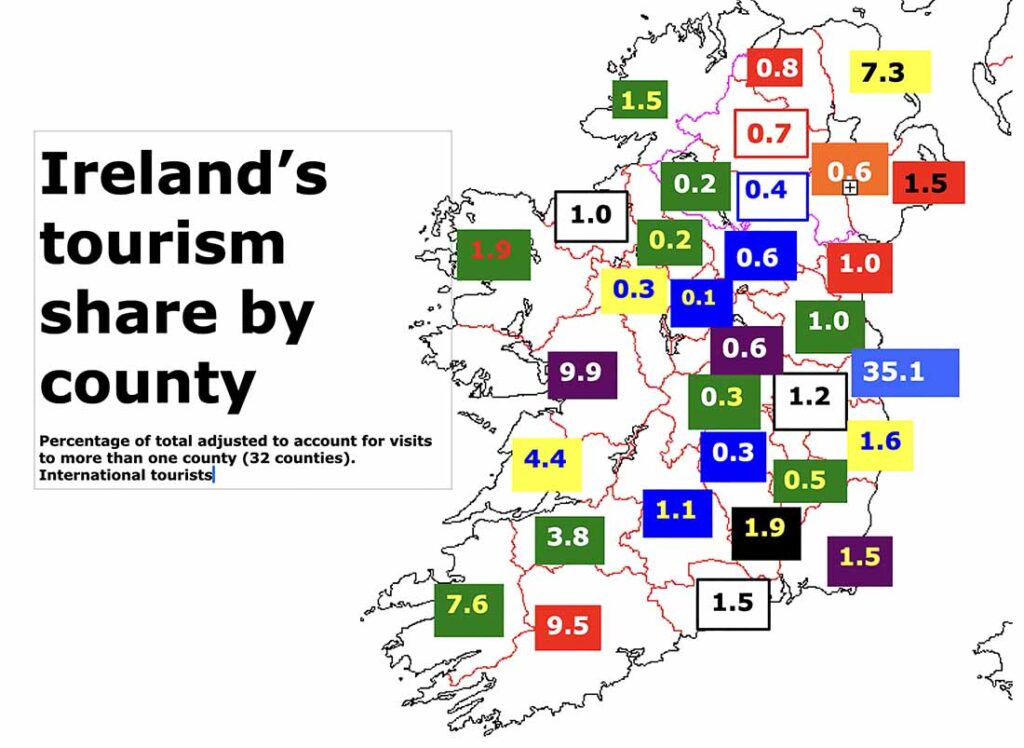
Ireland’s county Sligo is renowned for its poetic heritage and coastal scenery, with the Carrowmore Megalithic Cemetery offering one of Europe’s oldest prehistoric sites. The Benbulben mountain provides striking hiking trails, while Strandhill’s beaches are ideal for surfing. Other attractions include the historic Lissadell House and its gardens. Sligo is Ireland’s 22nd largest county by size (1,796 square km) and seventh smallest by population (70,198). Population peaked at 180,886 in 1841 and reached its lowest point, 50,275 in 1971. In terms of hospitality, Sligo is Ireland’s 17th most visited tourist county with around 133,000 international visitors per year.
Introduction – Adventure – Anthem – Archaeology – Attractions – Awards – Birdwatching – Camping – Castles – Churches – Contact list – Cycling – Dining – Equestrian – Festivals – Fishing – Folklore – Gardens – Golf – Graveyards – Happening – Haunted – Highest – Hiking – History – Holy Wells – Hotels – Hotels top 8 – Hunting & shooting – Instagrammable – Itineraries – Largest town – Luxury – MICE – Movies – Music – Name – New – Novelists – Off the beaten track – Poets – Pubs – Quotes – Random Facts – Restaurant Awards – Sacred Places – Saints – Songs – Spas – Sports – Sunsets – Sustainable – Things to do – Towns – Video – Villages – Walking – Wanderlist – Weddings – Wild swimming – Writers – 1837 – 1846– 1852 – 1909 – 1955 – 1980 –