- Ardgillan Castle and the Lady’s Bridge Ghost: Ardgillan Castle’s Lady’s Bridge is haunted by a woman’s ghost, seen drifting, believed to have drowned after a tragic love affair. The 18th-century estate has tales of romantic tragedies. Local lore links the ghost to a lady’s fatal fall, per oral tradition. Ardgillan Castle, Balbriggan, County Dublin.
- Clontarf Castle and the Spectral Warrior: Clontarf Castle is haunted by a spectral warrior, seen near the grounds, believed to be a Viking killed in the 1014 Battle of Clontarf. The castle stands near the historic battle site. Dúchas.ie records tales of ghostly warriors tied to Clontarf’s violent past. Clontarf Castle, Clontarf, County Dublin.
- Drimnagh Castle and the Phantom Coach: Drimnagh Castle is haunted by a ghostly horse-drawn coach, driven by a spectral figure, believed to be a cursed Barnewall family member. The 13th-century castle was a Barnewall stronghold. Dúchas.ie includes tales of phantom coaches tied to its aristocratic past. Drimnagh Castle, Drimnagh, County Dublin.
- Howth Castle and the Handless Ghost: Howth Castle is haunted by a handless ghost, believed to be a pirate maimed during a raid, seen wandering the grounds. The castle, a Saint Lawrence family seat, faced coastal raids. Local lore ties the ghost to 16th-century piracy, per oral tradition. Howth Castle, Howth, County Dublin.
- Kilmainham Gaol and the Prisoners’ Spirits: Kilmainham Gaol is haunted by executed prisoners, with footsteps and cries heard in the cells, tied to 1916 executions. The gaol, operational from 1796 to 1924, saw political executions. Dúchas.ie includes tales of spectral unrest from its grim history. Kilmainham Gaol, Dublin city, County Dublin.
- Malahide Castle and Puck the Jester: Malahide Castle is haunted by Puck, a jester who fell in love with a prisoner and was killed, his spirit wandering the halls in jest or sorrow. The 12th-century castle was a Talbot stronghold with a history of sieges. Dúchas.ie records tales of Puck’s ghost tied to medieval tragedies. Malahide Castle, Malahide, County Dublin.
- Phoenix Park and the Spectral Carriage: Phoenix Park is haunted by a ghostly carriage, heard rattling at night, believed to carry a cursed noble. The park, a historic estate, has tales of aristocratic scandals. Dúchas.ie records stories of phantom carriages tied to 18th-century elites. Phoenix Park, Dublin city, County Dublin.
- Rathfarnham Castle and the Banshee’s Wail: Rathfarnham Castle is haunted by a banshee, whose cry foretells death for the Loftus family, heard in the castle’s towers. Built in the 16th century, the castle was a Loftus family seat. Dúchas.ie notes banshee tales linked to its Gaelic heritage. Rathfarnham Castle, Rathfarnham, County Dublin.
- Saint Brigid’s Well in Clondalkin: Saint Brigid’s Well offers cures for ailments, particularly eye diseases, when pilgrims perform rituals with its water and nearby rag trees. Saint Brigid, a 5th-century saint, is linked to healing wells in Irish folklore. Dúchas.ie documents the well’s popularity among Dublin pilgrims. Clondalkin, near Dublin city, County Dublin.
- Saint Michan’s Church and the Crusader’s Ghost: Saint Michan’s Church is haunted by a crusader’s ghost, seen in the crypt, believed to be a knight entombed in its vaults. The church’s 11th-century crypt holds mummified remains. Local lore links the ghost to medieval warriors, per Dúchas.ie. Saint Michan’s Church, Dublin city, County Dublin.
- Swords Castle and the Monk’s Ghost: Swords Castle is haunted by a spectral monk, seen near the chapel, guarding ancient relics from its monastic days. The 13th-century castle had a religious function. Dúchas.ie mentions ghostly monks linked to Swords’ early Christian history. Swords Castle, Swords, County Dublin.
- The Banshee of Rathfarnham Castle: Rathfarnham Castle is haunted by a banshee, whose wail foretells death for the Loftus family, former residents of the castle. Banshees are female spirits linked to Gaelic families. Dúchas.ie notes banshee cries near Rathfarnham, reflecting its history as a family stronghold. Rathfarnham Castle, Rathfarnham, County Dublin.
- The Cursed Stone of Lusk: A standing stone in Lusk is cursed, causing misfortune to those who touch or move it, as it marks a druidic site protected by ancient spells. Megalithic stones are linked to druids or fairies in Irish lore. Dúchas.ie notes local fears of disturbing stones in Dublin’s rural areas. Lusk, County Dublin.
- The Fairy Fort of Howth: A ring fort on Howth Head is a fairy fort, home to the aos sí (fairy folk), who curse those who disturb it with illness or misfortune. Ring forts, Iron Age structures, are seen as Otherworld portals in Celtic folklore. Dúchas.ie records local tales in Howth of fairy retribution for trespassing. Howth Head, near Howth, County Dublin.
- The Fairy Hawthorn of Swords: A lone hawthorn tree in Swords is a fairy tree, sacred to the aos sí, and cutting it invites curses like illness or livestock death. Fairy trees are rooted in Celtic beliefs about the Otherworld. Dúchas.ie records farmers in Swords avoiding such trees to appease fairies. Swords, County Dublin.
- The Fairy Music of Ticknock: Ticknock’s hills echo with fairy music at dusk, luring listeners into the Otherworld if they follow the sound. Fairy music is a common motif in Irish folklore, tied to enchanted landscapes. Dúchas.ie mentions supernatural sounds in Ticknock, enhancing its mystical reputation. Ticknock, near Sandyford, County Dublin.
- The Ghost of Malahide Castle: Malahide Castle is haunted by Puck, a jester who fell in love with a prisoner and was killed, his spirit wandering the castle in jest or sorrow. The castle, held by the Talbot family since the 12th century, has a history of conflict. Dúchas.ie includes accounts of Puck’s ghost tied to its medieval past. Malahide Castle, Malahide, County Dublin.
- The Leprechaun of Phoenix Park: Phoenix Park is known for leprechaun sightings, small fairy shoemakers who hide pots of gold but trick those who pursue them. Leprechauns are iconic in Irish folklore, symbolising elusive wealth. Dúchas.ie includes tales of leprechaun encounters in Dublin’s largest park. Phoenix Park, Dublin city, County Dublin.
- The Phantom Coach of Drimnagh Castle: A ghostly horse-drawn coach roams Drimnagh Castle’s grounds, driven by a spectral figure, believed to be a cursed member of the Barnewall family. Drimnagh, a 13th-century castle, has a history of feudal strife. Dúchas.ie includes tales of phantom coaches tied to its aristocratic past. Drimnagh Castle, Drimnagh, County Dublin.
- The Púca of Killiney Hill: Killiney Hill is home to a púca, a shape-shifting creature appearing as a black horse or goat, tricking travellers or offering cryptic warnings. The púca is a mischievous figure in Irish mythology, suited to hilly landscapes. Dúchas.ie mentions púca sightings on Killiney, tied to its wild terrain. Killiney Hill, near Dalkey, County Dublin.
Haunted
Antrim – Armagh – Carlow – Cavan – Clare – Cork – Derry – Donegal – Down – Dublin – Fermanagh – Galway – Kerry – Kildare – Kilkenny – Laois – Leitrim – Limerick – Longford – Louth – Mayo – Meath – Monaghan – Offaly – Roscommon – Sligo – Tipperary – Tyrone – Waterford – Westmeath – Wexford – Wicklow
County Dublin:
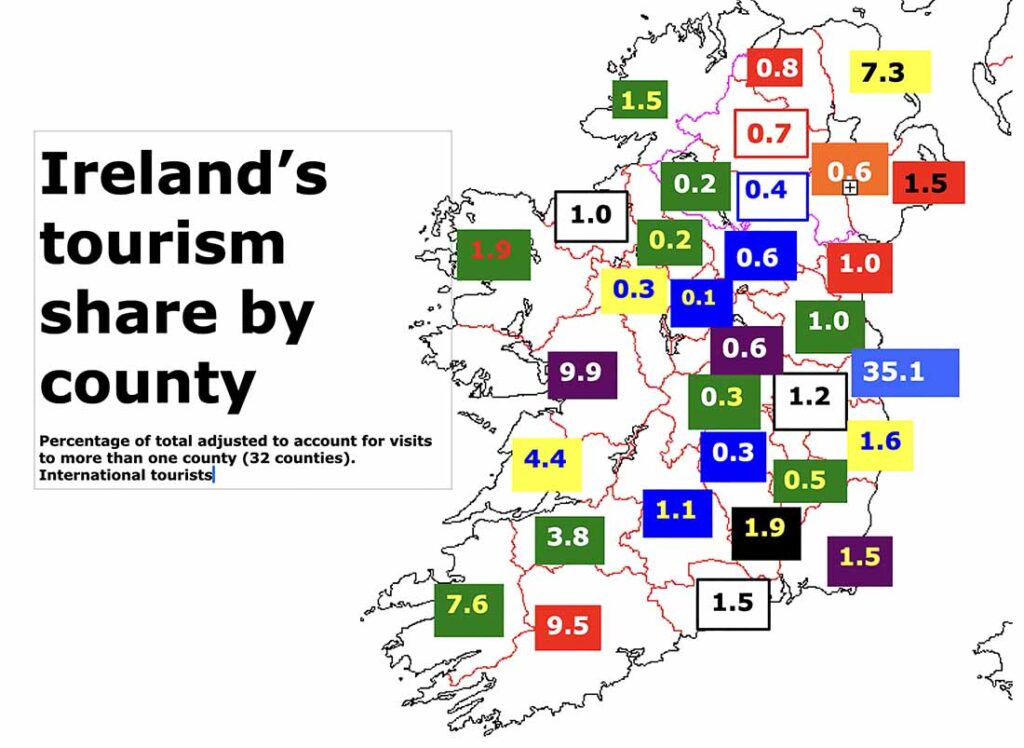
Ireland’s county Dublin combines cultural heritage with urban appeal, with Trinity College’s Book of Kells and Dublin Castle offering historical depth. The Guinness Storehouse provides a journey through Ireland’s iconic stout, while Phoenix Park’s vast green spaces are ideal for cycling. The River Liffey’s scenic walks and Kilmainham Gaol’s historical tours make Dublin a versatile destination for culture and history. Dublin is Ireland’s third smallest county by size (922 square km) and largest by population (1,458,154). Dublin is also Ireland’s most visited tourist county by a margin, with around four million international visitors per year. In terms of hospitality,
Introduction – Adventure – Anthem – Archaeology – Attractions – Awards – Birdwatching – Camping – Castles – Churches – Contact list – Cycling – Dining – Equestrian – Festivals – Fishing – Folklore – Gardens – Golf – Graveyards – Happening – Haunted – Highest – Hiking – History – Holy Wells – Hotels – Hotels top 8 – Hunting & shooting – Instagrammable – Itineraries – Largest town – Luxury – MICE – Movies – Music – New – Name – Novelists – Off the beaten track – Poets – Pubs – Quotes – Random Facts – Restaurant Awards – Sacred Places – Saints – Songs – Spas – Sports – Sunsets – Sustainable – Things to do – Towns – Video – Villages – Walking – Wanderlist – Weddings – Wild swimming – Writers – 1837 – 1846 – 1852 – 1909 – 1955 – 1980 –