- George Augustus Moore (1852-1933) Born in Moore Hall, near Ballyglass, Moore was a novelist, poet, and critic central to the Irish Literary Revival. His works, like A Mummer’s Wife (1885) and Esther Waters (1894), pioneered naturalism in English literature, while Hail and Farewell (1911-14) satirized Irish cultural figures. His Mayo estate influenced his depictions of Irish rural life.
- Ernie O’Malley (1897-1957) Born in Castlebar, O’Malley was a writer and revolutionary whose memoir On Another Man’s Wound (1936) is a classic account of the Irish War of Independence. His works, including The Singing Flame (1978, posthumous), blend vivid prose with Mayo’s revolutionary spirit. He also wrote for Bóthar na Saoirse (2011).
- William Larminie (1849-1900) Born in Castlebar, Larminie was a poet and folklorist whose West Irish Folk-Tales and Romances (1893) preserved Mayo’s oral traditions. His poetry collections, like Glinar (1888), reflected his Mayo upbringing and interest in Irish culture, contributing to the Irish Literary Revival.
- Olivia Knight (1829-1908) Born in Ballina, Knight was a poet and writer whose works, published in Irish and British journals, explored themes of nature and spirituality. Her poetry, often inspired by Mayo’s landscapes, gained recognition in the 19th century for its lyrical quality and regional focus.
- Riocard Bairéad (1735-1819) Born in Belclare, near Westport, Bairéad was a poet and satirist who wrote in Irish. His satirical poems, like “Eoghan Coir,” critiqued social injustices and are celebrated for their wit. A schoolteacher, his work preserved Mayo’s Irish literary tradition.
- Michael Davitt (1846-1906) Born in Straide, Davitt was a political writer, revolutionary, and founder of the Irish National Land League. His books, like The Fall of Feudalism in Ireland (1904) and Leaves from a Prison Diary (1885), advocated land reform and Irish nationalism, reflecting his Mayo roots and experience of eviction.
- Martin Haverty (1809-1887) Born in Killala, Haverty was a historian and writer whose History of Ireland (1860) was frequently reprinted for its accessible narrative of Irish history. A sub-librarian at King’s Inns, Dublin, his work, including Wanderings in Spain (1844), reflected his Mayo heritage and scholarly rigor.
- John Murphy (1924-1998) Born in Charlestown, Murphy was a playwright known for works like The Country Boy (1970), staged on Saturday Playhouse (1958) and adapted for television (Tom und seine Söhne, 1964). His plays, often set in Mayo, explored rural Irish life with humor and empathy.
- Peter Costello (1946-2019) Born in Kilkelly, Costello was a poet and writer whose books Rhyming Through Mayo and A Lot of Fact, A Little Fiction (both 2010) celebrated Mayo’s heritage and landscapes in verse. His poetry, blending local pride with global themes, contributed to Mayo’s modern literary scene.
- Eneas McDonnell (1783-1858) Born in Westport, McDonnell was a novelist, journalist, and Catholic advocate who edited the Cork Chronicle and wrote numerous pamphlets for the Catholic Association. His novel and Letters (1837) reflected his Mayo upbringing and commitment to Irish rights.
Writers
Antrim – Armagh – Carlow – Cavan – Clare – Cork – Derry – Donegal – Down – Dublin – Fermanagh – Galway – Kerry – Kildare – Kilkenny – Laois – Leitrim – Limerick – Longford – Louth – Mayo – Meath – Monaghan – Offaly – Roscommon – Sligo – Tipperary – Tyrone – Waterford – Westmeath – Wexford – Wicklow
County Mayo:
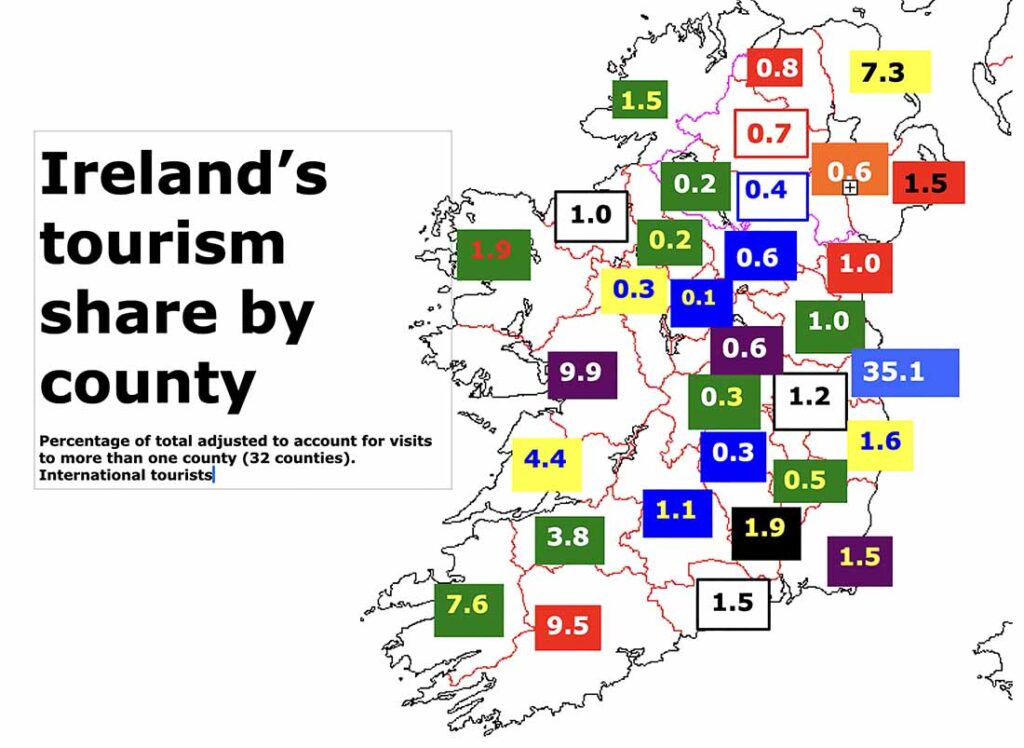
Ireland’s county Mayo offers dramatic scenery and ancient heritage, with the Cliffs of Moher’s rugged beauty and Croagh Patrick’s pilgrimage trail providing stunning vistas. The town of Westport features Georgian architecture and access to Clew Bay’s islands, while the Ceide Fields showcase a prehistoric farming landscape. Other attractions include the celebrity beaches of Achill Island. Mayo is Ireland’s third largest county by size (5,398 square km) and 18th largest by population (137,970). Population peaked at 388,887 in 1841 and reached its lowest point, 109,525 in 1971. In terms of hospitality, Mayo is Ireland’s tenth most visited tourist county with around 218,000 international visitors per year.
Introduction – Adventure – Anthem – Archaeology – Attractions – Awards – Birdwatching – Camping – Castles – Churches – Contact list – Cycling – Dining – Equestrian – Festivals – Fishing – Folklore – Gardens – Golf – Graveyards – Happening – Haunted – Highest – Hiking – History – Holy Wells – Hotels – Hotels top 8 – Hunting & shooting – Instagrammable – Itineraries – Largest town – Luxury – MICE – Movies – Music – Name – New – Novelists – Off the beaten track – Poets – Pubs – Quotes – Random Facts – Restaurant Awards – Sacred Places – Saints – Songs – Spas – Sports – Sunsets – Sustainable – Things to do – Towns – Video – Villages – Walking – Wanderlist – Weddings – Wild swimming – Writers – 1837 – 1846 – 1852 – 1909 – 1955 – 1980 –