Start your waking tour through the compact and atmospheric streets of Sligo town at Hyde Bridge, the handsome stone crossing over the Garavogue where the river flows from Lough Gill towards the sea. Here stands the Yeats Building, a striking late-nineteenth-century sandstone edifice originally a bank and now a cultural centre dedicated to W.B. Yeats, whose poetry drew endless inspiration from Sligo’s landscapes; the building’s riverside position offers an apt starting point, with views along the water and glimpses of swans gliding past.
From the bridge, follow the riverbank path or step onto Stephen Street to encounter the celebrated bronze statue of W.B. Yeats, seated thoughtfully outside a classical bank building, his gaze seemingly fixed on the flowing Garavogue. This contemplative figure, unveiled in the late twentieth century, serves as a poignant reminder of the poet’s deep ties to the town and county.
A short stroll along O’Connell Street or adjacent lanes leads to Queen Maeve Square, a modern civic space named for the legendary queen whose mythical tomb crowns nearby Knocknarea mountain, visible on clear days dominating the southern skyline. The square’s open feel, with its benches and occasional street performers, provides a pleasant pause amid the town’s gentle bustle.
Continue to the nearby Sligo Abbey, the town’s most evocative historic landmark. Founded in the thirteenth century by Dominican friars, the abbey’s well-preserved ruins include graceful cloisters, a striking fifteenth-century high altar—one of the few to survive in Ireland—and intricate Gothic and Renaissance carvings that hint at its former splendour despite damage from fire and conflict. The site, managed as a heritage attraction, invites quiet exploration of its roofless nave and tower, evoking centuries of monastic life.
From the abbey, wander along The Mall or riverside walkways back towards the Garavogue, where decorative bridges and colourful shopfronts line the water’s edge. The path offers serene prospects of the river, moored boats, and the occasional fisherman, while Doorly Park nearby extends the green space with lawns and mature trees ideal for a brief rest.
To complete the loop, return via Wine Street or Holborn Street, passing independent shops, cafés, and pubs that reflect Sligo’s contemporary vitality as a market and cultural centre. The circuit remains firmly within the town’s walkable core, with the distant silhouette of Benbulben mountain often framing the northern horizon as a dramatic backdrop.
This walk, easily accomplished in an hour or so at an easy pace, distils Sligo town’s essence: no overwhelming grandeur, but a harmonious blend of poetic resonance, medieval echoes, and the tranquil presence of the river that has shaped the place for generations..
Largest town walking tour
Antrim – Armagh – Carlow – Cavan – Clare – Cork – Derry – Donegal – Down – Dublin – Fermanagh – Galway – Kerry – Kildare – Kilkenny – Laois – Leitrim – Limerick – Longford – Louth – Mayo – Meath – Monaghan – Offaly – Roscommon – Sligo – Tipperary – Tyrone – Waterford – Westmeath – Wexford – Wicklow
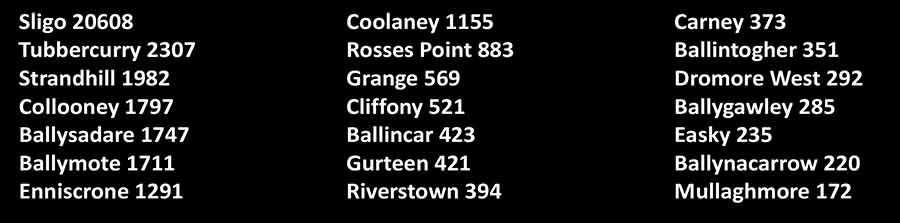
Population of towns in county Sligo
Towns
Antrim – Armagh – Carlow – Cavan – Clare – Cork – Derry – Donegal – Down – Dublin – Fermanagh – Galway – Kerry – Kildare – Kilkenny – Laois – Leitrim – Limerick – Longford – Louth – Mayo – Meath – Monaghan – Offaly – Roscommon – Sligo – Tipperary – Tyrone – Waterford – Westmeath – Wexford – Wicklow
Villages
Antrim – Armagh – Carlow – Cavan – Clare – Cork – Derry – Donegal – Down – Dublin – Fermanagh – Galway – Kerry – Kildare – Kilkenny – Laois – Leitrim – Limerick – Longford – Louth – Mayo – Meath – Monaghan – Offaly – Roscommon – Sligo – Tipperary – Tyrone – Waterford – Westmeath – Wexford – Wicklow
County Sligo:
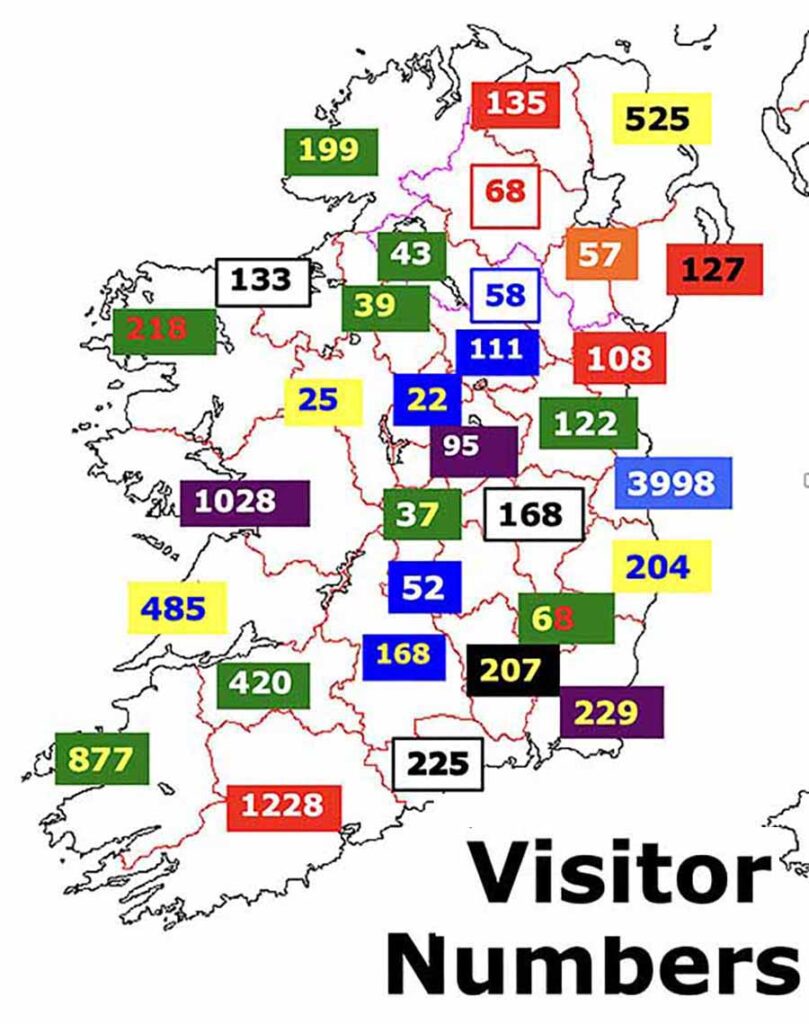
Ireland’s county Sligo is renowned for its poetic heritage and coastal scenery, with the Carrowmore Megalithic Cemetery offering one of Europe’s oldest prehistoric sites. The Benbulben mountain provides striking hiking trails, while Strandhill’s beaches are ideal for surfing. Other attractions include the historic Lissadell House and its gardens. Sligo is Ireland’s 22nd largest county by size (1,796 square km) and seventh smallest by population (70,198). Population peaked at 180,886 in 1841 and reached its lowest point, 50,275 in 1971. In terms of hospitality, Sligo is Ireland’s 17th most visited tourist county with around 133,000 international visitors per year.
Introduction – Adventure – Anthem – Archaeology – Attractions – Awards – Birdwatching – Camping – Castles – Churches – Contact list – Cycling – Dining – Equestrian – Festivals – Fishing – Folklore – Gardens – Golf – Graveyards – Happening – Haunted – Highest – Hiking – History – Holy Wells – Hotels – Hotels top 8 – Hunting & shooting – Instagrammable – Itineraries – Largest town – Luxury – MICE – Movies – Music – Name – New – Novelists – Off the beaten track – Poets – Pubs – Quotes – Random Facts – Restaurant Awards – Sacred Places – Saints – Songs – Spas – Sports – Sunsets – Sustainable – Things to do – Towns – Video – Villages – Walking – Wanderlist – Weddings – Wild swimming – Writers – 1837 – 1846– 1852 – 1909 – 1955 – 1980 –