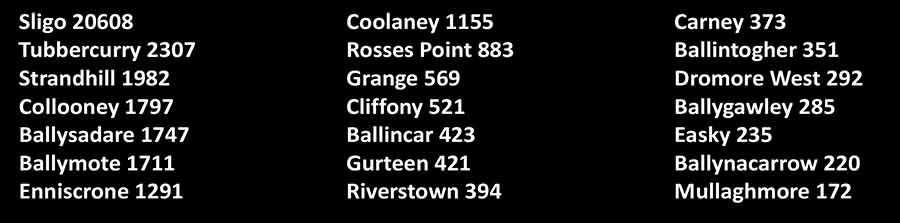
- Sligo (20,608 inhabitants): Sligo functions as the main town and administrative centre of the county. Visitors can expect a range of shops, cafés, and services in the town centre, together with Sligo Abbey ruins from the 13th century, a county museum with local history displays, and access to nearby sites such as Knocknarea mountain with its cairn, Benbulben views, and Lough Gill for boat trips or walks. The area serves as a base for exploring coastal and inland landscapes.
- Tubbercurry (2,307 inhabitants): Tubbercurry is a market town at the base of the Ox Mountains. Visitors might expect a centre for traditional Irish music and dance events, along with local amenities and access to nearby outdoor pursuits in the surrounding hills.
- Strandhill (1,982 inhabitants): Strandhill lies on the coast with a beach front. Visitors can expect wave activity suitable for surfing, seaweed baths for relaxation, and paths along the shore or nearby Knocknarea for walks with sea and mountain outlooks.
- Collooney (1,797 inhabitants): Collooney is a small town near the Owenmore River. Visitors might expect quiet local facilities, fishing opportunities on the river, and proximity to countryside paths or nearby attractions in the wider area.
- Ballysadare (1,747 inhabitants): Ballysadare stands on the Owenmore River with a waterfall feature. Visitors can expect river scenery, a peaceful village setting, and a convenient location close to Sligo town for day trips.
- Ballymote (1,711 inhabitants): Ballymote is a market town with castle ruins from the 14th century. Visitors might expect to see the remains of Ballymote Castle, local craft outlets such as pottery, and access to nearby sites including the Caves of Keash for exploration in a rural setting.
- Enniscrone (1,291 inhabitants): Enniscrone is a coastal town with a long beach. Visitors can expect seaside walks, water-based leisure, and facilities along the shore in a relaxed location.
- Coolaney (1,155 inhabitants): Coolaney sits in a rural part of the county. Visitors might expect a quiet community with basic amenities and access to surrounding countryside for peaceful outings.
- Rosses Point (883 inhabitants): Rosses Point overlooks Sligo Bay. Visitors can expect a golf course by the sea, coastal paths, and views across the bay in a small seaside community.
- Grange (569 inhabitants): Grange is a modest village near the coast. Visitors might expect rural surroundings, local services, and proximity to beaches or hills for gentle exploration.
- Cliffony (521 inhabitants): Cliffony lies in north Sligo. Visitors can expect a small settlement with countryside access and a calm atmosphere focused on local life.
- Ballincar (423 inhabitants): Ballincar is a tiny community close to the coast. Visitors might expect quiet rural lanes and basic facilities in a peaceful location.
- Gurteen (421 inhabitants): Gurteen functions as a small village in open countryside. Visitors can expect local amenities and surroundings suited to relaxed rural visits.
Population of towns in Sligo
Towns
Antrim – Armagh – Carlow – Cavan – Clare – Cork – Derry – Donegal – Down – Dublin – Fermanagh – Galway – Kerry – Kildare – Kilkenny – Laois – Leitrim – Limerick – Longford – Louth – Mayo – Meath – Monaghan – Offaly – Roscommon – Sligo – Tipperary – Tyrone – Waterford – Westmeath – Wexford – Wicklow
Villages
Antrim – Armagh – Carlow – Cavan – Clare – Cork – Derry – Donegal – Down – Dublin – Fermanagh – Galway – Kerry – Kildare – Kilkenny – Laois – Leitrim – Limerick – Longford – Louth – Mayo – Meath – Monaghan – Offaly – Roscommon – Sligo – Tipperary – Tyrone – Waterford – Westmeath – Wexford – Wicklow
Largest town in the county: a walking tour
Antrim – Armagh – Carlow – Cavan – Clare – Cork – Derry – Donegal – Down – Dublin – Fermanagh – Galway – Kerry – Kildare – Kilkenny – Laois – Leitrim – Limerick – Longford – Louth – Mayo – Meath – Monaghan – Offaly – Roscommon – Sligo – Tipperary – Tyrone – Waterford – Westmeath – Wexford – Wicklow
County Sligo:
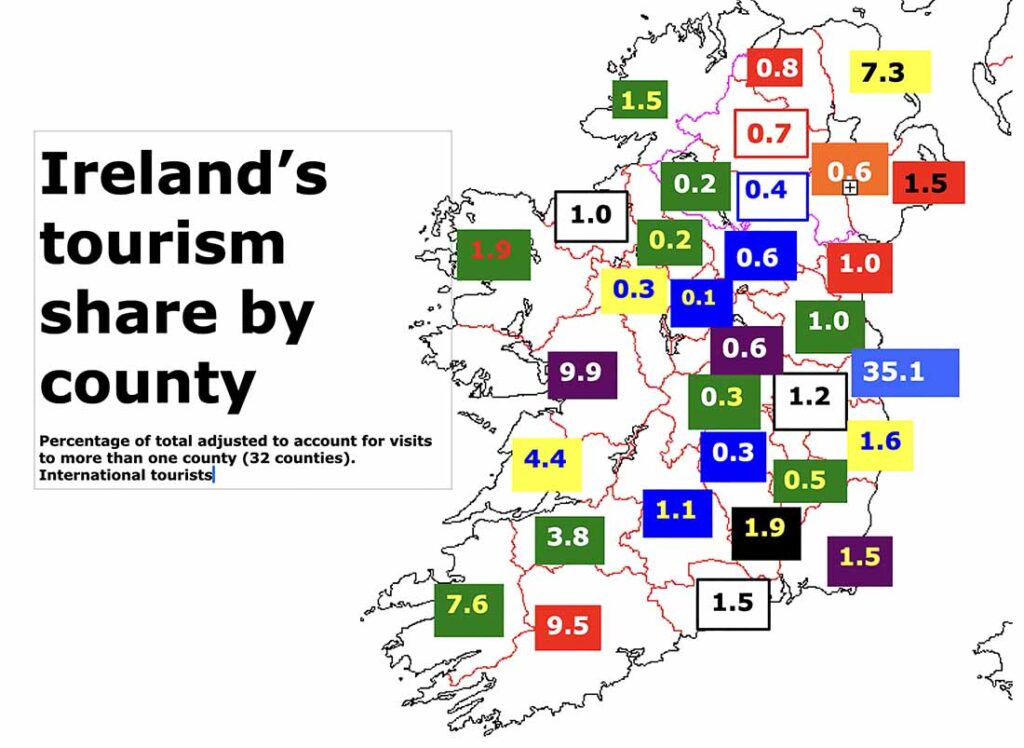
Ireland’s county Sligo is renowned for its poetic heritage and coastal scenery, with the Carrowmore Megalithic Cemetery offering one of Europe’s oldest prehistoric sites. The Benbulben mountain provides striking hiking trails, while Strandhill’s beaches are ideal for surfing. Other attractions include the historic Lissadell House and its gardens. Sligo is Ireland’s 22nd largest county by size (1,796 square km) and seventh smallest by population (70,198). Population peaked at 180,886 in 1841 and reached its lowest point, 50,275 in 1971. In terms of hospitality, Sligo is Ireland’s 17th most visited tourist county with around 133,000 international visitors per year.
Introduction – Adventure – Anthem – Archaeology – Attractions – Awards – Birdwatching – Camping – Castles – Churches – Contact list – Cycling – Dining – Equestrian – Festivals – Fishing – Folklore – Gardens – Golf – Graveyards – Happening – Haunted – Highest – Hiking – History – Holy Wells – Hotels – Hotels top 8 – Hunting & shooting – Instagrammable – Itineraries – Largest town – Luxury – MICE – Movies – Music – Name – New – Novelists – Off the beaten track – Poets – Pubs – Quotes – Random Facts – Restaurant Awards – Sacred Places – Saints – Songs – Spas – Sports – Sunsets – Sustainable – Things to do – Towns – Video – Villages – Walking – Wanderlist – Weddings – Wild swimming – Writers – 1837 – 1846– 1852 – 1909 – 1955 – 1980 –