The highest point in County Monaghan is an unnamed point on the Slieve Beagh range, standing at 373 meters (1,224 feet). Slieve Beagh is located in the northwest of County Monaghan, straddling the border with Counties Tyrone and Fermanagh. It lies near the villages of Knockatallon (Monaghan) and Roslea (Fermanagh), in a remote, upland area known for its blanket bogs and rolling hills, part of Ireland’s Hidden Heartlands.
- Elevation: At 373 meters, the highest point on Slieve Beagh is modest compared to Ireland’s taller peaks, but it is the highest in Monaghan. The summit is a flat, boggy plateau marked by a trig pillar, often referred to as Eshbrack or Slieve Beagh South.
- Terrain: The area is characterized by extensive blanket bog, heather moorland, and wet, peaty ground. The summit lacks dramatic features, with a gentle, open landscape and minimal distinct landmarks, making navigation challenging in poor visibility.
Starting Point and Access:
- Driving Route: The most common trailhead is near Knockatallon, Monaghan, accessible via the R187 from Monaghan town (20 minutes, 15 km) or the R186 from Cootehill. The trailhead is typically a lay-by or forest track near the Slieve Beagh Way starting point, close to the Three Counties Point (where Monaghan, Tyrone, and Fermanagh meet). From Enniskillen (Fermanagh), the drive takes about 30 minutes (20 km). Parking is limited, often along minor roads or at designated trail points.
- Alternative Access: Another approach is from Roslea (Fermanagh), following the Slieve Beagh Way or local paths toward the summit. A longer route starts from Cooneen, Tyrone, incorporating more of the upland bog landscape. The Sliabh Beagh Loop offers a waymarked option from Knockatallon.
- Public Transport: Public transport is limited. Monaghan town is served by buses from Dublin or Cavan (e.g., Bus Éireann 180 or Local Link), but reaching the trailhead requires a car or taxi. Guided hikes, such as those offered by Monaghan Walking or Ireland Walk Hike Bike, include transport from Monaghan or Enniskillen.
Slieve Beagh Way (Knockatallon):
- Distance: Approximately 6–8 km round trip.
- Duration: 2.5–4 hours, depending on pace and conditions.
- Description: This is the most direct route, starting near Knockatallon at a Slieve Beagh Way trailhead. The trail follows a rough path or sheep track through boggy terrain, ascending gently to the summit plateau. The highest point is marked by a trig pillar near Eshbrack, though the transmission mast on a nearby ridge can cause confusion. The route is part of the waymarked Slieve Beagh Way, but the summit area lacks clear signage. The descent retraces the path.
- Difficulty: Moderate, suitable for hikers with moderate fitness. The boggy terrain and lack of distinct paths require good navigation, especially in fog or rain.
Roslea Route:
- Distance: 8–10 km round trip.
- Duration: 3–5 hours.
- Description: Starting from Roslea, this route follows the Slieve Beagh Way or local tracks, crossing boggy moorland to reach the summit from the northern side. It offers views of Lough Erne and the Fermanagh lakelands but requires careful navigation due to faint paths.
- Difficulty: Moderate to strenuous, due to wet terrain and longer distance, best for hikers with navigation experience.
Sliabh Beagh Loop:
- Distance: 10–12 km round trip.
- Duration: 4–6 hours.
- Description: This waymarked loop starts at Knockatallon, following the Slieve Beagh Way and incorporating the summit. It includes scenic views of the Monaghan drumlins and the Three Counties Point, with a mix of boggy paths and forest tracks.
- Difficulty: Moderate, with some strenuous sections due to wet ground and elevation gain.
Navigation Tips:
- Use an Ordnance Survey map (Discovery Series Sheet 27 or Discoverer Series 18 for NI) or apps like HiiKER, AllTrails, or PeakVisor for navigation, as the summit plateau is featureless and disorienting in fog.
- Bring a compass or GPS device, as the boggy terrain lacks clear landmarks or waymarking beyond the Slieve Beagh Way.
- Wear waterproof hiking boots with good grip and gaiters, as the terrain is consistently wet and boggy. Trekking poles are essential for stability.
Scenery and Views:
- Summit Views: On clear days, Slieve Beagh offers expansive views of the Monaghan drumlins, the Fermanagh lakelands, and parts of Tyrone. Notable sights include Lough Erne, the Sperrin Mountains, and, on exceptional days, distant peaks like Cuilcagh or the Mournes. The flat, open plateau provides a serene, if understated, vantage point.
- Landscape: The area is dominated by blanket bog, heather, and grass, with wet, peaty ground and occasional rocky outcrops. The summit is marked by a trig pillar, with a nearby transmission mast visible but not at the highest point.
- Unique Features: Slieve Beagh is part of a Special Area of Conservation, known for its blanket bog ecosystem, one of the largest in Ireland. The Three Counties Point, where Monaghan, Tyrone, and Fermanagh meet, adds geographical interest. The area has historical significance, linked to cross-border folklore and smuggling routes.
Hiking Experience:
- Duration: The Slieve Beagh Way route takes 2.5–4 hours, Roslea 3–5 hours, and the Sliabh Beagh Loop 4–6 hours, including summit time.
- Conditions: The terrain is consistently boggy and wet, requiring careful footing. The summit plateau is exposed to wind and mist, with poor visibility common. Spring and summer (April–September) offer the best conditions, with vibrant heather in August. Autumn (September–October) provides colorful landscapes, while winter hikes are wetter and colder but feasible.
- Cultural Significance: Slieve Beagh is tied to Monaghan’s rural heritage, with folklore about fairies and historical smuggling routes. The nearby village of Knockatallon hosts community events that celebrate local traditions.
- Weather: The summit is exposed, with frequent mist and wind. Check forecasts (e.g., Met Éireann or Met Office) and avoid hiking in severe conditions.
- Terrain: The boggy ground can be treacherous, with hidden pools and uneven surfaces. Navigation is challenging due to the lack of distinct landmarks.
- Safety: Inform someone of your plans, as there are no rangers. Bring water, snacks, and warm clothing, as temperatures can drop. Solo hikers should be confident in navigation or opt for guided tours.
- Wildlife: Expect to see birds like skylarks, curlews, or hen harriers, and possibly hares or foxes. The blanket bog supports unique flora, including sphagnum moss, sundews, and bog cotton.
Highest point in county
Antrim – Armagh – Carlow – Cavan – Clare – Cork – Derry – Donegal – Down – Dublin – Fermanagh – Galway] – Kerry – Kildare – Kilkenny – Laois – Leitrim – Limerick – Longford – Louth – Mayo – Meath – Monaghan – Offaly – Roscommon – Sligo – Tipperary – Tyrone – Waterford – Westmeath – Wexford – Wicklow
County Monaghan:
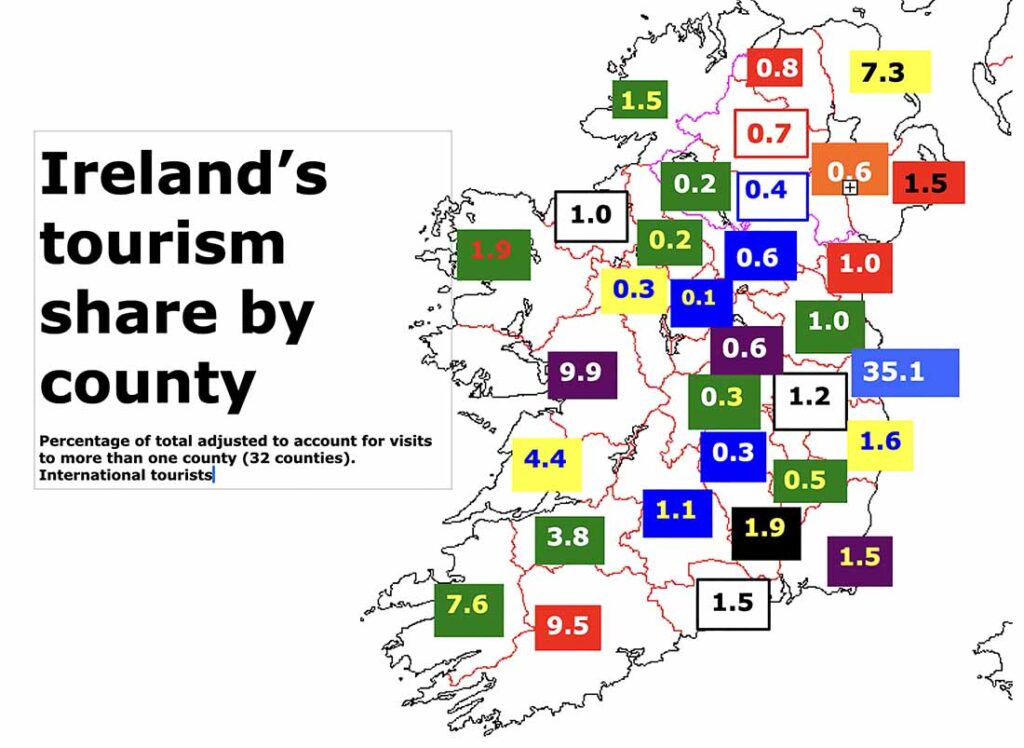
Ireland’s county Monaghan offers a serene blend of rolling hills and cultural heritage, with the Monaghan County Museum showcasing local history through artefacts and exhibits. The scenic Rossmore Forest Park provides walking trails amidst lakes and woodlands, while Castle Leslie’s historic estate offers a glimpse into aristocratic life. Other attractions include the county’s traditional lace-making heritage and quiet countryside. Monaghan is Ireland’s sixth smallest county by size (1,291 square km) and fifth smallest by population (65,288). Population peaked at 200,442 in 1841 and reached its lowest point, 45,732 in 1966. In terms of hospitality, Monaghan is Ireland’s 25th most visited tourist county with around 58,000 international visitors per year.
Introduction – Adventure – Anthem – Archaeology – Attractions – Awards – Birdwatching – Camping – Castles – Churches – Contact list – Cycling – Dining – Equestrian – Festivals – Fishing – Folklore – Gardens – Golf – Graveyards – Happening – Haunted – Highest – Hiking – History – Holy Wells – Hotels – Hotels top 8 – Hunting & shooting – Instagrammable – Itineraries – Largest town – Luxury – MICE – Movies – Music – Name – New – Novelists – Off the beaten track – Poets – Pubs – Quotes – Random Facts – Restaurant Awards – Sacred Places – Saints – Songs – Spas – Sports – Sunsets – Sustainable – Things to do – Towns – Video – Villages – Walking – Wanderlist – Weddings – Wild swimming – Writers – 1837 – 1846 – 1852 – 1909 – 1955 – 1980 –