- William Butler Yeats: Sligo town, County Sligo (1865-1939): Ireland’s most celebrated poet and a Nobel Laureate (1923), Yeats is deeply associated with Sligo, his mother’s home county, which inspired works like The Lake Isle of Innisfree and Under Ben Bulben. He spent summers in Sligo town and around Lough Gill, and is buried in Drumcliffe Churchyard with the epitaph “Cast a cold eye on Life, on Death. Horseman, pass by!” His connection to Sligo is central to his poetic identity.
- Michael A. Hargadon: Colgagh, Calry, County Sligo (born and lived) (1888-1968): A poet who emigrated to Canada in 1915, Hargadon was born in Colgagh, Calry. His works include collections like A Lovely Home, Irish and Canadian Poems, Among the Mountains, and A Wreath of Song. He worked as a journalist in Montreal and later as a publicity officer for Canadian Pacific. His poetry reflects his Sligo roots, and his legacy was commemorated in Calry with a plaque at his birthplace.
- Maeve McKenna, a contemporary Sligo-based poet,
- Jack B. Yeats (1871–1957): Brother of W.B. Yeats, he was a renowned painter and writer deeply connected to Sligo.
- Eva Gore-Booth (1870–1926): Poet, dramatist, and suffragist associated with Lissadell House.
- Leland Bardwell (1922–2016): Poet, novelist, and playwright.
- Dermot Healy (1947–2014): Renowned novelist, poet, and playwright who lived in Sligo.
- Mary Colum (1887–1957): Literary critic and writer.
- Thomas MacGreevy (1893–1967): Poet and critic.
Poets
Antrim – Armagh – Carlow – Cavan – Clare – Cork – Derry – Donegal – Down – Dublin – Fermanagh – Galway – Kerry – Kildare – Kilkenny – Laois – Leitrim – Limerick – Longford – Louth – Mayo – Meath – Monaghan – Offaly – Roscommon – Sligo – Tipperary – Tyrone – Waterford – Westmeath – Wexford – Wicklow
County Sligo:
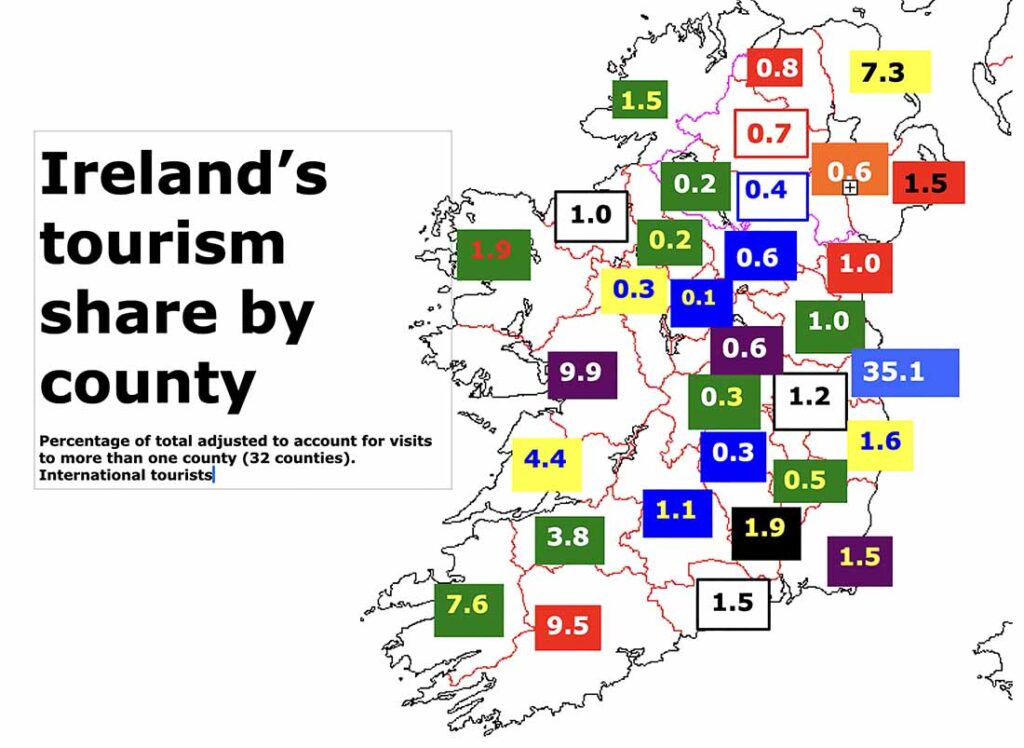
Ireland’s county Sligo is renowned for its poetic heritage and coastal scenery, with the Carrowmore Megalithic Cemetery offering one of Europe’s oldest prehistoric sites. The Benbulben mountain provides striking hiking trails, while Strandhill’s beaches are ideal for surfing. Other attractions include the historic Lissadell House and its gardens. Sligo is Ireland’s 22nd largest county by size (1,796 square km) and seventh smallest by population (70,198). Population peaked at 180,886 in 1841 and reached its lowest point, 50,275 in 1971. In terms of hospitality, Sligo is Ireland’s 17th most visited tourist county with around 133,000 international visitors per year.
Introduction – Adventure – Anthem – Archaeology – Attractions – Awards – Birdwatching – Camping – Castles – Churches – Contact list – Cycling – Dining – Equestrian – Festivals – Fishing – Folklore – Gardens – Golf – Graveyards – Happening – Haunted – Highest – Hiking – History – Holy Wells – Hotels – Hotels top 8 – Hunting & shooting – Instagrammable – Itineraries – Largest town – Luxury – MICE – Movies – Music – Name – New – Novelists – Off the beaten track – Poets – Pubs – Quotes – Random Facts – Restaurant Awards – Sacred Places – Saints – Songs – Spas – Sports – Sunsets – Sustainable – Things to do – Towns – Video – Villages – Walking – Wanderlist – Weddings – Wild swimming – Writers – 1837 – 1846– 1852 – 1909 – 1955 – 1980 –