The highest point in County Leitrim is Truskmore (Sliabh an Iarainn), standing at 647 meters (2,123 feet). Truskmore is located in the Dartry Mountains, straddling the border of County Leitrim and County Sligo, near the village of Ballintrillick, County Sligo, and close to Glencar Lough. It lies within the Ireland’s Hidden Heartlands region, known for its rugged hills and serene lakes.
- Elevation: At 647 meters, Truskmore is the highest peak in Leitrim and a prominent feature of the Dartry Mountains, offering expansive views over the surrounding landscape.
- Terrain: The mountain features a mix of boggy moorland, grassy slopes, and rocky outcrops. The summit is relatively flat, marked by a trig pillar and a large transmission mast, with some boggy patches and limestone features typical of the Dartry range.
Starting Point and Access:
- Driving Route: The most common trailhead is at Tievebaun, near Ballintrillick, County Sligo, accessible via the R278 from Sligo town (25 minutes, 20 km) or the N16 from Manorhamilton, County Leitrim (20 minutes, ~15 km). The trailhead is a small parking area near a forest track or lay-by at the base of Tievebaun, close to the Leitrim-Sligo border. From Carrick-on-Shannon, Leitrim’s main town, the drive takes about 40 minutes (35 km). The route offers scenic views of Glencar Lough and Benbulben.
- Alternative Access: Another approach is from Glencar Valley, starting near Glencar Waterfall, which incorporates parts of the Leitrim Way or local trails. This route is longer and less direct but more scenic, passing through lush valleys. A third option is from Lurganboy, following farm tracks toward Truskmore’s eastern slopes.
- Public Transport: Public transport is limited. Manorhamilton is served by buses from Sligo or Carrick-on-Shannon (e.g., Bus Éireann 458 or 470), but reaching the trailhead typically requires a car or taxi. Guided hikes, such as those offered by Leitrim Landscapes or Ireland Walk Hike Bike, include transport from nearby towns like Sligo or Carrick-on-Shannon.
Tievebaun Route:
- Distance: Approximately 6–8 km round trip.
- Duration: 3–5 hours, depending on pace and conditions.
- Description: This is the most direct route, starting at the Tievebaun trailhead. The trail follows a rough track or sheep path through boggy moorland, ascending gradually to the Truskmore ridge. The final approach to the summit involves navigating open, grassy slopes and boggy patches, with the trig pillar and transmission mast marking the peak. The descent retraces the same path, with care needed on wet terrain.
- Difficulty: Moderate, suitable for hikers with moderate fitness and some navigation experience. The boggy ground and lack of clear waymarking require caution, especially in poor visibility.
Glencar Valley Route:
- Distance: 10–12 km round trip.
- Duration: 4–6 hours.
- Description: Starting near Glencar Waterfall, this route follows the Leitrim Way or local paths through the Glencar Valley before ascending Truskmore’s northern slopes. It offers scenic views of Glencar Lough and Benbulben but is longer and involves more varied terrain, including boggy sections and steeper climbs.
- Difficulty: Moderately strenuous, best for experienced hikers comfortable with navigation and longer distances.
Truskmore and Benbulben Circuit:
- Distance: 12–15 km round trip.
- Duration: 6–8 hours.
- Description: This challenging circuit starts at Tievebaun or Glencar and includes Truskmore and nearby Benbulben (527 meters, in Sligo). It crosses the Dartry plateau, offering dramatic views but requiring advanced navigation due to faint paths and exposure.
- Difficulty: Strenuous, suitable for experienced hikers with strong navigation skills.
Navigation Tips:
- Use an Ordnance Survey map (Discovery Series Sheet 16) or apps like HiiKER, AllTrails, or PeakVisor for navigation, as the summit plateau can be disorienting in fog.
- Bring a compass or GPS device, as the open moorland lacks clear landmarks and paths are not waymarked.
- Wear waterproof hiking boots and gaiters, as the terrain is boggy and wet, especially after rain. Trekking poles are useful for stability.
Scenery and Views:
- Summit Views: On clear days, Truskmore offers stunning 360-degree views of the Dartry Mountains, Glencar Lough, Benbulben, and the Atlantic coastline. Notable sights include Donegal Bay, the Ox Mountains, and, on exceptional days, distant peaks like Nephin (Mayo) or Slieve League (Donegal). The proximity to the coast adds a unique maritime perspective.
- Landscape: The lower slopes are boggy with heather and grass, transitioning to open moorland and limestone outcrops. The summit is flat, with a trig pillar and a prominent transmission mast, surrounded by a rugged, windswept plateau.
- Unique Features: Truskmore’s limestone geology, part of the Dartry Mountains’ karst landscape, contrasts with nearby Benbulben’s dramatic cliffs. The area is rich in archaeological sites, including megalithic tombs visible from the slopes.
Hiking Experience:
- Duration: The Tievebaun route takes 3–5 hours, Glencar Valley 4–6 hours, and the Truskmore-Benbulben circuit 6–8 hours, including summit time.
- Conditions: The terrain is boggy and wet, especially on lower slopes, with some rocky sections near the summit. The plateau is exposed, with frequent mist and wind. Spring and summer (April–September) are ideal for milder weather and longer daylight, with August showcasing vibrant heather. Winter hikes are feasible but challenging due to wet conditions and shorter days.
- Cultural Significance: Truskmore is part of Leitrim’s Hidden Heartlands, with ties to local folklore and the nearby Glencar Waterfall, immortalized in W.B. Yeats’ poem The Stolen Child. The area’s quiet, rural charm adds to its appeal.
- Weather: The summit is exposed, with strong winds and frequent fog. Check forecasts (e.g., Met Éireann) and avoid hiking in severe conditions.
- Terrain: Boggy ground and faint paths require careful footing and navigation. The transmission mast is a useful landmark, but poor visibility can complicate route-finding.
- Safety: Inform someone of your plans, as there are no rangers. Bring water, snacks, and warm clothing, as temperatures can drop. Solo hikers should be confident in navigation or opt for guided tours.
- Wildlife: Expect to see birds like skylarks, meadow pipits, or peregrine falcons, and possibly hares or foxes. The bogs support unique flora, including bog cotton and sundews.
Highest point in county
Antrim – Armagh – Carlow – Cavan – Clare – Cork – Derry – Donegal – Down – Dublin – Fermanagh – Galway] – Kerry – Kildare – Kilkenny – Laois – Leitrim – Limerick – Longford – Louth – Mayo – Meath – Monaghan – Offaly – Roscommon – Sligo – Tipperary – Tyrone – Waterford – Westmeath – Wexford – Wicklow
County Leitrim:
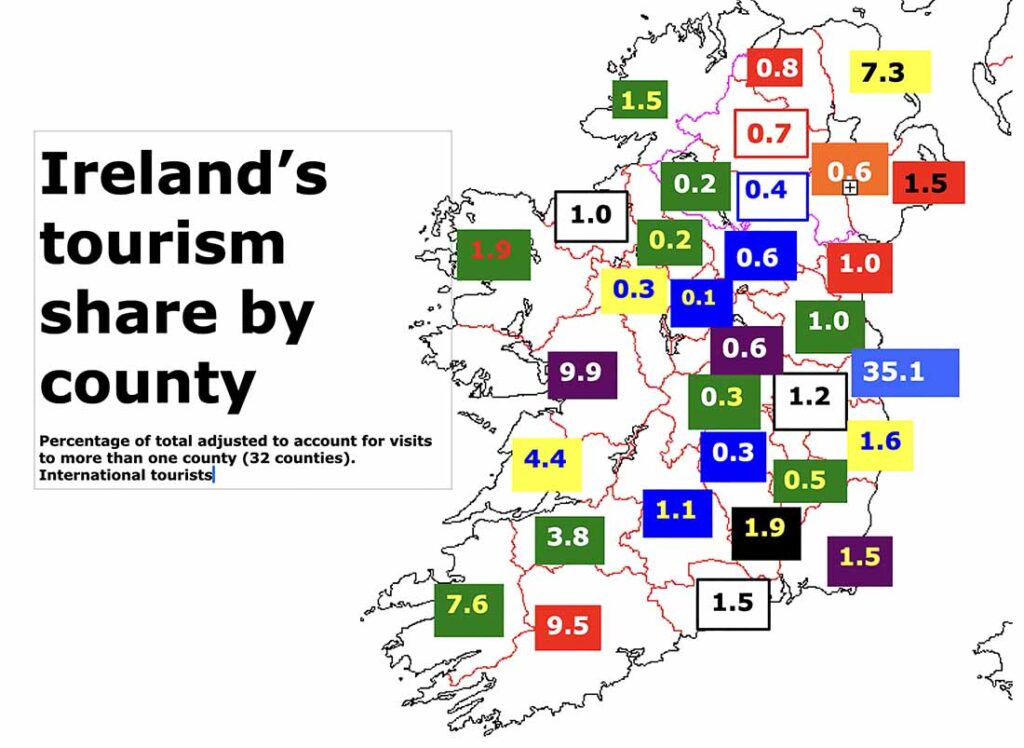
Ireland’s county Leitrim is a haven of waterways and unspoilt scenery, with the Shannon-Erne Waterway offering tranquil boating and fishing opportunities. Carrick-on-Shannon’s historic Costello Chapel and vibrant marina provide cultural and leisurely appeal, while Glencar Waterfall adds natural beauty. Leitrim is Ireland’s seventh smallest county by size (1,525 square km) and smallest by population (35,199). Population peaked at 155,297 in 1841 and reached its lowest point, 25,057 in 1996. In terms of hospitality, Leitrim is Ireland’s 29th most visited tourist county with around 39,000 international visitors per year.
Introduction – Adventure – Anthem – Archaeology – Attractions – Awards – Birdwatching – Camping – Castles – Churches – Contact list – Cycling – Dining – Equestrian – Festivals – Fishing – Folklore – Gardens – Golf – Graveyards – Happening – Haunted – Highest – Hiking – History – Holy Wells – Hotels – Hotels top 8 – Hunting & shooting – Instagrammable – Itineraries – Largest town – Luxury – MICE – Movies – Music – Name – New – Novelists – Off the beaten track – Poets – Pubs – Quotes – Random Facts – Restaurant Awards – Sacred Places – Saints – Songs – Spas – Sports – Sunsets – Sustainable – Things to do – Towns – Video – Villages – Walking – Wanderlist – Weddings – Wild swimming – Writers – 1837 – 1846 – 1852 – 1909 – 1955 – 1980 –