The highest point in County Wicklow is Lugnaquilla (Log na Coille), standing at 925 meters (3,035 feet). Lugnaquilla is located in the Wicklow Mountains, in the southwest of County Wicklow, near the village of Donard and the Glen of Imaal. It lies within the Wicklow Mountains National Park, part of Ireland’s Ancient East, renowned for its rugged peaks, glacial valleys, and heather-covered slopes.
- Elevation: At 925 meters, Lugnaquilla is the highest peak in Wicklow, the highest outside County Kerry, and the 13th highest in Ireland, offering a challenging climb with spectacular views.
- Terrain: The mountain features boggy moorland, grassy slopes, and rocky outcrops, with a broad, flat summit plateau marked by a large cairn. The terrain includes steep ascents, exposed ridges, and glacial features like the North and South Prisons (corrie cliffs), requiring careful navigation.
Starting Point and Access:
- Driving Route: The most common trailhead is at Fenton’s Pub in the Glen of Imaal, near Donard, accessible via the R759 from Baltinglass (20 minutes, 15 km) or the N81 from Blessington (25 minutes, ~20 km). The car park at Fenton’s is small, with permission typically required from the pub. From Dublin, the drive takes about 1 hour (60 km), and from Wicklow town, it’s about 45 minutes (~40 km). Another popular trailhead is at Glenmalure Valley, near Baravore Ford, for a southern approach.
- Alternative Access: A longer route starts from Aughavannagh, incorporating the Fraughan Rock Glen, or from Drumgoff, following the Wicklow Way. The Military Road (R115) provides access to routes via the Sally Gap for a northern approach. Note that parts of the Glen of Imaal are used as a military firing range, so hikers must check for restricted access (details below).
- Public Transport: Public transport is limited. Blessington or Rathdrum are served by buses from Dublin (e.g., St. Kevin’s Bus to Glendalough or Dublin Bus 65), but reaching the trailhead requires a car or taxi. Guided hikes, such as those offered by Wicklow Way Tours, HilltopTreks, or Ireland Walk Hike Bike, include transport from Dublin or Bray.
Glen of Imaal Route (Fenton’s Pub):
- Distance: Approximately 12–14 km round trip.
- Duration: 5–7 hours, depending on pace and conditions.
- Description: This is the most popular route, starting at Fenton’s Pub. The trail follows a track through the Glen of Imaal, passing Camara Hill, and ascends via the grassy ridge of Camenabologue (758 meters). Hikers cross boggy moorland to reach Lugnaquilla’s summit plateau, marked by a large cairn. The descent retraces the path, with care needed on boggy and steep sections. Check military firing schedules, as the Glen of Imaal is an active artillery range (see Safety below).
- Difficulty: Strenuous, suitable for experienced hikers with good fitness. The long distance, boggy terrain, and navigation challenges require preparation.
Glenmalure Route (Baravore Ford):
- Distance: 10–12 km round trip.
- Duration: 4.5–6 hours.
- Description: Starting at Baravore Ford in Glenmalure Valley, this route ascends via the Fraughan Rock Glen, following a steep path to the Arts Lough corrie and the South Prison cliffs. The trail joins the summit plateau from the south. It’s shorter but steeper, with stunning glacial scenery. The descent retraces the path.
- Difficulty: Strenuous, best for hikers comfortable with steep climbs and navigation.
Wicklow Way Route (Drumgoff):
- Distance: 15–18 km round trip.
- Duration: 6–8 hours.
- Description: This route starts at Drumgoff, following the Wicklow Way before branching off to ascend Lugnaquilla via Kelly’s Lough and the northern slopes. It offers a longer, scenic approach with views of Glendalough but requires stamina and navigation skills.
- Difficulty: Very strenuous, suitable for experienced hikers confident in open moorland navigation.
Navigation Tips:
- Use an Ordnance Survey map (Discovery Series Sheet 56) or apps like HiiKER, AllTrails, or PeakVisor for navigation, as the summit plateau is featureless and disorienting in fog.
- Bring a compass or GPS device, as the boggy terrain and lack of clear landmarks make navigation challenging, especially in poor visibility.
- Wear sturdy, waterproof hiking boots with good grip and gaiters, as the terrain is boggy and rocky. Trekking poles are essential for stability.
Scenery and Views:
- Summit Views: On clear days, Lugnaquilla offers breathtaking 360-degree views of the Wicklow Mountains, the Irish Sea, and much of Leinster. Notable sights include Glendalough, the Sugarloaf, and, on exceptional days, Snowdonia in Wales. The North and South Prisons, dramatic corrie cliffs, add to the visual spectacle.
- Landscape: The lower slopes feature boggy moorland and grassy ridges, transitioning to rocky outcrops and a vast summit plateau. The Wicklow Mountains’ glacial valleys, like Glenmalure and Glen of Imaal, create a rugged, wild landscape.
- Unique Features: Lugnaquilla’s summit cairn and corrie cliffs are iconic, with the mountain’s name meaning “hollow of the wood” in Irish, reflecting its forested lower slopes in ancient times. The area is rich in history, with nearby Glendalough linked to St. Kevin’s monastic settlement.
Hiking Experience:
- Duration: The Glen of Imaal route takes 5–7 hours, Glenmalure 4.5–6 hours, and the Wicklow Way route 6–8 hours, including summit time.
- Conditions: The terrain is boggy, with steep ascents and rocky sections. The summit is highly exposed to wind and frequent mist, reducing visibility. Spring and summer (April–September) offer the best conditions, with vibrant heather in August. Autumn (September–October) provides colorful landscapes, while winter hikes are challenging due to snow, ice, and shorter days.
- Cultural Significance: Lugnaquilla is central to Wicklow’s outdoor heritage, with the Wicklow Mountains National Park offering a pristine wilderness. The nearby Glendalough and Glenmalure valleys are steeped in monastic and rebellion history (e.g., the 1798 Rising).
- Weather: The summit is extremely exposed, with rapid weather changes, strong winds, and frequent fog. Check forecasts (e.g., Met Éireann) and avoid hiking in severe conditions.
- Terrain: Boggy ground, steep climbs, and the featureless summit plateau require careful footing and navigation. The Glenmalure route involves rocky scrambles near the corries.
- Military Range: The Glen of Imaal is an active military firing range. Check firing schedules with the Irish Defence Forces (available online or via local notices) to ensure the area is open. Red flags or signs indicate restricted access.
- Inform someone of your plans, as there are no rangers. Bring water, snacks, and warm clothing, as temperatures drop significantly. Solo hikers should be highly experienced or opt for guided tours.
- Wildlife: Expect to see red deer, Irish hares, and birds like peregrine falcons or skylarks. The moorland supports heather, bilberries, and bog asphodel.
Highest point in county
Antrim – Armagh – Carlow – Cavan – Clare – Cork – Derry – Donegal – Down – Dublin – Fermanagh – Galway] – Kerry – Kildare – Kilkenny – Laois – Leitrim – Limerick – Longford – Louth – Mayo – Meath – Monaghan – Offaly – Roscommon – Sligo – Tipperary – Tyrone – Waterford – Westmeath – Wexford – Wicklow
County Wicklow:
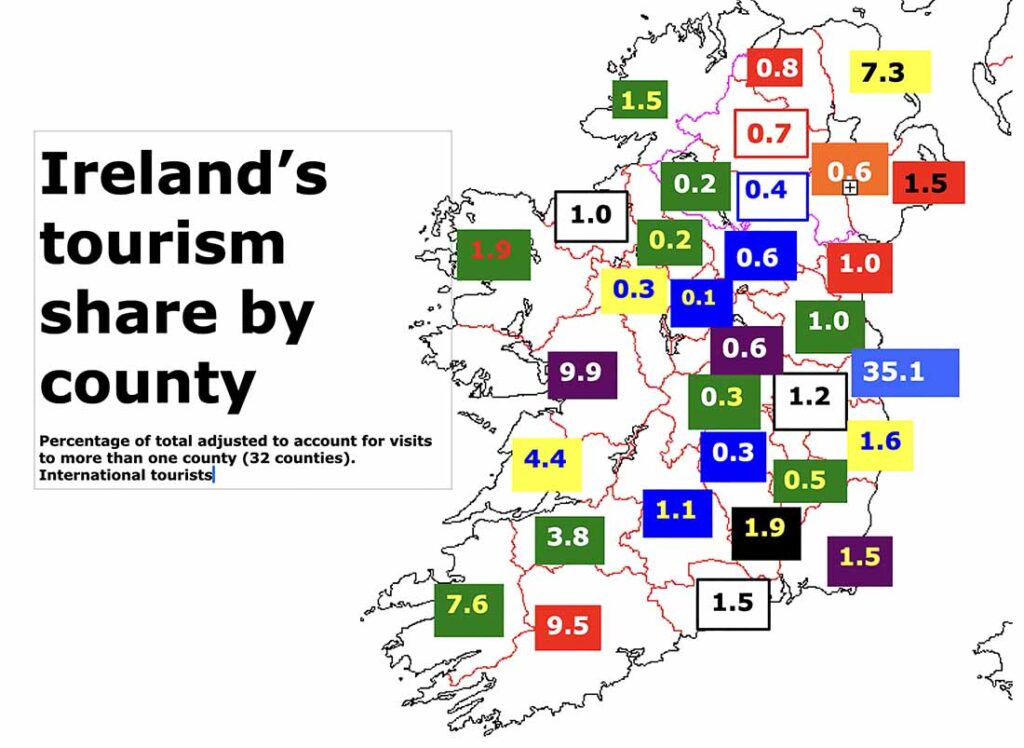
Ireland’s county Wicklow is known as the Garden of Ireland for its lush landscapes, with Glendalough’s monastic ruins and round tower set amidst serene lakes and valleys. The Wicklow Mountains National Park offers hiking trails with stunning views, while Powerscourt Estate’s manicured gardens and waterfall add natural elegance. Other attractions include the coastal paths of Bray. Wicklow is Ireland’s 17th largest county by size (,025 sq km) and 16th largest by population (155,851). Population peaked at 126,143 in 1841 and reached its lowest point, 57,591 in 1926. In terms of hospitality, Wicklow is Ireland’s twelfth most visited tourist county with around 204,000 international visitors per year.
Introduction – Adventure – Anthem – Archaeology – Attractions – Awards – Birdwatching – Camping – Castles – Churches – Contact list – Cycling – Dining – Equestrian – Festivals – Fishing – Folklore – Gardens – Golf – Graveyards – Happening – Haunted – Highest – Hiking – History – Holy Wells – Hotels – Hotels top 8 – Hunting & shooting – Instagrammable – Itineraries – Largest town – Luxury – MICE – Movies – Music – Name – New – Novelists – Off the beaten track – Poets – Pubs – Quotes – Random Facts – Restaurant Awards – Sacred Places – Saints – Songs – Spas – Sports – Sunsets – Sustainable – Things to do – Towns – Video – Villages – Walking – Wanderlist – Weddings – Wild swimming – Writers – 1837 – 1846– 1852 – 1909 – 1955 – 1980 –