The highest point in County Derry is Sawel Mountain, standing at 678 meters (2,224 feet). Sawel Mountain is located in the Sperrin Mountains, straddling the border between County Derry and County Tyrone, making it the highest point for both counties. It lies within the Sperrins Area of Outstanding Natural Beauty (AONB), a rugged and scenic region.
- Elevation: At 678 meters, Sawel is the highest peak in the Sperrin Mountains and a prominent feature in the region, offering expansive views across the surrounding landscape.
- Terrain: The mountain consists of open moorland, blanket bog, and heather-covered slopes, with a relatively flat summit plateau marked by a trig pillar. The terrain is often wet and boggy, especially after rain, with some rocky sections.
Starting Point and Access:
- Driving Route: The most common trailhead is near Sperrin village or Park village, accessible via the B47 road from Dungiven (County Derry) or Plumbridge (County Tyrone). A popular starting point is the car park at Barnes Gap or near Sperrin village, about 15–20 km from Dungiven (20–25 minutes’ drive). From Derry city, the drive to the trailhead takes approximately 40–50 minutes (30–35 km). The roads are narrow and winding, so caution is advised.
- Alternative Access: Another approach is from the Glenelly Valley (e.g., near Cranagh or Plumbridge), following paths like the Hudy’s Way trail, which can be extended to include Sawel. This is a longer route but offers a more scenic approach through the Sperrins.
- Public Transport: Public transport options are limited. Dungiven is served by buses from Derry city (e.g., Translink Goldliner 212), but reaching the trailhead typically requires a car or taxi. Guided hikes, such as those offered by Far and Wild or Sperrin Mountains Walking, provide transport from Derry or nearby towns.
Barnes Gap Route:
- Distance: Approximately 8–10 km round trip.
- Duration: 3–5 hours, depending on pace and conditions.
- Description: Starting at Barnes Gap, this is the most direct route to Sawel. The trail begins on a forest track or farm path, ascending gradually through grazing land and moorland. Hikers cross boggy terrain and follow a faint path toward the summit, marked by a trig pillar. The route involves navigating open hillsides, with some wire fences to cross (use stiles where available to avoid damage). The descent follows the same path.
- Difficulty: Moderate, suitable for hikers with some experience. The boggy terrain and lack of clear waymarking require good navigation skills, especially in poor visibility.
Glenelly Valley Route (via Hudy’s Way):
- Distance: 12–15 km round trip.
- Duration: 5–7 hours.
- Description: This route starts in the Glenelly Valley and follows part of Hudy’s Way, a waymarked trail through the Sperrins. It ascends Sawel via its southern slopes, passing other peaks like Dart Mountain. The route offers more varied scenery but is more challenging due to its length and exposure.
- Difficulty: Moderately strenuous, best for experienced hikers comfortable with longer distances and navigation.
Sawel and Dart Circuit:
- Distance: 15–20 km round trip.
- Description: This circular route combines Sawel with nearby Dart Mountain (619 meters), starting from Barnes Gap or Sperrin village. It covers a broader section of the Sperrins, offering additional views but requiring stamina and navigation.
- Difficulty: Challenging, due to the extended distance and varied terrain.
Navigation Tips:
- Use an Ordnance Survey map (Discoverer Series Sheet 13) or apps like HiiKER or PeakVisor for accurate navigation, as the summit plateau can be disorienting in fog.
- Bring a compass or GPS device, as the open moorland lacks clear landmarks.
- Wear waterproof boots and gaiters, as the terrain is notoriously boggy, especially after rain.
Scenery and Views:
- Summit Views: On clear days, Sawel offers spectacular 360-degree views across the Sperrin Mountains, with vistas of County Derry, County Tyrone, and beyond. You can see Lough Foyle, the Donegal hills, and even Slieve Donard in County Down on exceptional days. The rolling moorland and distant peaks create a wild, expansive atmosphere.
- Landscape: The Sperrins are characterized by blanket bogs, heather moorland, and gentle slopes, with Sawel’s summit being a flat, open plateau. The area feels remote and untouched, with minimal human presence.
- Unique Features: The summit’s trig pillar is a focal point, and the surrounding bogland supports unique flora like sphagnum moss and sundews. The Sperrins are also known for their archaeological significance, with ancient stone circles and cairns nearby.
Hiking Experience:
- Duration: The Barnes Gap route takes 3–5 hours, while longer circuits like the Glenelly Valley or Sawel-Dart loop take 5–7 hours.
- Conditions: The terrain is wet and boggy, particularly on the upper slopes, requiring careful footing. Spring and summer (April–September) offer the best hiking conditions, with longer daylight and milder weather. Autumn provides vibrant heather colors, while winter hikes are colder and wetter, with potential for snow.
- Cultural Significance: The Sperrins are steeped in history, with ties to Neolithic and Bronze Age sites, such as the Beaghmore Stone Circles (30 minutes’ drive from the trailhead). The area also has folklore connections, adding a mystical element to the hike.
- Weather: The summit is exposed, with frequent mist, strong winds, and rapid weather changes. Check forecasts and avoid hiking in severe conditions.
- Terrain: The boggy ground can be challenging, and wire fences require careful crossing. Inexperienced hikers should consider guided tours to navigate safely.
- Safety: Inform someone of your plans, as there are no rangers. Bring water, snacks, and warm clothing, as temperatures can drop significantly. Solo hikers should be confident in navigation.
- Wildlife: Expect to see birds like buzzards, ravens, or meadow pipits, and possibly hares or foxes. The bogs support unique plant life, including bog cotton and heather.
Highest point in county
Antrim – Armagh – Carlow – Cavan – Clare – Cork – Derry – Donegal – Down – Dublin – Fermanagh – Galway] – Kerry – Kildare – Kilkenny – Laois – Leitrim – Limerick – Longford – Louth – Mayo – Meath – Monaghan – Offaly – Roscommon – Sligo – Tipperary – Tyrone – Waterford – Westmeath – Wexford – Wicklow
County Derry:
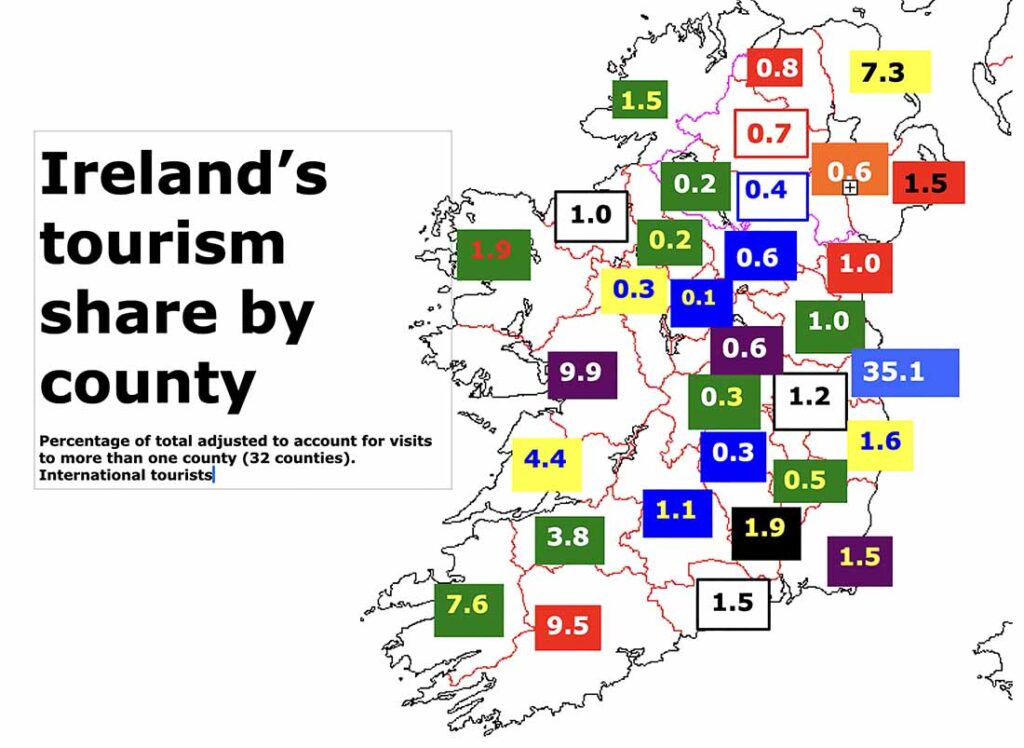
Ireland’s county Derry offers a rich historical tapestry, with the city’s 17th-century walls providing a walkable journey through its past. The Guildhall and Tower Museum explore Derry’s maritime and political history, while the Peace Bridge offers scenic views over the River Foyle. Derry is Ireland’s 15th largest county by size (2,067 square km) and sixth largest by population (252,231). Population previously peaked at 222,174 in 1841 and reached its lowest point, 139,693 in 1926. In terms of hospitality, Derry is Ireland’s 16th most visited tourist county with around 135,000 international visitors per year.
Introduction – Adventure – Anthem – Archaeology – Attractions – Awards – Birdwatching – Camping – Castles – Churches – Contact list – Cycling – Dining – Equestrian – Festivals – Fishing – Folklore – Gardens – Golf – Graveyards – Happening – Haunted – Highest – Hiking – History – Holy Wells – Hotels – Hotels top 8 – Hunting & shooting – Instagrammable – Itineraries – Largest town – Luxury – MICE – Movies – Music – New – Name – Novelists – Off the beaten track – Poets – Pubs – Quotes – Random Facts – Restaurant Awards– Sacred Places – Saints – Songs – Spas – Sports – Sunsets – Sustainable – Things to do – Towns – Video – Villages – Walking – Wanderlist – Weddings – Wild swimming – Writers – 1837 – 1846 – 1852 – 1909 – 1955 – 1980 –