The highest point in County Clare is Moylussa, standing at 531.6 meters (1,744 feet). Moylussa is located in the Slieve Bernagh mountain range, near the village of Killaloe in east County Clare, close to the border with County Tipperary. It overlooks Lough Derg and the River Shannon, providing a scenic backdrop within the Hidden Heartlands region.
- Elevation: At 531.6 meters, it is the highest point in County Clare, though modest compared to Ireland’s taller peaks. The summit is relatively flat and boggy, marked by a trig pillar.
- Terrain: The mountain features a mix of forest tracks, open bogland, and heather-covered slopes. The terrain can be wet and boggy, particularly after rain, with some rocky sections near the summit.
Starting Point and Access:
- Driving Route: The most common trailhead is near Two Mile Gate, a forest entrance accessible via the R463 from Killaloe to Limerick, then turning onto a minor road toward Ballycuggaran Forest. The trailhead is about 10–15 minutes from Killaloe (approximately 5–7 km). From Ennis, the drive takes about 40 minutes (30 km). Parking is available at the forest gate, though space is limited.
- Alternative Access: Some hikers start from O’Brien’s Bridge or Bridgetown, following longer routes through the Slieve Bernagh range. These are less common and require better navigation skills.
- Public Transport: Public transport to the trailhead is limited. Killaloe is served by buses from Limerick or Ennis (e.g., Bus Éireann route 345), but reaching Two Mile Gate typically requires a car or taxi. Guided hikes, such as those offered by Get West, include transport from nearby towns.
Two Mile Gate Route:
- Distance: Approximately 8–10 km round trip.
- Duration: 3–5 hours, depending on pace and conditions.
- Description: This is the most popular route, starting at Two Mile Gate. The trail begins on a forest track through Ballycuggaran Forest, ascending gradually through coniferous woodland. After about 2–3 km, the path opens onto boggy moorland, where hikers follow a faint track or sheep paths toward the summit. The final ascent involves navigating wet, peaty terrain to reach the trig pillar. The route is not waymarked, so a map (Ordnance Survey Discovery Series Sheet 58) or GPS is essential.
- Difficulty: Moderate, suitable for hikers with some experience. The forest section is straightforward, but the open bogland requires careful footing and navigation, especially in poor visibility or wet conditions.
Slieve Bernagh Loop:
- Distance: 12–15 km round trip.
- Duration: 5–7 hours.
- Description: This longer route starts from Two Mile Gate or nearby forest entrances and incorporates other peaks in the Slieve Bernagh range, such as Cragnamurragh. It offers a more challenging hike with additional views but requires good navigation and stamina.
- Difficulty: Moderately strenuous, best for experienced hikers comfortable with off-trail navigation.
Moylussa from O’Brien’s Bridge:
- Distance: 15–20 km round trip.
- Description: A less common approach, this route follows the Clare Glens and Slieve Bernagh trails, combining forest paths and open hills. It’s a longer, more scenic option but less direct.
- Difficulty: Challenging, due to distance and varied terrain.
Navigation Tips:
- Use a map (Ordnance Survey Sheet 58) or apps like HiiKER or AllTrails for route guidance, as the summit plateau can be disorienting in fog.
- Bring a compass or GPS device, as the boggy summit lacks clear landmarks.
- Wear waterproof boots and gaiters, as the upper slopes are often wet and muddy.
Scenery and Views:
- Summit Views: On clear days, Moylussa offers stunning panoramic views of Lough Derg, the River Shannon, and the surrounding counties of Tipperary, Limerick, and Galway. The Arra Mountains, Slieve Felim, and distant Keeper Hill are visible, with the Shannon’s shimmering waters adding to the spectacle. On exceptional days, the Galway and Connemara hills can be seen to the northwest.
- Landscape: The lower slopes are cloaked in dense forest, transitioning to open, heather-covered bogland near the summit. The trig pillar marks the highest point, set in a relatively flat, exposed area. The Slieve Bernagh range is less dramatic than Ireland’s coastal mountains but offers a peaceful, rural charm.
- Unique Features: The summit’s isolation provides a sense of tranquility, with minimal human presence. The nearby Lough Derg and River Shannon add a water-centric beauty to the experience.
Hiking Experience:
- Duration: The Two Mile Gate route takes 3–5 hours, while longer loops may take 5–7 hours. Plan extra time for rest and enjoying the views.
- Conditions: The forest paths are stable but can be muddy after rain. The open bogland is wet and peaty, requiring careful footing. Spring and summer (April–September) are ideal for milder weather and better visibility, though autumn offers vibrant heather colors. Winter hikes are feasible but colder and wetter.
- Cultural Significance: Moylussa is tied to local folklore and the heritage of the Shannon region, part of Ireland’s Hidden Heartlands. The nearby town of Killaloe is historically significant as the birthplace of Brian Boru, Ireland’s famous High King, adding cultural depth to the visit.
- Weather: The summit is exposed, with frequent mist and strong winds. Check forecasts and avoid hiking in severe conditions.
- Terrain: The boggy upper slopes can be slippery, and the lack of waymarking requires navigation skills. Inexperienced hikers should consider guided tours.
- Safety: Inform someone of your plans, as there are no rangers. Bring water, snacks, and warm clothing, as temperatures can drop significantly at the summit.
- Wildlife: Expect to see birds like buzzards, kestrels, or skylarks, and possibly deer or foxes in the forest. The bogland supports unique flora, such as heather and bog cotton.
Additional Attractions:
- Nearby Sites: Combine the hike with a visit to Killaloe and Ballina, twin towns linked by a historic bridge over the River Shannon. Explore St. Flannan’s Cathedral, Brian Boru’s heritage center, or take a boat tour on Lough Derg. The Clare Glens, a forested gorge with waterfalls, is a short drive away and offers gentler walks.
- Activities: Lough Derg is popular for fishing, kayaking, and sailing. The Limerick Greenway (40 km) or Ballyhoura Mountain Bike Trails (90 minutes away) offer alternative outdoor activities.
- Events: The Féile Brian Boru festival in Killaloe (typically July) celebrates local history with music, markets, and guided walks, which may include Moylussa.
Highest point in county
Antrim – Armagh – Carlow – Cavan – Clare – Cork – Derry – Donegal – Down – Dublin – Fermanagh – Galway] – Kerry – Kildare – Kilkenny – Laois – Leitrim – Limerick – Longford – Louth – Mayo – Meath – Monaghan – Offaly – Roscommon – Sligo – Tipperary – Tyrone – Waterford – Westmeath – Wexford – Wicklow
County Clare:
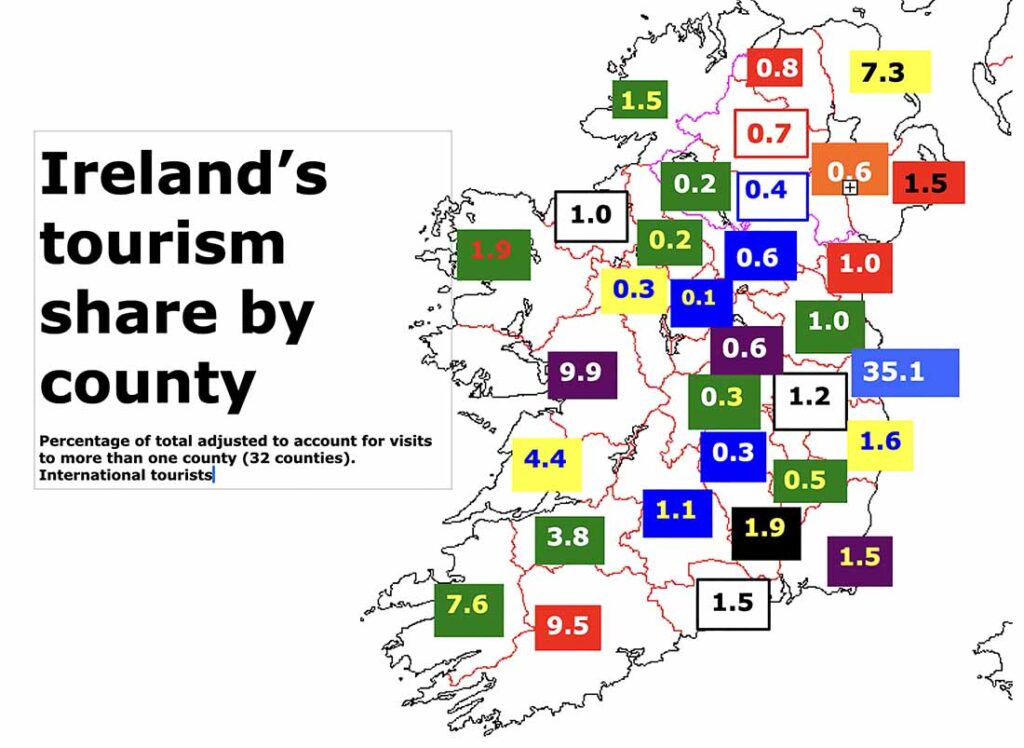
Ireland’s county Clare is renowned for its dramatic cliffs and traditional heritage, with the Cliffs of Moher offering breathtaking views over the Atlantic. The Burren’s unique limestone landscape provides hiking and rare flora, while Bunratty Castle offers medieval history with its restored interiors. Check out the traditional music scene in Doolin and the county’s coastal beaches. Clare is Ireland’s eighth largest county by size (3,188 square km) and 19th largest by population (127,938). Population peaked at 286,394 in 1841 and reached its lowest point, 73,597 in 1966. In terms of hospitality, Clare is Ireland’s sixth most visited tourist county with around 485,000 international visitors per year.
Introduction – Adventure – Anthem – Archaeology – Attractions – Awards – Birdwatching – Camping – Castles – Churches – Contact list – Cycling – Dining – Equestrian – Festivals – Fishing – Folklore – Gardens – Golf – Graveyards – Happening – Haunted – Highest – Hiking – History – Holy Wells – Hotels – Hotels top 8 – Hunting & shooting – Instagrammable – Itineraries – Largest town – Luxury – MICE – Movies – Music – New – Name – Novelists – Off the beaten track – Poets – Pubs – Quotes – Random Facts – Restaurant Awards – Sacred Places – Saints –Songs – Spas – Sports – Sunsets – Sustainable – Things to do – Towns – Video – Villages – Walking – Wanderlist – Weddings – Wild swimming – Writers – 1837– 1846 – 1852 – 1909 – 1955 – 1980 –