The highest point in County Kildare is Cupidstown Hill, standing at 379 meters (1,243 feet). Located in the northeast of the county near Kilteel, close to the Dublin-Wicklow border, Cupidstown Hill is a modest but significant peak in Kildare’s relatively flat landscape, part of the rolling hills extending from the Wicklow Mountains. While not as dramatic as Ireland’s taller peaks, it offers a gentle hike with rewarding views and a peaceful rural setting.
- Geological and Cultural Significance: Cupidstown Hill is a low, rounded hill formed from sedimentary rock, part of the eastern edge of the Bog of Allen and the broader Wicklow Mountains foothills. Its name may derive from the Irish Cnoc Bhaile Cupid or a connection to the Cupidstown townland, though its origins are unclear. The hill lacks the dramatic geology of taller peaks but is notable as Kildare’s highest point, offering a contrast to the county’s flat plains and bogs. The surrounding area is rich in history, with nearby sites like the Hill of Allen (legendary seat of Fionn MacCumhaill) and early Christian ruins in Kilteel.
- Scenic Beauty: The summit provides panoramic views over Kildare’s lush plains, the Bog of Allen, and, on clear days, the distant Wicklow Mountains to the south and Dublin city to the northeast. The open farmland and hedgerows create a quintessentially Irish pastoral scene.
Approaching Cupidstown Hill
- Access Points: Cupidstown Hill is best accessed from the village of Kilteel, about 30km southwest of Dublin city, near the N81 road. The primary starting point is a small lay-by or roadside parking area near Cupidstown townland, off minor roads like the L6002 (Grid Ref: O 960 215). Another approach is from the Rathmore Road (L2008), near Rathmore village, slightly further west. Public transport is limited, with the closest bus routes (e.g., Go-Ahead Ireland 65 to Blessington) requiring a drive or taxi to the trailhead. A car is recommended for access.
Trail Options:
- Kilteel Route: The most common route is a 4–6km round-trip hike (1.5–2 hours) starting near Kilteel. From the L6002, hikers follow a quiet country lane or farm track through private farmland, ascending gently to the summit. The path is not formally marked but follows field boundaries or faint tracks across grassy slopes. Permission from local landowners may be required, as the hill crosses private land. The summit is marked by a small cairn or grassy mound. This route is easy, suitable for beginners, though muddy patches are common.
- Rathmore Route: A slightly longer 6–8km round-trip hike (2–3 hours) starts near Rathmore, following minor roads and farm tracks toward the hill’s western slopes. This route is less direct but offers a scenic approach through rolling countryside. Like the Kilteel route, it crosses private land, so respect for property is essential.
- Extended Routes: Adventurous hikers may combine Cupidstown Hill with nearby low hills like Sillagh or Athgarvan Hill, though these are less defined and require navigation across farmland. The Kildare Way, a developing trail network, may offer future connections but currently does not directly link to Cupidstown.
- Navigation and Preparation: The routes to Cupidstown Hill are not waymarked, and the summit is understated, so hikers should carry a map (Ordnance Survey Ireland, Discovery Series Sheet 50 or 56), compass, or GPS to confirm the correct hill, as the area has several similar low rises. Waterproof boots and rain gear are advisable due to Kildare’s damp climate and muddy tracks. Bring water and snacks, as there are no facilities. Dogs are allowed but must be leashed to avoid disturbing livestock, which is common in the area. Always seek landowner permission if crossing private fields, and check weather forecasts, as fog or rain can reduce visibility.
Hiking Experience:
- The Kilteel route is a gentle, short hike, ideal for beginners or families. The ascent is gradual, crossing grassy fields and farm tracks, with minimal elevation gain. The lack of a clear path requires basic navigation, but the open terrain makes the summit easy to spot.
- The Rathmore route is similar but slightly longer, with more varied countryside views. Both routes are low-intensity but can be muddy, especially after rain, due to the clay-heavy soil.
- The summit is a broad, grassy mound with a small cairn, offering a quiet, unspoiled setting. Its modesty contrasts with taller peaks, but the lack of crowds enhances its charm for those seeking a quick escape from Dublin.
- Views and Photography: On clear days, the summit offers expansive views over Kildare’s green plains, dotted with farms and hedgerows. The Wicklow Mountains, including peaks like Kippure, are visible to the south, while Dublin’s skyline may be faintly discernible to the northeast. The pastoral landscape is ideal for photography, particularly at sunset when the fields glow golden. The hill’s low elevation limits long-distance vistas compared to taller peaks.
- Wildlife and Nature: Cupidstown Hill is surrounded by farmland and bog, supporting typical lowland species like hares, foxes, and birds such as skylarks and kestrels. Hedgerows host wildflowers like primroses in spring, while nearby boglands feature heather and mosses. Grazing sheep and cattle are common, emphasizing the area’s agricultural character.
- Cultural and Historical Context: Kildare is known as the “Thoroughbred County” for its horse racing heritage, and Cupidstown Hill lies near stud farms and historic estates. The nearby Hill of Allen, associated with Fionn MacCumhaill’s mythology, adds a legendary element. Kilteel village has a 13th-century castle ruin and early Christian church, offering historical stops post-hike. The area’s flatness makes Cupidstown’s prominence notable in local lore.
- Amenities: There are no facilities at the trailhead, so hikers must be self-sufficient. Kilteel village has no major amenities, but nearby towns like Naas (10km) or Blessington (12km) offer cafés, pubs, and shops for post-hike refreshments. The Kilteel Inn is a local pub for traditional fare. For accommodation, Naas or Dublin provide the closest options.
- Seasonal Considerations: Spring (April–May) and autumn (September–October) offer mild weather (8–15°C / 46–59°F) and vibrant scenery, with wildflowers or autumnal hues. Summer (June–August) is warmest (15–20°C / 59–68°F) but can be wet. Winter (November–March) brings muddier conditions and occasional frost, though snow is rare. Kildare’s 1,200–1,400 annual sunshine hours allow for decent visibility, but rain is frequent, so waterproof gear is essential.
- Guided Tours: Guided hikes are rare for Cupidstown Hill due to its low profile, but local walking groups or operators like those on visitkildare.ie may include it in broader Kildare tours. Joining a group can simplify access across private land.
- Safety: The hike is low-risk, but crossing private land requires respect for property (close gates, avoid disturbing livestock). Fog or rain can make navigation trickier, so inform someone of your plans. Mobile signal is generally good, but offline maps are recommended.
- Accessibility: Cupidstown Hill is one of Ireland’s easiest county high points, suitable for beginners due to its low elevation and gentle slopes. However, muddy tracks and private land access may limit wheelchair or stroller use.
- Cupidstown Hill offers a straightforward, peaceful hike in County Kildare, ideal for those seeking a quick outdoor escape near Dublin. Its gentle trails, rural views, and historical surroundings make it a rewarding, low-key destination. While less dramatic than Ireland’s taller peaks, its accessibility and quiet charm appeal to casual hikers and visitors exploring Kildare’s countryside. For more details, visit visitkildare.ie or consult Kieron Gibbons’ Ireland’s County High Points – A Walking Guide
Highest point in county
Antrim – Armagh – Carlow – Cavan – Clare – Cork – Derry – Donegal – Down – Dublin – Fermanagh – Galway] – Kerry – Kildare – Kilkenny – Laois – Leitrim – Limerick – Longford – Louth – Mayo – Meath – Monaghan – Offaly – Roscommon – Sligo – Tipperary – Tyrone – Waterford – Westmeath – Wexford – Wicklow
County Kildare:
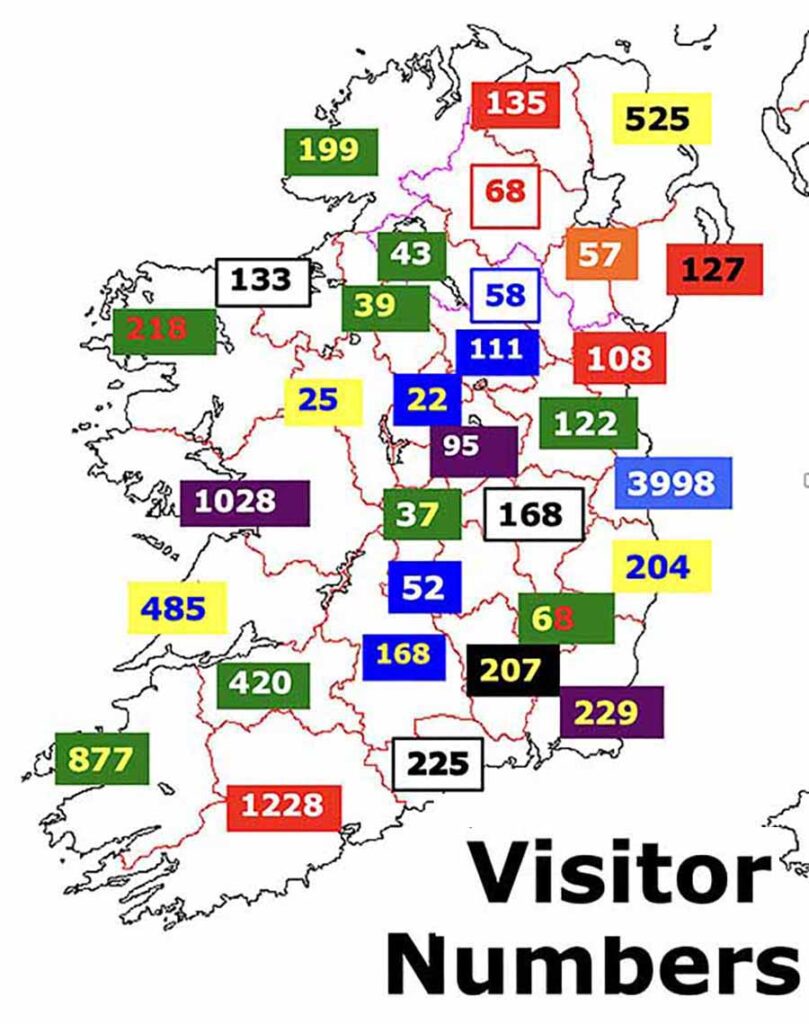
Ireland’s county Kildare blends historic sites with lush countryside, with the National Stud and Japanese Gardens offering a unique mix of equine heritage and serene landscapes. Castletown House, a grand Palladian mansion, provides historical insights, while the Curragh’s open plains are ideal for walking. The ancient Hill of Allen adds archaeological depth, making Kildare an engaging stop for culture and nature. The new Shackleton Experience has opened in Athy. Kildare is Ireland’s eighth smallest county by size (1,694 square km) and seventh largest by population (247,774). Population reached its lowest point, 57,892 in 1936. In terms of hospitality, Kildare is Ireland’s 15th most visited tourist county with around 168,000 international visitors per year.
Introduction – Adventure – Anthem – Archaeology – Attractions – Awards – Birdwatching – Camping – Castles– Churches – Contact list – Cycling – Dining – Equestrian – Festivals – Fishing – Folklore – Gardens – Golf – Graveyards – Happening – Haunted – Highest – Hiking – History – Holy Wells – Hotels – Hotels top 8 – Hunting & shooting – Instagrammable – Itineraries – Largest town – Luxury – MICE – Movies – Music – Name – New – Novelists – Off the beaten track – Poets – Pubs – Quotes – Random Facts – Restaurant Awards – Sacred Places – Saints – Songs – Spas – Sports – Sunsets – Sustainable – Things to do – Towns – Video – Villages – Walking – Wanderlist – Weddings – Wild swimming – Writers – 1837 – 1846 – 1852 – 1909 – 1955 – 1980 –