- Pádraic Ó Conaire (1882-1928) Born in Galway city, Ó Conaire was a pioneering Irish-language writer and one of the first to adopt a modernist style in Irish literature. Orphaned at 11, he moved to Rosmuc in Connemara and later worked as a civil servant in London, where he began writing seriously. His works include the short story collection Deoraíocht (1910) and the novel M’asal Beag Dubh. A statue in Galway commemorates his legacy, and his writings are still studied in Irish schools.
- Máirtín Ó Direáin (1910-1988) Born on Inishmore, Aran Islands, Ó Direáin was a prominent Irish-language poet whose work captured the rugged beauty and cultural isolation of his native Aran. After moving to Galway and later Dublin, he published poetry collections like Coinnle Geala (1942) at his own expense, earning international recognition. His poems often express nostalgia for the Gaeltacht and are studied in Irish education.
- Liam O’Flaherty (1896-1984) Born in Gort na gCapall, Aran Islands, O’Flaherty was a novelist and short story writer known for his stark, realistic depictions of Irish life. His novels The Informer (1925) and Famine (1937) explore themes of betrayal and survival, while his short stories, like those in The Short Stories of Liam O’Flaherty (1937), reflect his Aran roots. A key figure in the Irish Literary Revival, he also wrote in Irish.
- Máirtín Ó Cadhain (1906-1970) Born in An Cnocán Glas, Connemara, Ó Cadhain was a leading Irish-language novelist and short story writer, often compared to James Joyce for his experimental style. His masterpiece Cré na Cille (1949), a novel set in a graveyard, is a landmark in Irish literature. A teacher and IRA member, his work blends humor, satire, and Gaeltacht life. He taught at Trinity College Dublin.
- Walter Macken (1915-1967) Born in Galway city, Macken was a novelist, playwright, and actor whose works often depicted Galway’s landscapes and people. His novels Rain on the Wind (1950) and The Silent People (1962) explore Irish rural life and history, while his plays were staged at the Abbey Theatre. His vivid storytelling made him a beloved figure in Irish literature.
- Frank Harris (1856-1931) Born in Galway city, Harris was a journalist, editor, and writer best known for his controversial memoir My Life and Loves (1922-1927), banned for its explicit content. He edited major periodicals in London and was a friend of literary giants like Oscar Wilde and George Bernard Shaw. His eclectic career included novels, short stories, and biographies, reflecting his Galway origins.
- Eilís Dillon (1920-1994) Born in Galway city, Dillon was a prolific novelist and children’s author who wrote in both English and Irish. Her works, such as The Island of Ghosts (1989) and The Singing Cave (1959), often drew on Irish folklore and her Galway upbringing. She also wrote historical novels and was a member of Aosdána, Ireland’s cultural academy.
- Breandán Ó hEithir (1930-1990) Born in Carraroe, Galway, Ó hEithir was a journalist, novelist, and broadcaster who wrote in Irish and English. His novel Lig Sinn i gCathú (1976) is a classic in Irish literature, blending humor and social commentary. As a broadcaster with RTÉ, he popularized Irish-language media, and his works often reflected Connemara’s Gaeltacht culture.
- Ken Bruen (1951-2025) Born in Galway city, Bruen was a crime novelist known for his Jack Taylor series, set in Galway, including The Guards (2001). His gritty, poetic style and depiction of modern Ireland earned him international acclaim, with adaptations of his work for television. He died in Galway in March 2025.
- Geraldine Aron (1941-) Born in Galway city, Aron is a playwright whose works, such as Bar and Ger (1975) and My Brilliant Divorce (2001), have been performed internationally. Her one-hander My Brilliant Divorce earned a Laurence Olivier Award nomination in 2004. Her plays often explore personal and societal themes, rooted in her Galway background.
Writers
Antrim – Armagh – Carlow – Cavan – Clare – Cork – Derry – Donegal – Down – Dublin – Fermanagh – Galway – Kerry – Kildare – Kilkenny – Laois – Leitrim – Limerick – Longford – Louth – Mayo – Meath – Monaghan – Offaly – Roscommon – Sligo – Tipperary – Tyrone – Waterford – Westmeath – Wexford – WicklowCounty Galway:
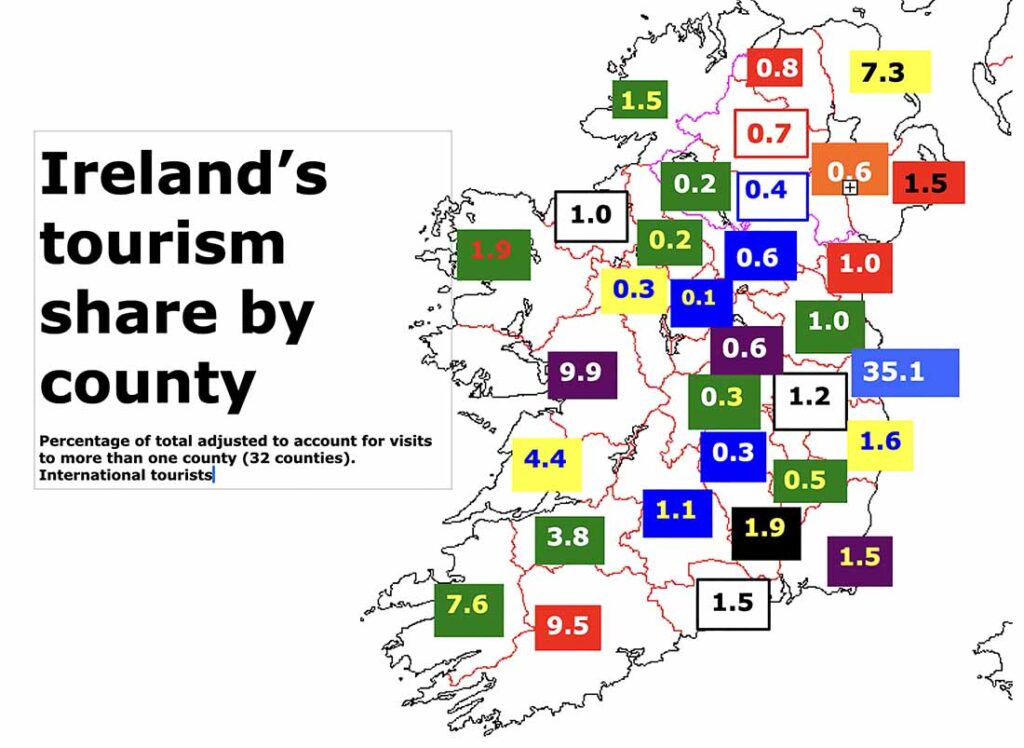
Ireland’s county Galway offers a delightful mix of cultural heritage and coastal beauty, with Galway City’s Latin Quarter showcasing historic streets and traditional music venues. The Connemara National Park provides hiking trails through rugged mountains and bogs, while the Aran Islands offer ancient stone forts like Dún Aonghasa. Other favourite stop is ithe Kylemore Abbey’s Victorian gardens and coastal cliffs. Galway is Ireland’s second largest county by size (5,939 sq km) and fifth largest by population (277,737). Population peaked at 440,198 in 1841 and reached its lowest point, 148,340 in 1966. In terms of hospitality, Galway is Ireland’s third most visited tourist county with around 1,028,000 international visitors per year.
Introduction – Adventure – Anthem – Archaeology – Attractions – Awards – Birdwatching – Camping – Castles – Churches – Contact list – Cycling – Dining – Equestrian – Festivals – Fishing – Folklore – Gardens – Golf – Graveyards – Happening – Haunted – Highest – Hiking – History – Holy Wells – Hotels – Hotels top 8 – Hunting & shooting – Instagrammable – Itineraries – Largest town – Luxury – MICE – Movies – Music – Name – New – Novelists – Off the beaten track – Poets – Pubs – Quotes – Random Facts – Restaurant Awards – Sacred Places – Saints – Songs – Spas – Sports – Sunsets – Sustainable – Things to do – Towns – Video – Villages – Walking – Wanderlist – Weddings – Wild swimming – Writers – 1837 – 1846 – 1852 – 1909 – 1955 – 1980 –