- St. Macartan (Mac Cairthinn): March 24, c. 5th–6th century (exact dates uncertain): Clogher (Diocese of Clogher, Monaghan) Macartan is the patron saint of the Diocese of Clogher, which covers County Monaghan. Tradition holds he was a companion of St. Patrick, who consecrated him as the first bishop of Clogher around 454 AD. He is said to have founded the see of Clogher, and his relics were venerated there. The Monaghan Genealogy Centre is located at St. Macartan’s College, Mullaghmurphy, Monaghan. His life is noted for asceticism and missionary work, with a holy well in Clogher dedicated to him.
- Saint Enda of Aran: March 21, c. 450–530: Killanny (partly in Monaghan, Diocese of Clogher) Enda, a warrior-turned-monk, is linked to Monaghan through the church dedication in Killanny, which spans Counties Louth and Monaghan. Born in the kingdom of Oriel (including Monaghan), he trained under St. Ailbe and later founded a monastery on Inishmore, Aran Islands. Known for his strict monastic discipline, he is considered a father of Irish monasticism. His connection to Killanny suggests local veneration in Monaghan.
- Saint Molua (Moluag): June 25, c. 530–592: Possible influence in Clogher Diocese parishes Molua, also known as Lugaidh, was a disciple of St. Comgall of Bangor. While primarily associated with Lismore and Scotland, his missionary activities in the north of Ireland, including areas like Monaghan within the Oriel region, suggest a possible connection. He founded monasteries and was known for his piety and missionary zeal. Specific Monaghan parishes are not directly named, but his influence in Ulster monasticism likely reached the area.
- Saint Tigernach of Clones: April 4, c. 5th–6th century (d. c. 548): Clones, Monaghan Tigernach founded the monastery at Clones, a significant early Christian site in Monaghan. He was reputedly educated in Scotland and returned to Ireland to establish Clones as a center of learning and faith. Tradition claims he was a godson of St. Brigid and succeeded St. Macartan as bishop of Clogher. His relics were enshrined in Clones, and the monastery remained influential until Viking raids.
- Saint Dympna: May 15 or May 30, c. 7th century: Possible veneration in Monaghan parishes (no specific parish named) Dympna, a martyr saint, fled from her pagan father’s advances to Gheel, Belgium, where she was killed. Though her primary cult is in Gheel, her Irish origins are often linked to the Oriel region, including Monaghan. She is the patron saint of mental health. While no specific Monaghan parish is directly tied to her, her story resonates in the region due to its historical connection to Oriel.
- Saint Maelruain (Máel Rúain): July 7, c. 8th century: Possible influence in Monaghan through Clogher Diocese Maelruain founded the monastery of Tallaght, but his influence as a leader of the Céli Dé reform movement extended to Ulster, including Monaghan. His emphasis on asceticism and scriptural study impacted monasteries in the region. No specific Monaghan parish is named, but his legacy likely reached Clogher Diocese communities.
- Saint Fanchea: January 1, c. 5th–6th century: Rossory (near Monaghan, in Clogher Diocese) Fanchea, sister of St. Enda, founded a nunnery at Rossory, near Enniskillen, close to Monaghan’s borders. She is credited with guiding her brother toward monastic life. Her influence in the region, part of the ancient Oriel kingdom, suggests local veneration in Monaghan parishes, though specific ties are limited. She is known for her piety and miracles, including healing.
- Saint Davog (Dabhach): Unknown (possibly August 1), c. 6th century: Possible association with Lough Derg, near Monaghan Davog is linked to Lough Derg, a pilgrimage site near Monaghan, where he is said to have lived as a hermit. His life is obscure, but his connection to this significant spiritual site in the Clogher Diocese suggests local veneration. He is associated with miracles and ascetic practices. Specific parish ties in Monaghan are not well-documented.
- Saint Mogue (Áedán): January 31, c. 550–625: Possible influence in Monaghan through Clogher Diocese Mogue, also known as Áedán of Ferns, was a bishop and missionary whose activities extended across Ulster. While primarily associated with Wexford, his work in the north, including areas like Monaghan, is noted in hagiographies. He founded monasteries and was known for his charity and miracles. No specific Monaghan parish is directly linked, but his regional influence is plausible.
- Saint Conall (Conald): May 22, c. 6th century: Possible association with Donagh, Monaghan Conall, a lesser-known saint, is sometimes linked to the Donagh area in Monaghan, where a church may have been dedicated to him. His life is poorly documented, but he is associated with early Christian foundations in Ulster. His veneration likely remained local, with possible ties to Monaghan’s early churches.
- Saint Ultan of Ardbraccan: September 4, c. 6th–7th century (d. c. 657): Possible influence in Monaghan through missionary work Ultan, a bishop and scholar, was active in Meath but had connections to Ulster through his missionary efforts. He is credited with writing hymns and caring for orphans. While no specific Monaghan parish is named, his work in the Oriel region suggests possible influence in Monaghan’s early Christian communities.
- Saint Comgall: May 10, c. 510–602: Possible influence in Monaghan through Bangor’s network Comgall founded the great monastery of Bangor, Co. Down, which influenced monasticism across Ulster, including Monaghan. As a teacher of St. Columbanus and St. Molua, his legacy reached far. While no specific Monaghan parish is directly tied, his monastic network likely impacted Clogher Diocese communities. He was known for his strict rule and missionary zeal
Saints
Antrim – Armagh – Carlow – Cavan – Clare – Cork – Derry – Donegal – Down – Dublin – Fermanagh – Galway – Kerry – Kildare – Kilkenny – Laois – Leitrim – Limerick – Longford – Louth – Mayo – Meath – Monaghan – Offaly – Roscommon – Sligo – Tipperary – Tyrone – Waterford – Westmeath – Wexford – Wicklow
Sacred Places
Antrim – Armagh – Carlow – Cavan – Clare – Cork – Derry – Donegal – Down – Dublin – Fermanagh – Galway – Kerry – Kildare – Kilkenny – Laois – Leitrim – Limerick – Longford – Louth – Mayo – Meath – Monaghan – Offaly – Roscommon – Sligo – Tipperary – Tyrone – Waterford – Westmeath – Wexford – Wicklow
Holy Wells
Antrim – Armagh – Carlow – Cavan – Clare – Cork – Derry – Donegal – Down – Dublin – Fermanagh – Galway – Kerry – Kildare – Kilkenny – Laois – Leitrim – Limerick – Longford – Louth – Mayo – Meath – Monaghan – Offaly – Roscommon – Sligo – Tipperary – Tyrone – Waterford – Westmeath – Wexford – Wicklow
County Monaghan:
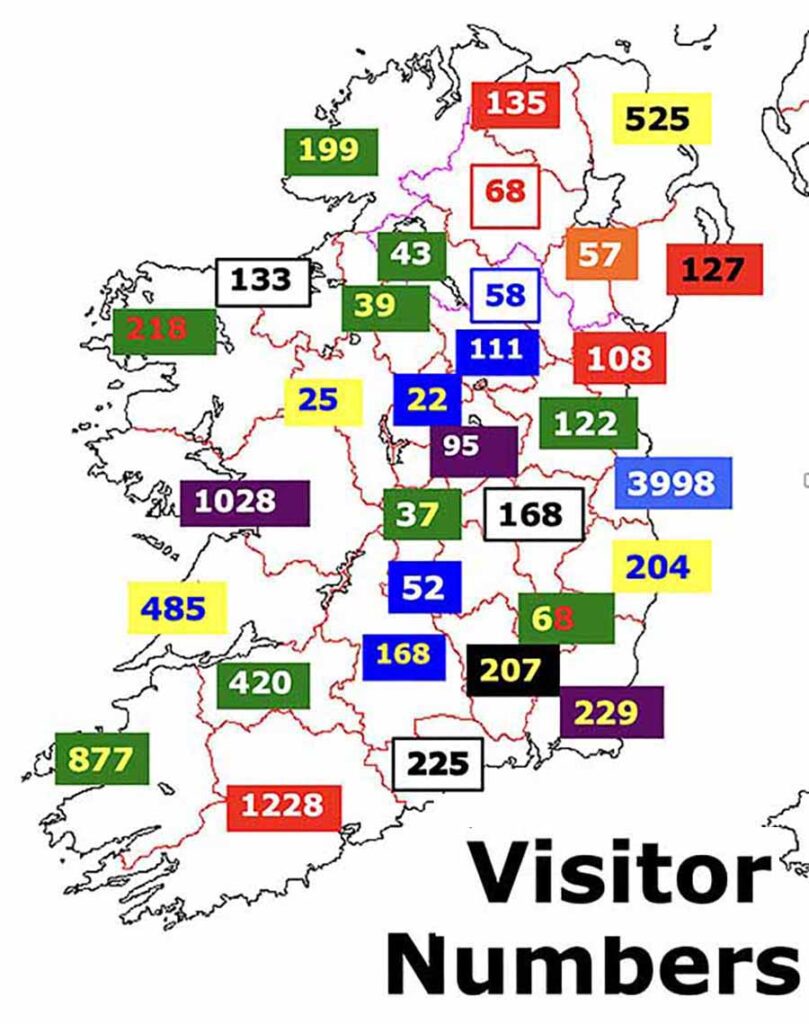
Ireland’s county Monaghan offers a serene blend of rolling hills and cultural heritage, with the Monaghan County Museum showcasing local history through artefacts and exhibits. The scenic Rossmore Forest Park provides walking trails amidst lakes and woodlands, while Castle Leslie’s historic estate offers a glimpse into aristocratic life. Other attractions include the county’s traditional lace-making heritage and quiet countryside. Monaghan is Ireland’s sixth smallest county by size (1,291 square km) and fifth smallest by population (65,288). Population peaked at 200,442 in 1841 and reached its lowest point, 45,732 in 1966. In terms of hospitality, Monaghan is Ireland’s 25th most visited tourist county with around 58,000 international visitors per year.
Introduction – Adventure – Anthem – Archaeology – Attractions – Awards – Birdwatching – Camping – Castles – Churches – Contact list – Cycling – Dining – Equestrian – Festivals – Fishing – Folklore – Gardens – Golf – Graveyards – Happening – Haunted – Highest – Hiking – History – Holy Wells – Hotels – Hotels top 8 – Hunting & shooting – Instagrammable – Itineraries – Largest town – Luxury – MICE – Movies – Music – Name – New – Novelists – Off the beaten track – Poets – Pubs – Quotes – Random Facts – Restaurant Awards – Sacred Places – Saints – Songs – Spas – Sports – Sunsets – Sustainable – Things to do – Towns – Video – Villages – Walking – Wanderlist – Weddings – Wild swimming – Writers – 1837 – 1846 – 1852 – 1909 – 1955 – 1980 –