- Saint Patrick’s Well (Dabhach Phádraig), Belcoo: Pattern day: Last Sunday of July to August 15 (Lughnasa period), with active pilgrimage. Located in Cavancarragh near Belcoo, this spring-fed, oval-shaped pool (40×20 feet) is linked to Saint Patrick, who blessed it for Christian use. Known for curing nervous and stomach complaints, pilgrims perform rounds, reciting the Rosary and an Act of Contrition, leaving clooties, medals, and photos on two ash trees. The site, where “three streams meet,” includes a medieval church ruin and bullaun stones, one with Saint Patrick’s horse or donkey prints. The O’Dolan family are hereditary caretakers. Cavancarragh, Cleenish Parish, near Belcoo, Co. Fermanagh.
- Tobar Tiarnaigh (Saint Tiarnach’s Well), Clontivren: Pattern day: April 4 (Saint Tiarnach’s Day), though patterns have lapsed. In Clontivren, this small well near a river is associated with Saint Tiarnach of Clones. Once crystal-clear, it’s now foul but was famed for curing headaches, sinus issues, and hay fever. Pilgrims performed rounds, but the sacred tree (crann) was removed by a farmer, ending offerings. Legend tells of Saint Tiarnach proving his humility over Saint Nooa at this well, securing his abbacy. Clontivren, Co. Fermanagh.
- Saint Molaise’s Well, Devenish Island: Pattern day: September 12 (Saint Molaise’s Day), historically observed but rare today. On Devenish Island in Lough Erne, this well is linked to Saint Molaise, founder of a 6th-century monastery. Used for general healing, particularly eye ailments, pilgrims performed rounds and left clooties on nearby trees. The well’s monastic setting, near ancient church ruins, enhances its spiritual significance, though access requires a boat, limiting visits. Devenish Island, Lough Erne, Co. Fermanagh.
- Tobar na Súl, Near Enniskillen: Pattern day: Unknown, possibly tied to Lughnasa (August 1) or summer gatherings. Known as the “Eye Well,” this well near Enniskillen was famed for curing eye ailments, a common attribute of holy wells. Pilgrims bathed their eyes with the water and tied clooties to nearby bushes, believing ailments would fade as the rags decayed. Its rural setting keeps it obscure, with minimal modern use. Near Enniskillen, Co. Fermanagh.
- Saint Brigid’s Well, Near Lisnaskea: Pattern day: February 1 (Saint Brigid’s Day), though patterns are no longer active. Dedicated to Saint Brigid, this well near Lisnaskea was used for healing headaches and fertility issues. Pilgrims performed sunwise rounds (deiseal), recited the Rosary, and left ribbons or rosaries on a sacred tree. Now surrounded by farmland, the well is neglected but reflects Fermanagh’s devotion to Brigid. Near Lisnaskea, Co. Fermanagh.
- Tobar na nGealt, Near Irvinestown: Pattern day: Unknown, possibly linked to summer festivals or local saint’s days. The “Well of the Insane” near Irvinestown was believed to cure mental illnesses, reflecting ancient Otherworldly beliefs. Pilgrims performed rounds, recited prayers, and left clooties, hoping ailments would transfer to the cloth. Its remote location and specialized healing focus make it a hidden, rarely visited site. Near Irvinestown, Co. Fermanagh.
- Saint Ninnidh’s Well, Inishmacsaint: Pattern day: January 18 (Saint Ninnidh’s Day), though patterns are scarce. On Inishmacsaint Island in Lough Erne, this well is linked to Saint Ninnidh, a 6th-century saint. Used for healing, particularly skin conditions, pilgrims performed rounds and left offerings like coins or medals. Accessible only by boat, the well’s monastic setting near a historic church keeps it serene but isolated. Inishmacsaint Island, Lough Erne, Co. Fermanagh.
- Tobar na Baiste, Near Garrison: Pattern day: June 24 (Saint John the Baptist’s Day), likely a historical focus. Known as the “Well of Baptism,” this well near Garrison was used for early Christian baptisms and to aid children’s ailments. Pilgrims performed rounds, used the water for purification, and left tokens like coins. Its borderland location near Leitrim adds to its cultural significance, though it’s now less maintained. Near Garrison, Co. Fermanagh.
- Saint Faber’s Well, Near Boho: Pattern day: November 1 (Saint Faber’s Day), though patterns are not well-documented. Linked to Saint Faber (Febor), a local saint, this well near Boho was used for general healing, particularly rheumatism. Pilgrims performed rounds and left clooties or rosaries on a nearby tree. Its rural, hilly setting in the Boho uplands preserves its quiet sanctity, though it’s rarely visited today. Near Boho, Co. Fermanagh.
- Our Lady’s Well, Near Kesh: Pattern day: August 15 (Feast of the Assumption), with possible past devotions. Dedicated to the Blessed Virgin Mary, this well near Kesh was used for spiritual blessings and women’s health. Pilgrims performed rounds, recited prayers, and left candles or ribbons. Its Marian devotion reflects Fermanagh’s Catholic heritage, but urban proximity has reduced its prominence. Near Kesh, Co. Fermanagh.
- Tobar na Plaighe, Near Derrygonnelly: Pattern day: Unknown, possibly linked to plague-related rituals or summer gatherings. The “Well of the Plague” near Derrygonnelly was visited during disease outbreaks for protection or healing. Pilgrims performed rounds and left clooties, believing the water held curative powers. Its historical role in community survival makes it poignant, though it’s now obscure and overgrown. Near Derrygonnelly, Co. Fermanagh.
- Saint Colman’s Well, Near Newtownbutler: Pattern day: November 24 (Saint Colman’s Day), though patterns are poorly documented. Linked to Saint Colman, this well near Newtownbutler was used for healing, particularly stomach ailments. Pilgrims performed rounds and left offerings like medals or rags on a nearby tree. Its rural setting and association with a local saint keep it part of Fermanagh’s spiritual landscape, though it’s largely forgotten. Near Newtownbutler, Co. Fermanagh.
Holy Wells
Antrim – Armagh – Carlow – Cavan – Clare – Cork – Derry – Donegal – Down – Dublin – Fermanagh – Galway – Kerry – Kildare – Kilkenny – Laois – Leitrim – Limerick – Longford – Louth – Mayo – Meath – Monaghan – Offaly – Roscommon – Sligo – Tipperary – Tyrone – Waterford – Westmeath – Wexford – Wicklow
Sacred Places
Antrim – Armagh – Carlow – Cavan – Clare – Cork – Derry – Donegal – Down – Dublin – Fermanagh – Galway – Kerry – Kildare – Kilkenny – Laois – Leitrim – Limerick – Longford – Louth – Mayo – Meath – Monaghan – Offaly – Roscommon – Sligo – Tipperary – Tyrone – Waterford – Westmeath – Wexford – Wicklow
County Fermanagh:
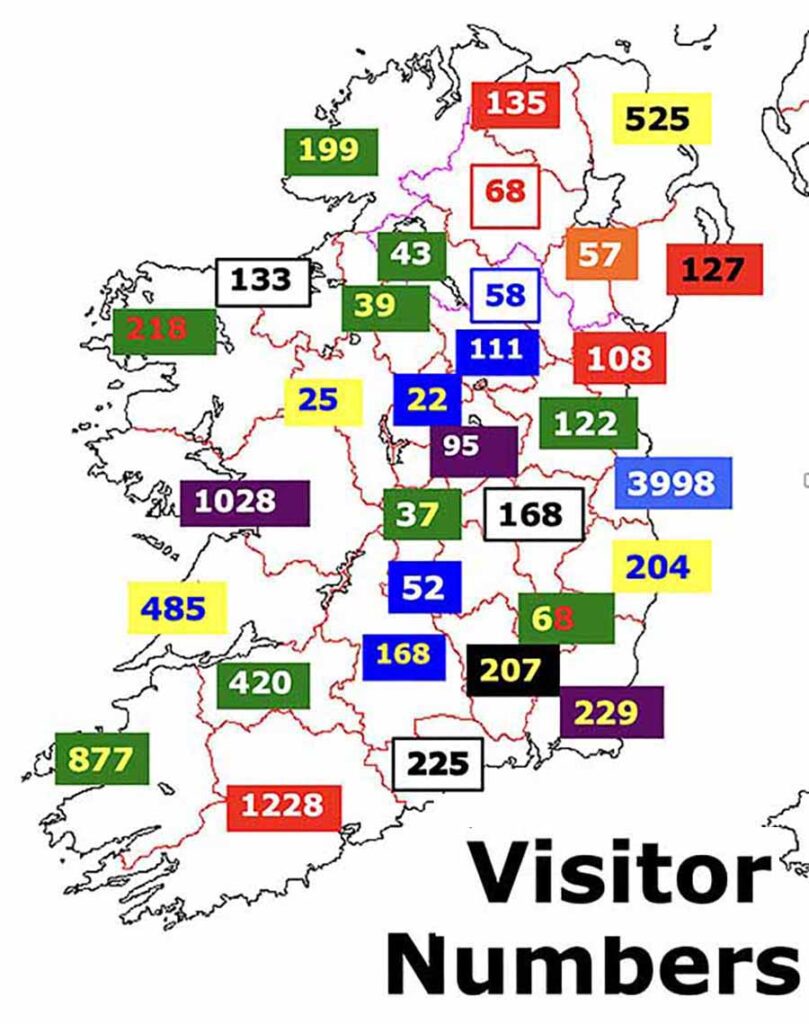
Ireland’s county Fermanagh is a county of lakes and historic charm, with Lough Erne’s waterways offering boating and fishing amidst serene islands. Enniskillen Castle and its museums explore local history, while the Marble Arch Caves, part of a UNESCO Geopark, showcase stunning underground caverns. Other attractions include the historic Florence Court estate and its gardens. Fermanagh is Ireland’s 20th largest county by size (1,876 square km) and fourth smallest by population (63,585). Population peaked at 156,481 in 1841 and reached its lowest point, 49,886 in 1966. In terms of hospitality, Fermanagh is Ireland’s 28th most visited tourist county with around 43,000 international visitors per year.
Introduction – Adventure – Anthem – Archaeology – Attractions – Awards – Birdwatching – Camping – Castles – Churches – Contact list – Cycling – Dining – Equestrian – Festivals – Fishing – Folklore – Gardens – Golf – Graveyards – Happening – Haunted – Highest – Hiking – History – Holy Wells – Hotels – Hotels top 8 – Hunting & shooting – Instagrammable – Itineraries – Largest town – Luxury – MICE – Movies – Music – Name – New – Novelists – Off the beaten track – Poets – Pubs – Quotes – Random Facts – Restaurant Awards – Sacred Places – Saints – Songs – Spas – Sports – Sunsets – Sustainable – Things to do – Towns – Video – Villages – Walking – Wanderlist – Weddings – Wild swimming – Writers – 1837 – 1846 – 1852 – 1909 – 1955 – 1980 –