- Saint Feichin of Fore: January 20, c. 6th–7th century (exact dates unknown), Fore, County Westmeath. Feichin founded a monastery at Fore, a significant early Christian site with surviving ruins, including a church and anchorite cell. Known for his asceticism and miracles, such as healing the sick, he also established communities in Galway and Sligo. He died of plague, and his cult was strong in Westmeath.
- Saint Finnian of Clonard: December 12, c. 470–549, Clonard, County Westmeath (near Meath border). Known as the “Tutor of the Saints of Ireland,” Finnian founded the monastic school at Clonard, which trained the Twelve Apostles of Ireland. His monastery was a major center of learning, influencing Westmeath’s Christian development. He is celebrated for his scholarship and miracles.
- Saint Senach of Clonard: August 21, c. 6th century, died 587, Clonard, County Westmeath (and Clonfad, Westmeath). Senach, a bishop and successor to Saint Finnian at Clonard, was also linked to Clonfad (Cluain-foda-fine) in Westmeath’s Fartullagh barony. He tutored Saint Ailbe and was known for his eloquence and long rule. The Martyrology of Aengus praises him as the “eloquent bishop of vast Clonard.”
- Saint Colman Elo of Muckamore: June 7, c. 555–611, Muckamore, County Westmeath (and Antrim). Born in Westmeath, Colman Elo founded Muckamore monastery, spanning Westmeath and Antrim. A relative of Saint Columba, he studied under Saint Fursey and was known for miracles, such as healing ailments. His monastery was a center of learning, and his feast is noted in Irish calendars.
- Saint Columba (Colum Cille): June 9, c. 521–597, Clonard, County Westmeath (via influence). Columba, a major Irish saint, studied at Clonard under Finnian, linking him to Westmeath. He founded Iona and missionized in Scotland after exile following the Battle of Cúl Dreimhne. His influence reached Westmeath through monastic networks, and he is venerated regionally.
- Saint Patrick: March 17, c. 385–461, Athlone, County Westmeath (via mission). Ireland’s patron saint, Patrick, is linked to Westmeath through his missionary work, possibly visiting Athlone. He converted Ireland to Christianity, using the shamrock to explain the Trinity. His influence is evident in Westmeath’s early Christian parishes like Saint Mary’s, Athlone.
- Saint Brigid of Kildare: February 1, c. 451–525, Mullingar, County Westmeath (via veneration). Brigid, one of Ireland’s three chief saints, founded Kildare’s monastery but is venerated in Westmeath, notably in Mullingar parishes. Known for her generosity and miracles, like multiplying food, her cult spread widely, influencing Westmeath’s churches.
- Saint Maeldubh Beg of Fore: October 2, c. 7th century (exact dates unknown), Fore, County Westmeath. Maeldubh Beg, an obscure saint, is linked to Fore, possibly as a monk under Saint Feichin. His feast is recorded in the Martyrology of Tallaght, reflecting local veneration in Westmeath’s monastic tradition.
- Saint Hugh/Aodh (Áed mac Bricc, also known as Saint Hugh) of Rahugh (Ráith Aodha) in the barony of Moycashel, Co. Westmeath, was a 6th-century Irish bishop and saint, principal patron of Rahugh, Killare (Ceall Air) in nearby Rathconrath barony, and a church at Slieve League (Sliabh Liag) in Co. Donegal’s Glencolumbkille parish. Descended from Fiacha son of Niall Noígíallach via his father Breac (Cormac Breac), he is the sole saint linked to the Cenél Fiachach, though Donegal associations sometimes tied him to Cenél Boghaine and a close bond with Colum Cille, who reportedly directed him to Slieve League and miraculously learned of his death. His main church at Rahugh features prominently in annals from 776 to 1246, including a notable royal assembly in 859, and hosts his origin legend in surviving Lives (preserved in Latin collections like the O’Donohue group, likely compiled in the 12th century under Augustinian influence, given proximity to priories at Durrow and Ballymore). The hagiography depicts his youth in Munster with his mother Eithne, encounters with saints like Cainneach and Breanainn, foundations including one in Munster lands, miracles (such as curing Brighid and aiding the birth of Áed Sláine), and activities across the Midlands and beyond, often tied to property claims or regional tensions. Reputed a healer (invoked against headaches), he died in 589 (per annals), with his principal feast on 10 November, plus others on 28 February, 4 May, and 16 November; traditions lingered at Killare into the 19th century, and his crozier survives in the National Museum.
- Saint Canice of Aghaboe: October 11, c. 515–600, Kilkenny West, County Westmeath (via influence). Canice founded Aghaboe, Laois, but his influence reached Westmeath through monastic networks, possibly Kilkenny West. A missionary in Scotland and friend of Columba, he was known for miracles. His cult was venerated regionally, including in Westmeath.
- Saint Giallán of Killelan: October 2, c. 6th century (exact dates unknown), Killelan, County Westmeath. Giallán is an obscure saint associated with Killelan, possibly a monastic site in Westmeath. His feast is listed in the Martyrology of Tallaght, but little is known beyond his local veneration, typical of early Irish saints.
- Saint Samthann of Clonbroney: December 19, c. 7th century, died 734, Clonbroney, County Longford (near Westmeath). Samthann, a female saint, founded Clonbroney, near Westmeath’s border, influencing the region. She left her husband to become a nun under Saint Fuinech, becoming abbess of Clonbroney. Known for miracles, her Vita describes her spiritual leadership.
Saints
Antrim – Armagh – Carlow – Cavan – Clare – Cork – Derry – Donegal – Down – Dublin – Fermanagh – Galway – Kerry – Kildare – Kilkenny – Laois – Leitrim – Limerick – Longford – Louth – Mayo – Meath – Monaghan – Offaly – Roscommon – Sligo – Tipperary – Tyrone – Waterford – Westmeath – Wexford – Wicklow
Sacred Places
Antrim – Armagh – Carlow – Cavan – Clare – Cork – Derry – Donegal – Down – Dublin – Fermanagh – Galway – Kerry – Kildare – Kilkenny – Laois – Leitrim – Limerick – Longford – Louth – Mayo – Meath – Monaghan – Offaly – Roscommon – Sligo – Tipperary – Tyrone – Waterford – Westmeath – Wexford – Wicklow
Holy Wells
Antrim – Armagh – Carlow – Cavan – Clare – Cork – Derry – Donegal – Down – Dublin – Fermanagh – Galway – Kerry – Kildare – Kilkenny – Laois – Leitrim – Limerick – Longford – Louth – Mayo – Meath – Monaghan – Offaly – Roscommon – Sligo – Tipperary – Tyrone – Waterford – Westmeath – Wexford – Wicklow
County Westmeath:
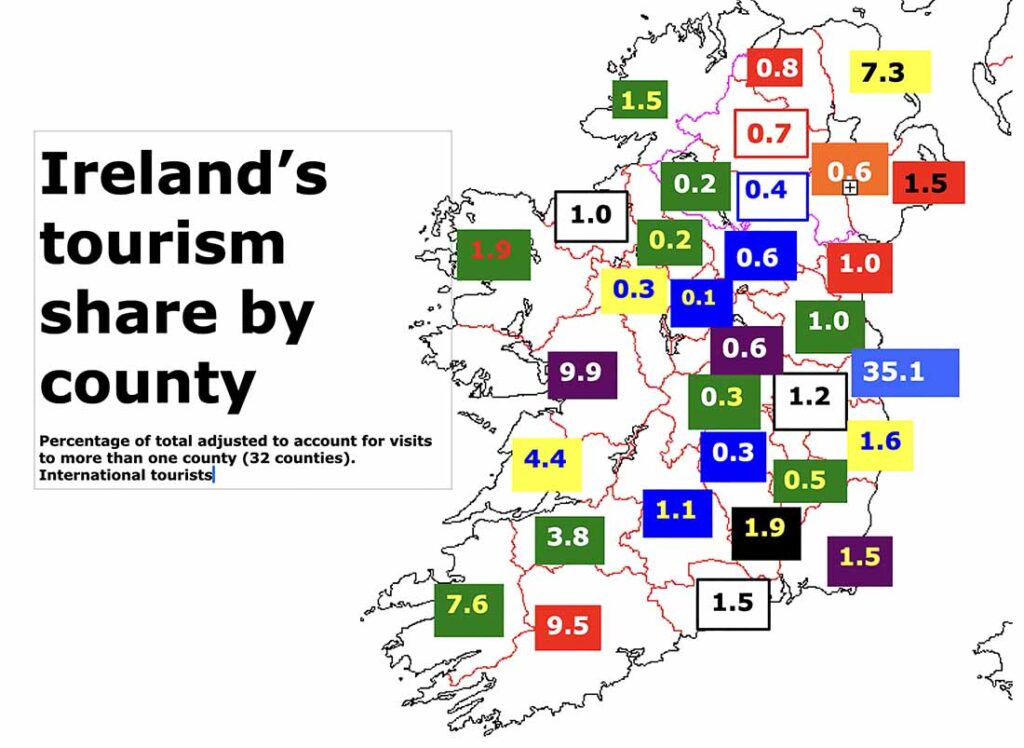
Ireland’s county Westmeath offers a blend of lakes and historic charm, with Athlone Castle providing insights into medieval Ireland along the Shannon River. The Belvedere House and Gardens showcase Georgian elegance, while Lough Ree offers boating and fishing opportunities. Other attractions include the ancient Fore Abbey and its monastic ruins and traditional seven wonders. Westmeath is Ireland’s tenth smallest county by size (1,763 square km) and 11th smallest by population (96,221). Population peaked at 141,300 in 1841 and reached its lowest point, 52,861 in 1961. In terms of hospitality, Westmeath is Ireland’s 22nd most visited tourist county with around 95,000 international visitors per year.
Introduction – Adventure – Anthem – Archaeology – Attractions – Awards – Birdwatching – Camping – Castles – Churches – Contact list – Cycling – Dining – Equestrian – Festivals – Fishing – Folklore – Gardens – Golf – Graveyards – Happening – Haunted – Highest – Hiking – History – Holy Wells – Hotels – Hotels top 8 – Hunting & shooting – Instagrammable – Itineraries – Largest town – Luxury – MICE – Movies – Music – Name – New – Novelists – Off the beaten track – Poets – Pubs – Quotes – Random Facts – Restaurant Awards – Sacred Places – Saints – Songs – Spas – Sports – Sunsets – Sustainable – Things to do – Towns – Video – Villages – Walking – Wanderlist – Weddings – Wild swimming – Writers – 1837 – 1846– 1852 – 1909 – 1955 – 1980 –