- Saint Patrick: March 17, c. 385–461: Downpatrick (Cathedral of the Holy Trinity), SaulIreland’s primary patron saint, Patrick was enslaved in Ireland before returning as a missionary. He founded his first church at Saul in 432 and is traditionally buried in Downpatrick alongside St. Brigid and St. Columba. His Confession describes his evangelization, and he established Armagh’s primacy, influencing Down. Downpatrick’s cathedral and Saul’s church are key pilgrimage sites, with his feast in the Martyrology of Donegal.
- Saint Brigid of Kildare: February 1, c. 451–525: Downpatrick, FaughanOne of Ireland’s three patron saints, Brigid founded Kildare’s convent but is linked to Downpatrick, where tradition claims she is buried with Patrick and Columba. Known for her generosity and miracles, like making a cross from rushes, her cult spread to Down. Her feast is in the Martyrology of Donegal, and Downpatrick’s parishes honor her legacy, reflecting her national significance.
- Saint Columba (Columcille): June 9, c. 521–597: DownpatrickThe third patron saint of Ireland, Columba, born in Donegal, founded Iona’s monastery in Scotland. Tradition links him to Downpatrick through his burial alongside Patrick and Brigid. His copying of a psalter caused the Battle of Cul Dremhe (561). His Life by Adomnán records miracles, and his feast is in the Martyrology of Donegal. Downpatrick’s cathedral venerates him.
- Saint Comgall: May 10, c. 510–602: BangorComgall founded Bangor Abbey around 558, a major center of learning that trained St. Columbanus. Born in Antrim, he studied under St. Fintan and was known for his ascetic rule. The Antiphonary of Bangor reflects his monastery’s influence. Bangor parish churches honor him, and his feast is in the Martyrology of Donegal, marking his role in European monasticism.
- Saint Finnian of Movilla: September 10, c. 495–589: Newtownards (Movilla)One of the “Twelve Apostles of Ireland,” Finnian founded Movilla Abbey near Newtownards, a key educational center. He studied in Wales, bringing manuscripts to Ireland, and trained St. Columba. Known for his scholarship, his feast is in the Martyrology of Donegal. Movilla’s parish and cemetery ruins preserve his legacy, reflecting Down’s monastic prominence.
- Saint Malachy: November 3, 1094–1148: Downpatrick, BangorBorn in Armagh, Malachy became Bishop of Down and Connor, reforming the diocese and residing in Bangor. He introduced Roman liturgy to Ireland and founded Mellifont Abbey. Known for visions, including the “Prophecy of the Popes,” he died at Clairvaux. Canonized in 1190, his feast is in the Martyrology of Donegal. Downpatrick and Bangor parishes honor his reforms.
- Saint Columbanus: November 23, c. 543–615: BangorTrained at Bangor Abbey under St. Comgall, Columbanus left Ireland in 590 to evangelize Europe, founding monasteries at Luxeuil (France) and Bobbio (Italy). Known for his strict rule and theological writings, he is considered Ireland’s first great missionary. His feast is in the Martyrology of Donegal. Bangor parish churches venerate him, reflecting Down’s missionary legacy.
- Saint Donard (Domangard): March 24, c. 5th century: Maghera (Newcastle)Donard, a hermit, lived on Slieve Donard, Down’s highest peak, named after him. A disciple of St. Patrick, he founded a church at Maghera, near Newcastle, and is known for his ascetic life. His feast is in the Martyrology of Oengus, and Maghera’s parish preserves his memory, with the mountain as a pilgrimage site.
- Saint Tassach: April 14, c. 5th century: Raholp (Saul)Tassach, one of St. Patrick’s earliest disciples, was a bishop and craftsman who provided the last rites to Patrick at Saul. He founded a church at Raholp, near Saul, and is known for his metalwork, possibly crafting Patrick’s bell. His feast is in the Martyrology of Donegal, and Raholp parish venerates him, reflecting Down’s early Christian ties to Patrick.
- Saint Mochaoi (Caolan): June 23, c. 5th century: Nendrum (Mahee Island)Mochaoi, a swineherd converted by St. Patrick, founded Nendrum monastery on Mahee Island in Strangford Lough. One of Ireland’s earliest monasteries, it was a center of learning. His feast is in the Martyrology of Oengus, and Nendrum’s ruins, with a round tower, are a key archaeological site in Down’s Comber parish.
- Saint Loarn: August 30, c. 6th century: BrightLoarn, an obscure saint, founded a church at Bright, near Downpatrick. A disciple of St. Patrick, he is venerated for his missionary work in east Down. His feast is in the Martyrology of Donegal, and Bright parish preserves his memory, with his church site reflecting Down’s dense network of local saints.
- Saint Dairbile (Derbhile): October 26, c. 6th century: Errigal (Mayo, but linked to Down’s monastic network)Dairbile, a female saint, is primarily associated with Errigal, Mayo, but her influence reached Down through monastic ties to Bangor. Known for her piety, her feast is in the Martyrology of Oengus. Her veneration in Down, possibly in Bangor parish, reflects the county’s role in female monasticism.
Saints
Antrim – Armagh – Carlow – Cavan – Clare – Cork – Derry – Donegal – Down – Dublin – Fermanagh – Galway – Kerry – Kildare – Kilkenny – Laois – Leitrim – Limerick – Longford – Louth – Mayo – Meath – Monaghan – Offaly – Roscommon – Sligo – Tipperary – Tyrone – Waterford – Westmeath – Wexford – Wicklow
Sacred Places
Antrim – Armagh – Carlow – Cavan – Clare – Cork – Derry – Donegal – Down – Dublin – Fermanagh – Galway – Kerry – Kildare – Kilkenny – Laois – Leitrim – Limerick – Longford – Louth – Mayo – Meath – Monaghan – Offaly – Roscommon – Sligo – Tipperary – Tyrone – Waterford – Westmeath – Wexford – Wicklow
Holy Wells
Antrim – Armagh – Carlow – Cavan – Clare – Cork – Derry – Donegal – Down – Dublin – Fermanagh – Galway – Kerry – Kildare – Kilkenny – Laois – Leitrim – Limerick – Longford – Louth – Mayo – Meath – Monaghan – Offaly – Roscommon – Sligo – Tipperary – Tyrone – Waterford – Westmeath – Wexford – Wicklow
County Down:
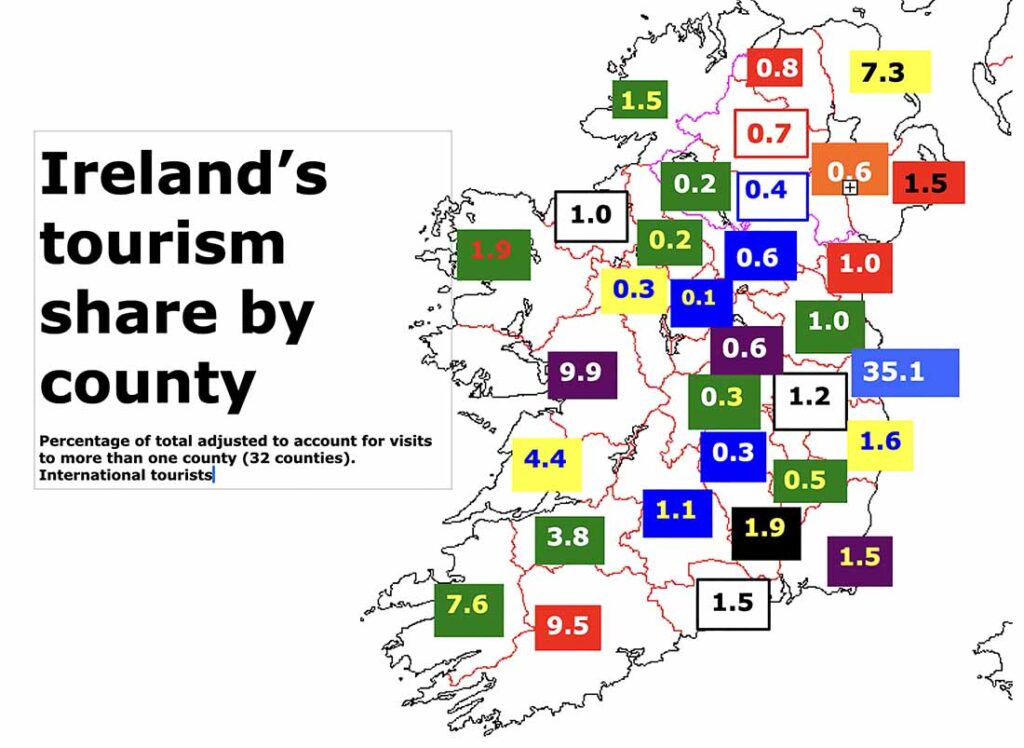
Ireland’s county Down offers a mix of historic sites and scenic landscapes, with Downpatrick’s Saint Patrick Centre and cathedral providing insights into Ireland’s patron saint. The Mourne Mountains offer hiking trails with sweeping views, while Strangford Lough provides kayaking and wildlife spotting. Other attractions include the historic Tollymore Forest Park. Down is Ireland’s 12th largest county by size (2,447 square km) and fourth largest by population (553,261). Population peaked at 361,446 in 1841 and reached its lowest point, 204,303, in 1911. In terms of hospitality, Down is Ireland’s 18th most visited tourist county with around 127,000 international visitors per year.
Introduction – Adventure – Anthem – Archaeology – Attractions – Awards – Birdwatching – Camping – Castles – Churches – Contact list – Cycling – Dining – Equestrian – Festivals – Fishing – Folklore – Gardens – Golf – Graveyards – Happening – Haunted – Highest – Hiking – History – Holy Wells – Hotels – Hotels top 8 – Hunting & shooting – Instagrammable – Itineraries – Largest town – Luxury – MICE – Movies – Music – New – Name – Novelists – Off the beaten track – Poets – Pubs – Quotes – Random Facts – Restaurant Awards – Sacred Places – Saints – Songs – Spas – Sports – Sunsets – Sustainable – Things to do – Towns – Video – Villages – Walking – Wanderlist – Weddings – Wild swimming – Writers – 1837 – 1846 – 1852 – 1909 – 1955 – 1980 –