Pre-1000 The Gaelic Nation
County Clare’s history before 1000 CE is rooted in its role within the Gaelic kingdom of Thomond (Tuamhain), part of the Dál gCais dynasty. Archaeological sites, such as the ringforts at Mooghaun and Cahercommaun, and the wedge tomb at Poulnabrone (c. 3800 BCE), indicate Bronze and Iron Age settlement. The Dál gCais, emerging in the 5th century, established dominance, with figures like Lachtna (d. c. 600) laying the foundations for later leaders like Brian Boru. Christianity arrived early, with monasteries founded at Inis Cathaigh (Scattery Island) by Saint Senan (d. c. 560) and at Kilfenora. The Annals of Ulster (mention Clare’s monastic activities, but secular records are scarce. Viking raids targeted coastal Clare, particularly Inis Cathaigh, due to its strategic position on the Shannon Estuary. Ecclesiastical sources dominate, potentially exaggerating Christian influence while marginalising pre-Christian Gaelic culture.
1000–1100: Dál gCais Ascendancy and Brian Boru
The 11th century was a pivotal period for Clare, marked by the rise of the Dál gCais under Brian Boru (d. 1014), born near Killaloe. Brian’s defeat of the Vikings at Clontarf (1014) elevated Thomond’s status, with Clare as its heartland. The Annals of Inisfallen (detail Brian’s campaigns, portraying him as a unifying figure, though his portrayal tend to be idealised. Killaloe emerged as a religious and political centre, with its cathedral founded in this period. Viking influence waned, but Clare’s coastal location kept it exposed to raids. The O’Brien dynasty, Brian’s descendants, consolidated power in Thomond. The lack of secular records limits insights into local life, and ecclesiastical sources, such as Cogitosus’s writings, focus on monastic achievements, requiring cautious interpretation.
1100–1200: Norman Incursions and Gaelic Resistance
The Norman invasion (1169–1171) had limited direct impact on Clare due to its western location. Thomond remained under O’Brien control, with leaders like Domnall Mór O’Brien (d. 1194) resisting Norman expansion. The Annals of the Four Masters (record O’Brien victories, such as the Battle of Thurles (1174), which kept Clare largely free of Norman settlement. The establishment of Cistercian monasteries, like Corcomroe Abbey (c. 1190), introduced European influences, complementing older foundations like Inis Cathaigh. Norman sources, such as the “Song of Dermot and the Earl”, focus on eastern conquests, offering little on Clare. Gaelic sources provide a more local perspective but are sparse.
1200–1300: O’Brien Dominance and Ecclesiastical Growth
In the 13th century, Clare remained a Gaelic stronghold under the O’Briens, with Thomond resisting Anglo-Norman encroachment. The county’s boundaries were formalised, encompassing the Burren and Shannon Estuary. Ennis emerged as a religious centre with the founding of Ennis Friary (c. 1240) by Donnchadh O’Brien. The O’Briens built stone castles, such as Bunratty (c. 1270), to assert control. The Burren’s unique landscape supported small-scale farming, while coastal trade grew. Norman records marginalise Gaelic achievements, and ecclesiastical sources overemphasise monastic contributions, requiring critical reading to uncover secular dynamics.
1300–1400: Gaelic Resilience and O’Brien Power
The 14th century saw Clare maintain Gaelic autonomy under the O’Briens, with figures like Turlough O’Brien (d. 1306) strengthening Thomond. The Black Death (1348–1350) had a lesser impact in rural Clare, and the Statute of Kilkenny (1366) was largely irrelevant due to limited Norman presence. The O’Briens resisted English authority, with Bunratty Castle serving as a defensive hub. The period saw cultural continuity, with Gaelic law and language prevailing. English sources of the time portray Gaelic lords as fractious, necessitating careful interpretation.
1400–1500: O’Brien Autonomy and Gaelic Culture
The 15th century saw Clare under strong O’Brien leadership, with figures like Conor O’Brien (d. 1444) maintaining Thomond’s independence. The Wars of the Roses (1460–1485) distracted English authorities, allowing Gaelic lords greater autonomy. Ennis and Killaloe remained ecclesiastical centres, with the O’Briens patronising churches and bards. The Book of the O’Briens, a lost genealogical text, originated in this period, reflecting cultural pride. Clare’s isolation preserved its Gaelic character, but the lack of secular records limits insights into daily life, and ecclesiastical sources dominate, focusing on church activities.
1500–1600: Tudor Reconquest and O’Brien Submission
The 16th century brought Tudor efforts to control Clare. The O’Briens, under Murrough O’Brien (d. 1551), submitted to Henry VIII’s surrender and regrant policy, accepting the title of Earl of Thomond in 1543. This secured their lands but aligned Clare with English rule. The Reformation had limited impact, as Clare remained Catholic. The Nine Years’ War (1594–1603) saw minor O’Brien involvement, with Clare largely unaffected. Early plantation efforts began, with English settlers arriving in Bunratty. English records portray the O’Briens as loyalists, potentially downplaying local tensions.
1600–1700: Plantations and Confederate Wars
The 17th century saw significant upheaval in Clare. The Ulster Plantation (1609) had indirect effects, but local confiscations targeted O’Brien and other Catholic lands, particularly after the 1641 Rebellion. Clare was a Confederate stronghold, with Ennis and Bunratty Castle as key bases. The Cromwellian conquest (1649–1653) led to extensive land redistributions, with figures like Henry Ireton overseeing settlements in Clare. The transplantation of Catholics to Clare under Cromwell’s “to Hell or to Connacht” policy increased the county’s Catholic population. The Williamite War (1689–1691) saw Bunratty besieged, reinforcing Colonial/protestan control. The Annals of the Four Masters document Confederate losses. English sources vilify Catholic rebels, requiring critical interpretation.
1700–1800: Protestant Ascendancy and Economic Stagnation
The 18th century saw Clare under the Colonial/Protestant Ascendancy, with Anglo-Irish landlords, including the O’Briens, dominating land ownership. The Penal Laws marginalized Catholics, who formed the majority, fostering resentment. Clare’s economy remained agricultural, with Ennis as a market town. The Burren’s rocky terrain limited large-scale farming, and coastal trade was minimal. The 1798 Rebellion had little impact in Clare, though local discontent simmered. The Act of Union (1800) strengthened English control. English and colonial narratives tend to downplay native Irish or Catholic grievances.
1800–1900: Famine and Nationalist Awakening
The 19th century was marked by hardship in Clare. The Great Famine (1845–1849) devastated the county, reducing its population from 286,000 in 1841 to 212,000 in 1851 due to starvation, disease, and emigration. Clare’s reliance on smallholdings exacerbated the crisis. The railway (1859) and Ennis’s growth as a market town supported recovery. The Gaelic Revival saw the Gaelic League promote Irish language and culture, with Clare’s bards and musicians gaining prominence. The GAA, founded in 1884, established strong clubs, with Clare winning hurling titles. The Land League and Home Rule movement, led locally by figures like William O’Shea, gained traction. English famine records tend to understate suffering.
1900–2025: Independence, Cultural Revival, and Tourism
The 20th and 21st centuries saw Clare navigate Ireland’s independence and modernisation. The War of Independence (1919–1921) saw significant IRA activity in Clare, with figures like Michael Brennan leading ambushes. The Civil War (1922–1923) divided the county, with fighting around Ennis. Clare’s GAA tradition flourished, with All-Ireland hurling titles in 1914, 1995, 1997, and 2013. The county remained rural, with agriculture and fishing dominating, though tourism grew around the Cliffs of Moher, the Burren, and Bunratty Castle. The Shannon Free Zone (1959) boosted industry and made Clare a poster-child for economic progress outside the major cities. Clare is one of 24 Irish counties that still has a smaller population than it did in 1841.
History
Antrim – Armagh – Carlow – Cavan – Clare – Cork – Derry – Donegal – Down – Dublin – Fermanagh – Galway – Kerry – Kildare – Kilkenny – Laois – Leitrim – Limerick – Longford – Louth – Mayo – Meath – Monaghan – Offaly – Roscommon – Sligo – Tipperary – Tyrone – Waterford – Westmeath – Wexford – Wicklow
County Clare:
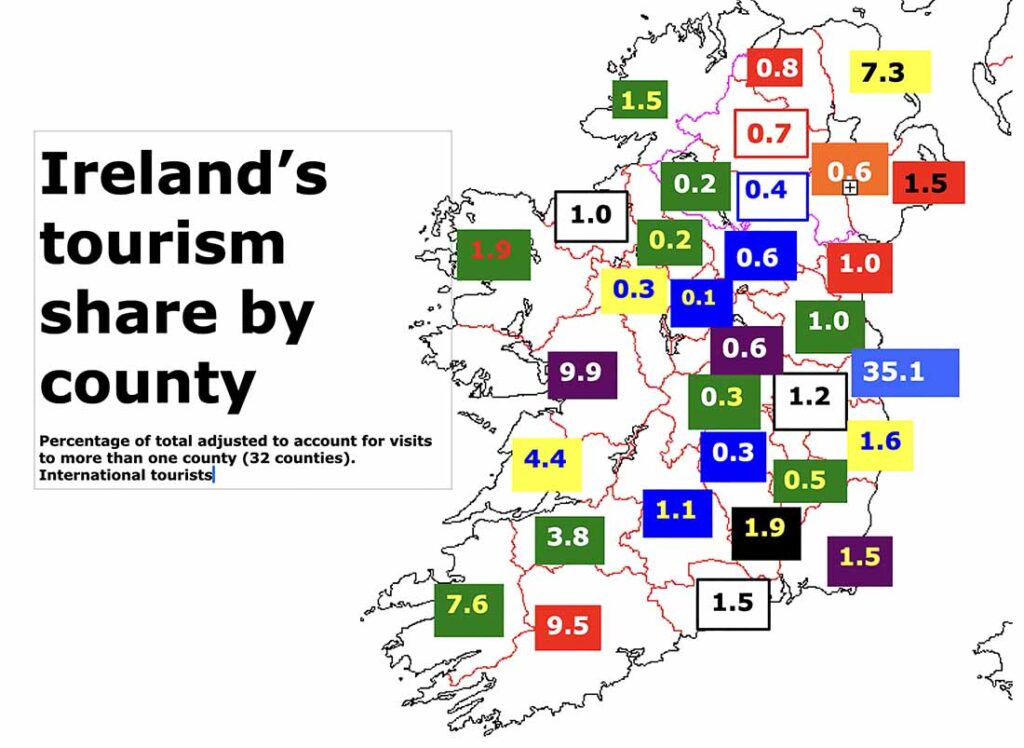
Ireland’s county Clare is renowned for its dramatic cliffs and traditional heritage, with the Cliffs of Moher offering breathtaking views over the Atlantic. The Burren’s unique limestone landscape provides hiking and rare flora, while Bunratty Castle offers medieval history with its restored interiors. Check out the traditional music scene in Doolin and the county’s coastal beaches. Clare is Ireland’s eighth largest county by size (3,188 square km) and 19th largest by population (127,938). Population peaked at 286,394 in 1841 and reached its lowest point, 73,597 in 1966. In terms of hospitality, Clare is Ireland’s sixth most visited tourist county with around 485,000 international visitors per year.
Introduction – Adventure – Anthem – Archaeology – Attractions – Awards – Birdwatching – Camping – Castles – Churches – Contact list – Cycling – Dining – Equestrian – Festivals – Fishing – Folklore – Gardens – Golf – Graveyards – Happening – Haunted – Highest – Hiking – History – Holy Wells – Hotels – Hotels top 8 – Hunting & shooting – Instagrammable – Itineraries – Largest town – Luxury – MICE – Movies – Music – New – Name – Novelists – Off the beaten track – Poets – Pubs – Quotes – Random Facts – Restaurant Awards – Sacred Places – Saints –Songs – Spas – Sports – Sunsets – Sustainable – Things to do – Towns – Video – Villages – Walking – Wanderlist – Weddings – Wild swimming – Writers – 1837– 1846 – 1852 – 1909 – 1955 – 1980 –