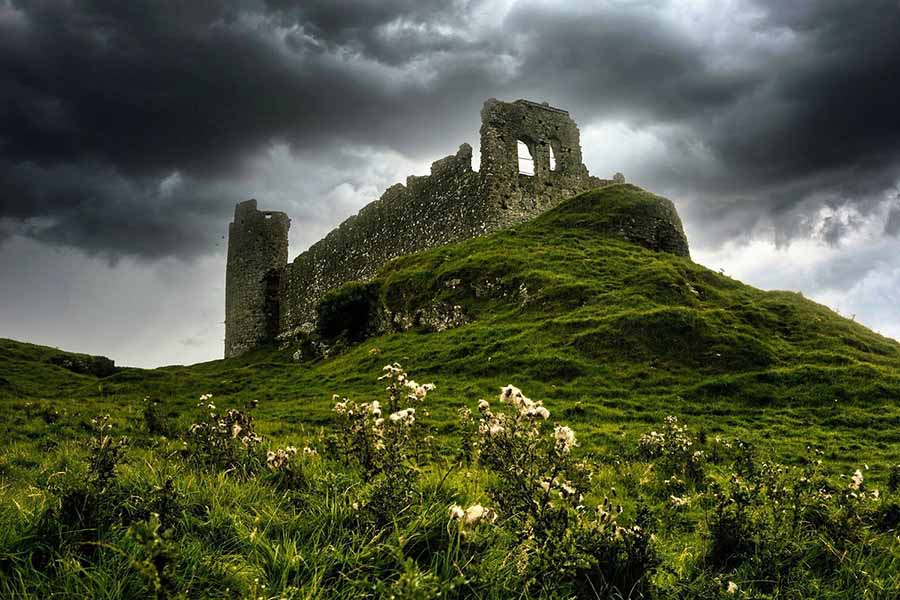
The highest point in County Louth is Slieve Foye (also spelled Slieve Foy or Sliabh Feá), standing at 589 meters (1,932 feet). Slieve Foye is located in the Cooley Mountains, near the town of Carlingford in northeast County Louth. It lies within the Cooley Peninsula, part of Ireland’s Ancient East, known for its dramatic hills, coastal views, and rich medieval heritage.
- Elevation: At 589 meters, Slieve Foye is the highest peak in County Louth and dominates the Cooley Peninsula, offering stunning views over Carlingford Lough and the Mourne Mountains.
- Terrain: The mountain features a mix of grassy paths, rocky slopes, and heather-covered moorland. The summit is a broad ridge with a cairn, providing expansive vistas but requiring care due to steep drops and exposure in some areas.
Starting Point and Access:
- Driving Route: The most common trailhead is at Carlingford, specifically from the Carlingford Adventure Centre or the Tain Way car park near the village of Omeath, accessible via the R173 from Dundalk (20 minutes, 15 km) or the R176 from Carlingford (5 minutes, ~3 km). From Drogheda, the drive takes about 30 minutes (25 km), and from Dublin, it’s about 1 hour (~80 km). Parking is available at the Tain Way trailhead or near forest tracks in Carlingford.
- Alternative Access: Another approach starts from Omeath village, following the Táin Way, a 40-km waymarked trail that loops around the Cooley Peninsula and includes Slieve Foye. A less common route is from Ravensdale Forest, offering a longer ascent through woodland.
- Public Transport: Carlingford is served by buses from Dundalk or Drogheda (e.g., Bus Éireann 161 or Local Link 917), but reaching the trailhead may require a short walk or taxi. Guided hikes, such as those offered by Cooley Peninsula Walking Tours or Ireland Walk Hike Bike, include transport from Dundalk or Drogheda.
Carlingford/Táin Way Route:
- Distance: Approximately 7–9 km round trip.
- Duration: 3–5 hours, depending on pace and conditions.
- Description: This is the most popular route, starting at the Táin Way car park or near Carlingford. The trail follows the waymarked Táin Way, ascending through grassy fields and forest tracks before reaching open moorland. The path climbs steadily to the summit ridge, marked by a cairn. The route offers clear views of Carlingford Lough and is well-trodden but involves steep sections. The descent retraces the path or follows a loop via the Táin Way for variety.
- Difficulty: Moderate, suitable for hikers with moderate fitness. The path is mostly clear, but steep slopes and rocky sections require good footwear and caution.
Omeath Route:
- Distance: 8–10 km round trip.
- Duration: 4–6 hours.
- Description: Starting from Omeath, this route follows the Táin Way or local paths, ascending Slieve Foye’s northern slopes. It offers scenic views of Carlingford Lough and the Mourne Mountains but is steeper and less frequented than the Carlingford route.
- Difficulty: Moderate to strenuous, best for hikers comfortable with steeper inclines and navigation.
Ravensdale Forest Route:
- Distance: 10–12 km round trip.
- Duration: 4–6 hours.
- Description: This route starts at Ravensdale Forest, north of Dundalk, and ascends through woodland before joining the open slopes of Slieve Foye. It’s a longer, quieter approach with more varied terrain, including forest tracks and boggy patches.
- Difficulty: Moderately strenuous, requiring navigation skills due to less defined paths.
Navigation Tips:
- Use an Ordnance Survey map (Discovery Series Sheet 36) or apps like HiiKER, AllTrails, or PeakVisor for navigation, as fog can reduce visibility on the summit ridge.
- The Táin Way is waymarked, but a compass or GPS device is useful for alternative routes or in poor weather.
- Wear waterproof hiking boots with good grip, as the terrain includes boggy patches and rocky slopes. Trekking poles help with stability on steeper sections.
Scenery and Views:
- Summit Views: On clear days, Slieve Foye offers spectacular 360-degree views of Carlingford Lough, the Mourne Mountains (including Slieve Donard), the Irish Sea, and the Cooley Peninsula. On exceptional days, the Isle of Man and even parts of Wales are visible. The contrast between the lush peninsula and rugged mountains is striking.
- Landscape: The lower slopes feature grassy fields and some woodland, transitioning to heather-covered moorland and rocky outcrops. The summit ridge is broad but exposed, with a cairn marking the highest point.
- Unique Features: Slieve Foye is steeped in mythology, linked to the Táin Bó Cúailnge (Cattle Raid of Cooley), an epic Irish saga featuring Cúchulainn. The Cooley Peninsula’s medieval heritage, including Carlingford’s castles, adds historical depth.
Hiking Experience:
- Duration: The Carlingford/Táin Way route takes 3–5 hours, Omeath 4–6 hours, and Ravensdale 4–6 hours, including summit time.
- Conditions: The trails are generally well-maintained, especially on the Táin Way, but boggy patches and steep slopes can be slippery after rain. The summit is exposed to wind and mist. Spring and summer (April–September) offer the best conditions, with vibrant greenery and longer daylight. Autumn (September–October) provides colorful heather, while winter hikes are wetter and colder but feasible.
- Cultural Significance: Slieve Foye is central to the Cooley Peninsula’s identity, with ties to Irish mythology and the Táin Way trail. Carlingford’s medieval heritage, including King John’s Castle and the Holy Trinity Heritage Centre, enhances the cultural experience.
- Weather: The summit is exposed, with frequent mist and strong winds. Check forecasts (e.g., Met Éireann) and avoid hiking in severe conditions.
- Terrain: Steep slopes and boggy sections require careful footing. The Táin Way is well-marked, but alternative routes may need navigation skills.
- Safety: Inform someone of your plans, as there are no rangers. Bring water, snacks, and layered clothing. The hike is suitable for solo hikers, but beginners may prefer guided tours for navigation and safety.
- Wildlife: Expect to see birds like kestrels, skylarks, or buzzards, and possibly hares or foxes. The moorland supports heather, gorse, and wildflowers.
Highest point in county
Antrim – Armagh – Carlow – Cavan – Clare – Cork – Derry – Donegal – Down – Dublin – Fermanagh – Galway] – Kerry – Kildare – Kilkenny – Laois – Leitrim – Limerick – Longford – Louth – Mayo – Meath – Monaghan – Offaly – Roscommon – Sligo – Tipperary – Tyrone – Waterford – Westmeath – Wexford – Wicklow
County Louth:
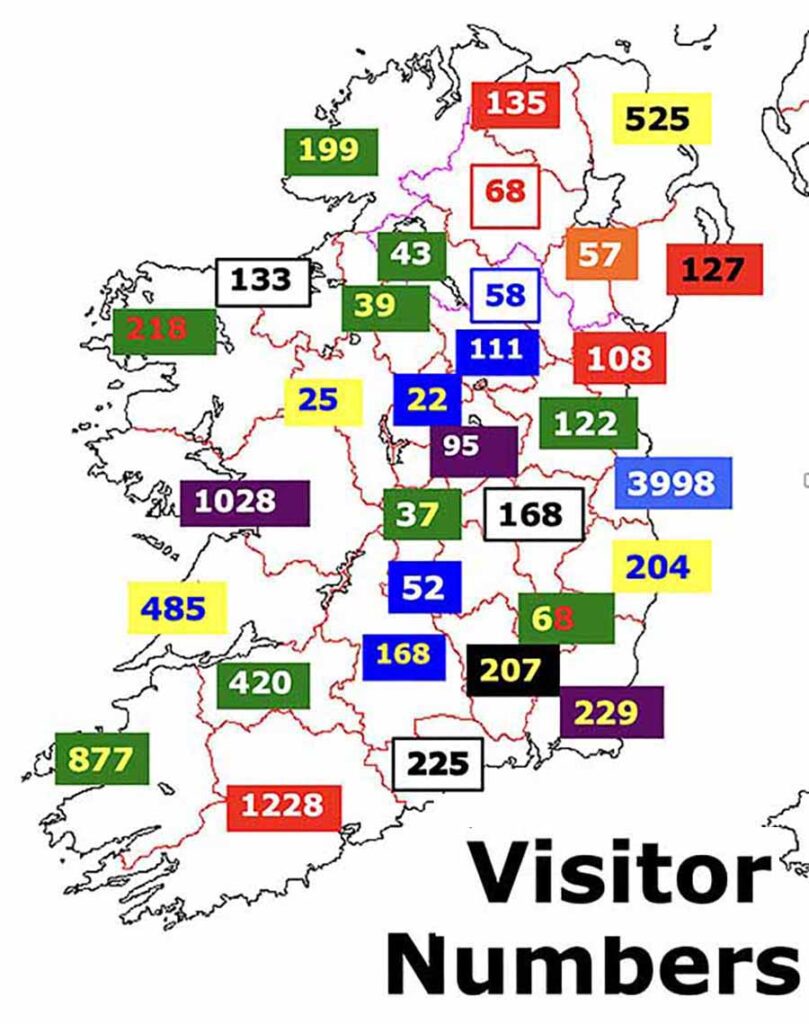
Ireland’s county Louth is a county of historic depth and coastal beauty, with Drogheda’s St Peter’s Church housing a historic shrine and the Boyne Valley offering ancient sites like Newgrange, a UNESCO-listed passage tomb just over the border in county Meath. Carlingford’s medieval streets and castle provide scenic walks, while Dundalk’s coastal paths add natural allure. Other attractions include the Cooley Peninsula’s hiking trails. Louth is Ireland’s smallest county by size (821 sq km) and 17th largest by population (139,703). Population peaked at 128,240 in 1841 and reached its lowest point, 63,665 in 1926. In terms of hospitality, Louth is Ireland’s 21st most visited tourist county with around 108,000 international visitors per year.
Introduction – Adventure – Anthem – Archaeology – Attractions – Awards – Birdwatching – Camping – Castles – Churches – Contact list – Cycling – Dining – Equestrian – Festivals – Fishing – Folklore – Gardens – Golf – Graveyards – Happening – Haunted – Highest – Hiking – History – Holy Wells – Hotels – Hotels top 8 – Hunting & shooting – Instagrammable – Itineraries – Largest town – Luxury – MICE – Movies – Music – Name – New – Novelists – Off the beaten track – Poets – Pubs – Quotes – Random Facts – Restaurant Awards – Sacred Places – Saints – Songs – Spas – Sports – Sunsets – Sustainable – Things to do – Towns – Video – Villages – Walking – Wanderlist – Weddings – Wild swimming – Writers – 1837 – 1846 – 1852 – 1909 – 1955 – 1980 –