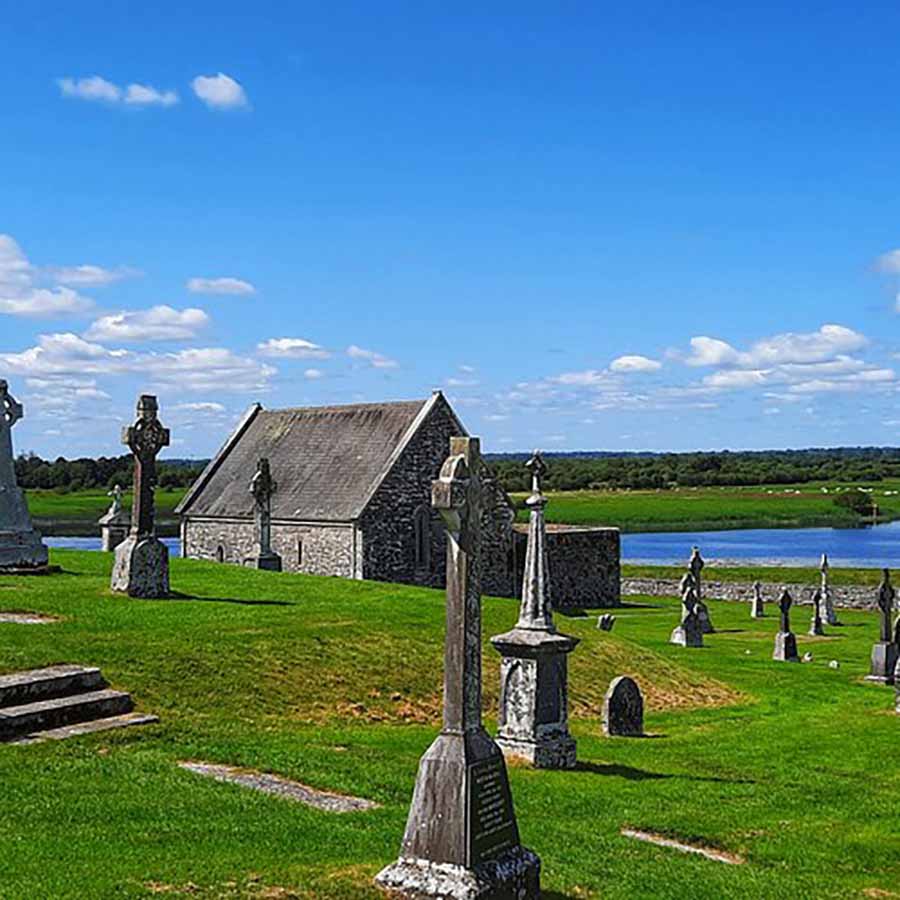
- Saint Ciarán of Clonmacnoise: September 9, c. 512–546: Clonmacnoise, County Offaly Known as Ciarán the Younger, he founded the monastery at Clonmacnoise, a major center of learning and spirituality along the Shannon River. Born in Connacht, he studied under St. Enda on the Aran Islands and St. Finnian at Clonard. Ciarán is one of the Twelve Apostles of Ireland and is credited with miracles, including healing the sick. His monastery became a hub for scholars and missionaries, thriving until the Norman period. He died young, possibly of plague.
- Saint Brendan of Birr: November 29, c. 500–573: Birr, County Offaly One of the Twelve Apostles of Ireland, Brendan founded a monastery at Birr, where Birr Castle now stands. Known as “Brendan the Elder” to distinguish him from Brendan the Navigator, he was a contemporary of St. Columba and advised him at the Synod of Meltown. His monastery was a spiritual center, and the area is linked to a science center today due to the later construction of a historic telescope at Birr.
- Saint Colmán of Lann: September 26, c. 6th century (exact dates unknown): Lynally (Lann Elo), County Offaly Colmán Elo (or Colmán of Lann) founded the monastery at Lynally, near Tullamore. A disciple of St. Columba, he was known for his eloquence and ascetic life. His monastery was a significant religious site, and he is also associated with miracles, including healing and divine visions. His relics were venerated locally.
- Saint Mochonnoe of Killoughy: April 13, c. 6th century (exact dates unknown): Killoughy, County Offaly Mochonnoe (or Mochonna) is linked to the church at Killoughy, where he is venerated as a local saint. Little is known about his life, but he is considered an early monastic figure in Offaly, possibly a disciple of St. Ciarán. His feast is recorded in Irish martyrologies, reflecting local devotion.
- Saint Fintan of Clonenagh: February 17, c. 526–603: Clonenagh, County Laois (near Offaly border) While primarily associated with Clonenagh in Laois, Fintan’s influence extended to Offaly due to proximity and his role as a teacher of St. Comgall. He founded a monastery known for strict asceticism, attracting many disciples. His life included miracles like multiplying food for the poor. His cult was strong in the region, including parts of Offaly.
- Saint Canice (Cainnech) of Aghaboe: October 11, c. 515–600: Aghaboe, County Laois (near Offaly) Canice founded a monastery at Aghaboe, close to Offaly, and is linked to Kilkenny, which derives its name from him (Cill Chainnigh). He was a missionary in Scotland and Ireland, known for miracles and his friendship with St. Columba. His influence likely reached Offaly due to regional monastic networks.
- Saint Molua of Clonfertmulloe: August 4, c. 6th century (exact dates unknown): Clonfertmulloe (Kyle), County Offaly Molua (or Lughaidh) founded a monastery at Clonfertmulloe, near Birr. He was known for his piety and miracles, including calming storms. His monastery was a local spiritual center, and his feast is noted in Irish calendars. He is sometimes confused with other saints of similar names.
- Saint Cronan of Roscrea: April 28, c. 6th century (exact dates unknown): Roscrea, County Tipperary (near Offaly) Cronan founded a monastery at Roscrea, close to Offaly, which became a significant religious site. He was known for his humility and miracles, including healing the sick. His influence extended into Offaly due to the monastery’s regional importance.
- Saint Carthage (Mochuda): May 14, c. 555–637: Rahan, County Offaly Carthage founded a monastery at Rahan before being expelled and moving to Lismore. A disciple of St. Comgall, he was known for his strict monastic rule and miracles, such as curing ailments. His time at Rahan made it a key early Christian site in Offaly.
- Saint Fiacre: August 18 (or September 1 in some traditions), c. 7th century (exact dates unknown): Possible early connections to Offaly monasteries Fiacre is primarily known as a hermit in France, but Irish traditions link him to Offaly, possibly as a monk trained in one of its monasteries like Clonmacnoise. He is the patron saint of gardeners and is venerated for his healing abilities, especially for ailments like hemorrhoids. His connection to Offaly is less direct but noted in some hagiographies.
- Saint Ailill of Cloonown: July 1, c. 6th century (exact dates unknown): Cloonown, County Offaly Ailill is an obscure saint listed in Irish martyrologies, associated with Cloonown near Athlone, which borders Offaly. Little is known beyond his monastic foundation and local veneration. His feast day reflects his recognition in the region.
- Saint Cuimmein of Nendrum: July 1, c. 6th century (exact dates unknown): Possible training at Clonmacnoise, County Offaly Cuimmein is primarily linked to Nendrum in County Down but may have studied at Clonmacnoise, connecting him to Offaly. He was a monk known for his learning and piety. His inclusion here is tentative, as his Offaly link is through monastic networks rather than a direct foundation.
Saints
Antrim – Armagh – Carlow – Cavan – Clare – Cork – Derry – Donegal – Down – Dublin – Fermanagh – Galway – Kerry – Kildare – Kilkenny – Laois – Leitrim – Limerick – Longford – Louth – Mayo – Meath – Monaghan – Offaly – Roscommon – Sligo – Tipperary – Tyrone – Waterford – Westmeath – Wexford – Wicklow
Sacred Places
Antrim – Armagh – Carlow – Cavan – Clare – Cork – Derry – Donegal – Down – Dublin – Fermanagh – Galway – Kerry – Kildare – Kilkenny – Laois – Leitrim – Limerick – Longford – Louth – Mayo – Meath – Monaghan – Offaly – Roscommon – Sligo – Tipperary – Tyrone – Waterford – Westmeath – Wexford – Wicklow
Holy Wells
Antrim – Armagh – Carlow – Cavan – Clare – Cork – Derry – Donegal – Down – Dublin – Fermanagh – Galway – Kerry – Kildare – Kilkenny – Laois – Leitrim – Limerick – Longford – Louth – Mayo – Meath – Monaghan – Offaly – Roscommon – Sligo – Tipperary – Tyrone – Waterford – Westmeath – Wexford – Wicklow
County Offaly:
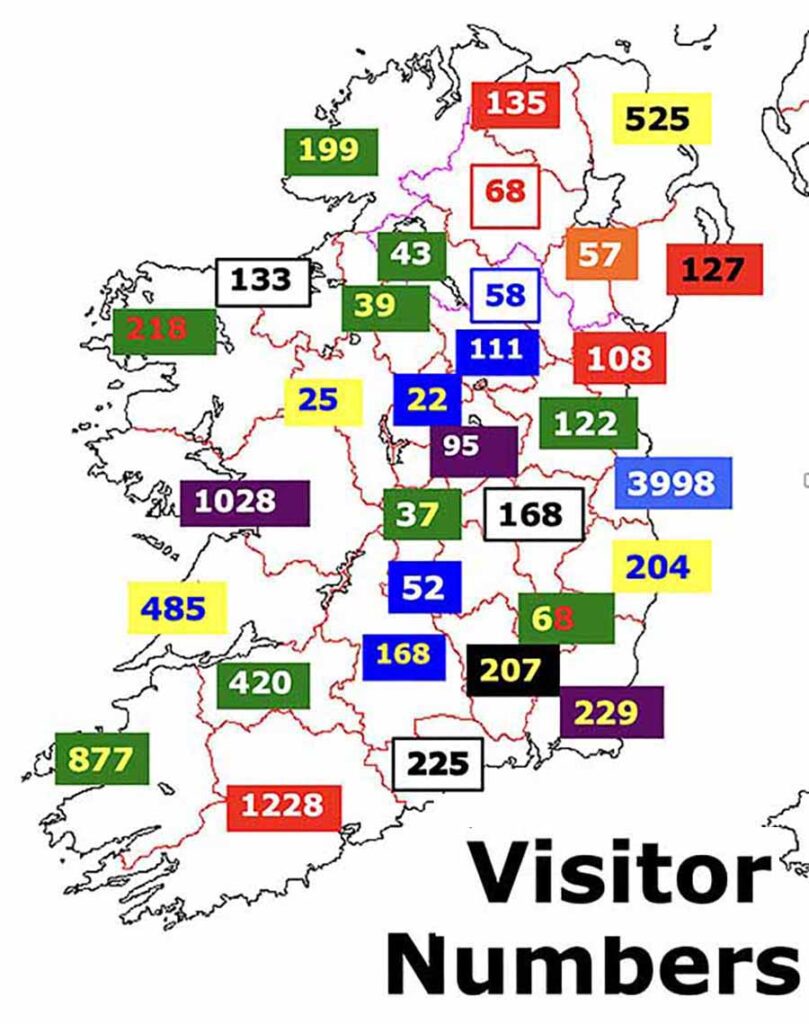
Ireland’s county Offaly is a county of historic depth and natural beauty, with the Clonmacnoise monastic site featuring ancient high crosses and a riverside setting along the Shannon. Tullamore’s historic distillery provides insights into Irish whiskey production, while the Bog of Allen Nature Centre explores the county’s unique peatlands. Other attractions include the Slieve Bloom Mountains’ hiking trails. Offaly is Ireland’s 18th largest county by size (1,998 square km) and ninth smallest by population (83,150). Population peaked at 146,857 in 1841 and reached its lowest point, 51,533 in 1961. In terms of hospitality, Offaly is Ireland’s 30th most visited (and third least visited) tourist county with around 37,000 international visitors per year.
Introduction – Adventure – Anthem – Archaeology – Attractions – Awards – Birdwatching – Camping – Castles – Churches – Contact list – Cycling – Dining – Equestrian – Festivals – Fishing – Folklore – Gardens – Golf – Graveyards – Happening – Haunted – Highest – Hiking – History – Holy Wells – Hotels – Hotels top 8 – Hunting & shooting – Instagrammable – Itineraries – Largest town – Luxury – MICE – Movies – Music – Name – New – Novelists – Off the beaten track – Poets – Pubs – Quotes – Random Facts – Restaurant Awards – Sacred Places – Saints – Songs – Spas – Sports – Sunsets – Sustainable – Things to do – Towns – Video – Villages – Walking – Wanderlist – Weddings – Wild swimming – Writers – 1837 – 1846 – 1852 – 1909 – 1955 – 1980 –