- Castle Ward: Located near Strangford Lough, Castle Ward is an 18th-century mansion built in 1760s for Bernard Ward, 1st Viscount Bangor, and his wife, Lady Ann. It’s unique for its dual architectural styles: classical on one side (Bernard’s preference) and Gothic on the other (Ann’s preference). Set within an 820-acre estate, it’s a National Trust property and a Game of Thrones filming location (Winterfell). The castle has historical ties to the Ward family and the Georgian era. Open year-round (house tours: February–May, Monday/Thursday/Friday, 11 AM–3 PM hourly; Saturday–Sunday, self-guided 11 AM–4 PM; check nationaltrust.org.uk for summer hours), visitors can explore the mansion’s contrasting interiors, including the Victorian dining room and Gothic saloon, for £10 adults, £5 children, free for National Trust members. The estate offers 30 km of trails, including the Castle Trail to Audley’s Castle (a 15th-century tower house used as Robb’s Camp in Game of Thrones). Amenities include a tea room, gift shop, second-hand bookshop, and family-friendly play zones (Summer of Play, July–August). Expect a 2–3 hour visit with cycling, walking, and wildlife spotting (butterflies, swans). Parking is ample, with wheelchair and mobility scooter access. The scenic Strangford Lough views and Game of Thrones connection make it a highlight. Ideal for families, history enthusiasts, and fans of Game of Thrones, with a vibrant mix of history and outdoor activities.
- Killyleagh Castle: Situated in Killyleagh village, Killyleagh Castle is one of Ireland’s oldest inhabited castles, with origins dating to 1180 when Norman knight John de Courcy built a fortress. Rebuilt in the 17th century by the Hamilton family and modified in the 19th century with fairytale-like turrets, it remains the home of the Rowan-Hamilton family. Its imposing towers and coastal setting make it a striking landmark. As a private residence, the castle is not regularly open for public tours, but guided tours are occasionally offered during local festivals or by appointment (contact killyleaghcastle.com). Visitors may view the exterior from the village, admiring its romantic architecture and parkland. Expect a brief 20–30 minute stop to photograph the castle and explore Killyleagh’s charming streets. No formal facilities are available, but nearby cafes and parking exist. The castle hosts events like weddings or concerts, which may allow limited access. The nearby Delamont Country Park offers additional walks. Best for those passing through Killyleagh, though limited access makes it more of a scenic stop than a full experience.
- Dundrum Castle: Perched on a rocky hill overlooking Dundrum village, Dundrum Castle was built around 1177 by John de Courcy on the site of an earlier Irish fort (Dún Droma, “fort of the ridge”). A key Norman stronghold, it features a circular keep and gatehouse, later controlled by the Magennis family and damaged during the 17th century. Its commanding views over Dundrum Bay make it a National Monument. Managed by the NI Environment Agency, the castle is free to visit and open year-round (dawn–dusk). Visitors can explore the ruins, including the keep and walls, with information boards detailing its Norman history. Expect a 30–60 minute visit, climbing the hill for panoramic views of the Mourne Mountains and Dundrum Bay. No facilities like restrooms or a visitor center are available, but parking is nearby in Dundrum village. The site suits history buffs and hikers, with paths linking to the Mourne Coastal Route. Its hilltop setting and free access make it a rewarding stop for those exploring County Down’s coastal areas.
- Hillsborough Castle: Located in Hillsborough village, Hillsborough Castle is an 18th-century Georgian mansion, not a medieval fortress, serving as a residence of the English monarchy. Built in the 1770s for the Hill family (Marquesses of Downshire), it was later acquired by the government. Its elegant interiors and 100-acre gardens reflect its role as a state and royal residence. Open April–October (daily, 10 AM–5 PM; winter hours vary, check hillsboroughcastle.org), visitors can tour the State Rooms (£10 adults, £5 children) to see royal portraits, chandeliers, and historical artifacts. The gardens, with lakes and rare plants, are a highlight (£7 adults, free for under 16s). Guided tours (45 minutes) cover the castle’s political and royal history. Amenities include a cafe, gift shop, parking, and wheelchair access. Expect a 1–2 hour visit, ideal for those interested in Georgian architecture and royal connections. Nearby Hillsborough Fort (a 17th-century artillery fort) adds historical context. Perfect for a refined experience, combining history, gardens, and proximity to Belfast (12 miles away).
- Audley’s Castle: A 15th-century tower house near Strangford Lough, Audley’s Castle was built by the Audley family on a promontory, offering defensive and scenic advantages. Named after its owners, it’s a small but well-preserved bawn castle, famous as a Game of Thrones filming location (Robb’s Camp). It’s part of the Castle Ward estate but stands alone as a picturesque ruin. Free to visit year-round (dawn–dusk, managed by the National Trust), Audley’s Castle is accessible via a 1-mile trail from Castle Ward’s car park. Visitors can explore the three-story tower and bawn, enjoying views of Strangford Lough. Expect a 30–45 minute visit, with no facilities on-site (nearest at Castle Ward). The trail is dog-friendly but uneven, so wear sturdy shoes. Ideal for Game of Thrones fans and those seeking a quiet, scenic ruin. Best combined with a Castle Ward visit for a full day of exploration.
County Down has minor castle ruins like Quoile Castle (16th-century tower house, free, near Downpatrick, with minimal remains) and Bright Castle (15th-century ruin, private land, viewable from a distance). These are less prominent and lack visitor infrastructure. Bangor Castle, a 19th-century mansion (now a town hall), is notable but not a traditional castle, offering limited historical access.
Castle Ward and Hillsborough stand out for accessibility, while Dundrum and Audley’s offer rugged, historical charm.
Castles
Antrim – Armagh – Carlow – Cavan – Clare – Cork – Derry – Donegal – Down – Dublin – Fermanagh – Galway – Kerry – Kildare – Kilkenny – Laois – Leitrim – Limerick – Longford – Louth – Mayo – Meath – Monaghan – Offaly – Roscommon – Sligo – Tipperary – Tyrone – Waterford – Westmeath – Wexford – Wicklow
County Down:
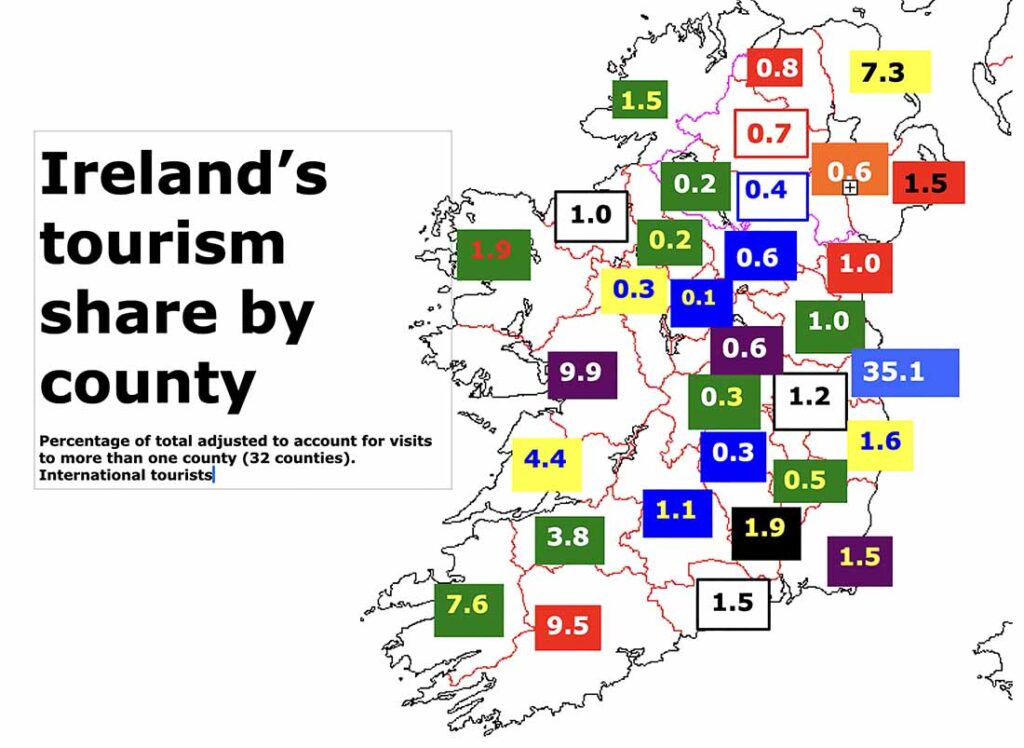
Ireland’s county Down offers a mix of historic sites and scenic landscapes, with Downpatrick’s Saint Patrick Centre and cathedral providing insights into Ireland’s patron saint. The Mourne Mountains offer hiking trails with sweeping views, while Strangford Lough provides kayaking and wildlife spotting. Other attractions include the historic Tollymore Forest Park. Down is Ireland’s 12th largest county by size (2,447 square km) and fourth largest by population (553,261). Population peaked at 361,446 in 1841 and reached its lowest point, 204,303, in 1911. In terms of hospitality, Down is Ireland’s 18th most visited tourist county with around 127,000 international visitors per year.
Introduction – Adventure – Anthem – Archaeology – Attractions – Awards – Birdwatching – Camping – Castles – Churches – Contact list – Cycling – Dining – Equestrian – Festivals – Fishing – Folklore – Gardens – Golf – Graveyards – Happening – Haunted – Highest – Hiking – History – Holy Wells – Hotels – Hotels top 8 – Hunting & shooting – Instagrammable – Itineraries – Largest town – Luxury – MICE – Movies – Music – New – Name – Novelists – Off the beaten track – Poets – Pubs – Quotes – Random Facts – Restaurant Awards – Sacred Places – Saints – Songs – Spas – Sports – Sunsets – Sustainable – Things to do – Towns – Video – Villages – Walking – Wanderlist – Weddings – Wild swimming – Writers – 1837 – 1846 – 1852 – 1909 – 1955 – 1980 –