- Saint Coemgen (Kevin) of Glendalough: June 3, c. 498–618: Glendalough, County Wicklow Kevin founded the monastery at Glendalough, a major early Christian site with a round tower, cathedral, and St. Kevin’s Kitchen. Known for his asceticism, he lived as a hermit in a cave and performed miracles, like communing with animals. His monastery became a center of learning, and he is a patron saint of Dublin.
- Saint Patrick: March 17, c. 385–461: Wicklow town, County Wicklow (via mission) Ireland’s patron saint, Patrick, is linked to Wicklow through his missionary work in Leinster, possibly landing at Wicklow town during his travels. He converted Ireland to Christianity, using the shamrock to explain the Trinity. Churches like St. Patrick’s in Wicklow reflect his veneration.
- Saint Brigid of Kildare: February 1, c. 451–525: Bray, County Wicklow (via veneration) Brigid, one of Ireland’s three chief saints, founded Kildare’s monastery but is venerated in Wicklow, notably in Bray’s churches. Known for her generosity and miracles, like multiplying food, her cult spread widely, influencing Wicklow’s parishes.
- Saint Columba (Colum Cille): June 9, c. 521–597: Glendalough, County Wicklow (via influence) Columba, born in Donegal, founded Iona and studied at Clonard, influencing Wicklow through Glendalough’s monastic network. Exiled after a dispute, he missionized in Scotland. His cult was venerated in Wicklow due to its proximity to Dublin and Leinster centers.
- Saint Laurence O’Toole: November 14, c. 1128–1180: Glendalough, County Wicklow Laurence, born in Kildare, became abbot of Glendalough and later archbishop of Dublin. Known for his piety and diplomatic efforts during the Norman invasion, he rebuilt Glendalough’s community. Canonized in 1225, he is a patron saint of Dublin, with strong Wicklow ties.
- Saint Palladius: July 7, c. 4th–5th century (exact dates unknown): Wicklow town, County Wicklow Palladius, a pre-Patrician missionary, is traditionally believed to have landed in Wicklow in 431, sent by Pope Celestine I to evangelize Ireland. He founded churches, possibly in Wicklow town, before moving to Scotland. His mission laid early Christian foundations in the region.
- Saint Mantan of Wicklow: October 26, c. 6th century (exact dates unknown): Wicklow town, County Wicklow Mantan, an obscure saint, is linked to Wicklow town, possibly as a monk or hermit. His feast is recorded in the Martyrology of Donegal, but details are scarce. He represents local veneration in Wicklow’s early Christian community.
- Saint Moling of St. Mullins: June 17, c. 6th–7th century (exact dates unknown): Rathdrum, County Wicklow (via influence) Moling, born in Wexford, founded a monastery at St. Mullins, Carlow, near Wicklow’s border. A bishop and scholar, he performed miracles, like building a mill without labor. His influence reached Wicklow through monastic networks, possibly Rathdrum.
- Saint Fintan of Clonenagh: February 17, c. 526–603: Baltinglass, County Wicklow (via influence) Fintan founded Clonenagh, Laois, but his influence extended to Wicklow through monastic networks, possibly Baltinglass. Known for strict asceticism and miracles like multiplying food, his cult was venerated in Leinster, including Wicklow.
- Saint Ibar of Beggerin: April 23, c. 5th century (exact dates unknown): Beggerin Island, County Wexford (near Wicklow) Ibar founded a monastery on Beggerin Island, Wexford, near Wicklow’s border. A pre-Patrician saint, he evangelized the region and performed miracles like calming storms. His influence reached Wicklow through Leinster’s early Christian networks.
- Saint Baoithin of Ennisboyne: May 22, c. 6th century (exact dates unknown): Ennisboyne (Inis Baoithin), County Wicklow Baoithin, an obscure saint, is linked to Ennisboyne, possibly a monastic site in Wicklow. His feast is recorded in the Martyrology of Tallaght, reflecting local veneration. Little is known, but he likely lived as a monk or hermit.
- Saint Comgall of Bangor: May 10, c. 516–601: Glendalough, County Wicklow (via influence) Comgall founded Bangor, Down, but his influence reached Wicklow through Glendalough’s monastic network, as he trained saints like Columbanus. Known for his ascetic rule and miracles, his cult was venerated in Leinster, including Wicklow.
Saints
Antrim – Armagh – Carlow – Cavan – Clare – Cork – Derry – Donegal – Down – Dublin – Fermanagh – Galway – Kerry – Kildare – Kilkenny – Laois – Leitrim – Limerick – Longford – Louth – Mayo – Meath – Monaghan – Offaly – Roscommon – Sligo – Tipperary – Tyrone – Waterford – Westmeath – Wexford – Wicklow
Sacred Places
Antrim – Armagh – Carlow – Cavan – Clare – Cork – Derry – Donegal – Down – Dublin – Fermanagh – Galway – Kerry – Kildare – Kilkenny – Laois – Leitrim – Limerick – Longford – Louth – Mayo – Meath – Monaghan – Offaly – Roscommon – Sligo – Tipperary – Tyrone – Waterford – Westmeath – Wexford – Wicklow
Holy Wells
Antrim – Armagh – Carlow – Cavan – Clare – Cork – Derry – Donegal – Down – Dublin – Fermanagh – Galway – Kerry – Kildare – Kilkenny – Laois – Leitrim – Limerick – Longford – Louth – Mayo – Meath – Monaghan – Offaly – Roscommon – Sligo – Tipperary – Tyrone – Waterford – Westmeath – Wexford – Wicklow
County Wicklow:
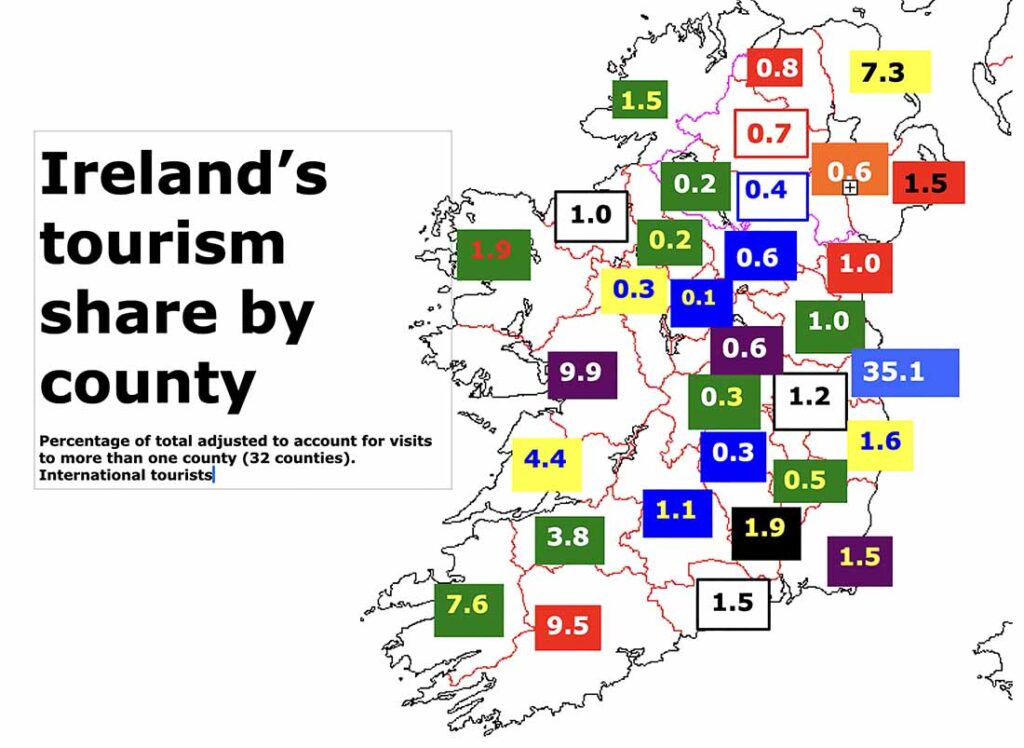
Ireland’s county Wicklow is known as the Garden of Ireland for its lush landscapes, with Glendalough’s monastic ruins and round tower set amidst serene lakes and valleys. The Wicklow Mountains National Park offers hiking trails with stunning views, while Powerscourt Estate’s manicured gardens and waterfall add natural elegance. Other attractions include the coastal paths of Bray. Wicklow is Ireland’s 17th largest county by size (,025 sq km) and 16th largest by population (155,851). Population peaked at 126,143 in 1841 and reached its lowest point, 57,591 in 1926. In terms of hospitality, Wicklow is Ireland’s twelfth most visited tourist county with around 204,000 international visitors per year.
Introduction – Adventure – Anthem – Archaeology – Attractions – Awards – Birdwatching – Camping – Castles – Churches – Contact list – Cycling – Dining – Equestrian – Festivals – Fishing – Folklore – Gardens – Golf – Graveyards – Happening – Haunted – Highest – Hiking – History – Holy Wells – Hotels – Hotels top 8 – Hunting & shooting – Instagrammable – Itineraries – Largest town – Luxury – MICE – Movies – Music – Name – New – Novelists – Off the beaten track – Poets – Pubs – Quotes – Random Facts – Restaurant Awards – Sacred Places – Saints – Songs – Spas – Sports – Sunsets – Sustainable – Things to do – Towns – Video – Villages – Walking – Wanderlist – Weddings – Wild swimming – Writers – 1837 – 1846– 1852 – 1909 – 1955 – 1980 –