- Harry Avery’s Castle: Built in the 14th century by or for Henry Aimhréidh O’Neill, a Gaelic chieftain, Harry Avery’s Castle is a small sandstone ruin on a hilltop near Newtownstewart. Named after a local leader, it features two drum towers, a rectangular hall, and remnants of a defensive wall, unusual for Gaelic castles which typically used wood. A National Monument, it reflects the O’Neill clan’s power before the Plantation of Ulster. Open year-round (free, dawn–dusk, managed by the NI Environment Agency), visitors can explore the ruins, accessible via a short, steep climb from a roadside parking area. Expect a 30–45 minute visit to view the towers and hilltop, offering panoramic views of the Mourne Valley. Information boards provide historical context. No facilities like restrooms or a visitor center are available; bring sturdy shoes for uneven terrain. Combine with nearby Baronscourt Estate or the Ulster American Folk Park for a fuller day. A compact, evocative site for history enthusiasts and those seeking scenic views in a quiet setting.
- Castlederg Castle: Constructed in 1497 by the O’Neill clan, Castlederg Castle is a ruined tower house on the River Derg in Castlederg village. A strategic stronghold, it was contested by the O’Neill and O’Donnell clans, later granted to Sir John Davies in the 17th century during the Plantation. Known for its thatched roof in the Annals of the Four Masters, it was built on an earlier O’Neill site and is near ancient tombs like the Druid’s Altar. Now a ruin, it holds historical significance in a village known as “the most bombed small town.” Open year-round (free, dawn–dusk), visitors can view the castle ruins from public paths in Castlederg village, though access may be restricted due to private land and safety concerns (e.g., loose masonry). Expect a 15–30 minute stop to see the fragmented stonework and river setting. No formal facilities or guided tours; parking is available in the village, with cafes nearby. The adjacent Dergfest Music Festival or Castlederg Library offer cultural context. Combine with a visit to St. Patrick’s Well or the War Memorial. Best for a quick stop, appealing to those exploring local history or the River Derg area.
- Castle Caulfield: Built between 1611 and 1619 by Sir Toby Caulfield on the site of an earlier O’Donnelly Gaelic fort, Castle Caulfield is a Plantation-era ruin in Castlecaulfield village. Featuring a three-story manor house with mullioned windows and remnants of a bawn, it was burned in 1641 during the Irish Rebellion and never rebuilt. A National Monument, it reflects Ulster’s transition to English control. Open year-round (free, dawn–dusk), visitors can explore the ruins, including the manor’s walls and chimneys, accessible via a short walk from village parking. Expect a 30–45 minute visit, with information boards detailing Plantation history. No facilities like restrooms or a cafe; the site is exposed, so dress for weather. The rural setting, 5 km from Dungannon, suits history buffs. Combine with the Ulster American Folk Park or Dungannon’s Hill of The O’Neill. A quiet, atmospheric ruin for those interested in Plantation-era history.
- Benburb Castle: Built in 1611 by Sir Richard Wingfield during the Plantation of Ulster, Benburb Castle is a fortified bawn on a limestone cliff overlooking the River Blackwater, near Benburb village. Designed to control the Ulster-Armagh border, it was a strategic outpost but fell into ruin after the 17th century. Now part of Benburb Valley Park, it’s a National Monument with scenic trails. Open year-round (free, dawn–dusk), visitors can explore the bawn’s ruins and surrounding park trails, offering views of the Blackwater gorge. Expect a 45–60 minute visit, with paths suitable for walking but uneven in places. Information boards highlight its history. No on-site facilities; parking and toilets are in Benburb village. The castle’s cliffside setting is ideal for hikers and photographers. Combine with the nearby Servite Priory or Moy’s antiques shops. Perfect for outdoor enthusiasts and those seeking a blend of history and nature.
- Aghantine Castle (Aughentaine Castle): Built before 1619 by Sir William Stewart, Aghantine Castle near Fivemiletown is a ruined Plantation-era castle described in historical records as a “large CastleCastle of Lyme & Stone” with a bawn, four flankers, and three stories. Destroyed in 1641 by Sir Phelim O’Neill during the Irish Rebellion, it remains a fragmented ruin on private land, reflecting early 17th-century Ulster fortifications. Open year-round (free, exterior viewing only), the castle is on private land, so access requires landowner permission (check locally). Visitors can view the ruins from nearby roads, seeing remnants of the bawn and walls. Expect a 15–30 minute stop, with no facilities or guided tours. The rural setting, 10 km from Fivemiletown, is remote, so bring navigation tools. Combine with Clogher Valley or the Beaghmore Stone Circles for a historical day trip. A minor site for dedicated history enthusiasts comfortable with limited access.
Tyrone’s castles are often Plantation-era ruins or Gaelic strongholds. Harry Avery’s and Benburb offer the best visitor experiences due to their settings, while others are more niche.
There are minor castle sites like Castle Curlews (Kirlish Castle) near Castlederg (16th-century, ruin, private, minimal remains) and Derg Castle (often confused with Castlederg, little documentation). These are less prominent due to their poor condition or lack of public access.
Castles
Antrim – Armagh – Carlow – Cavan – Clare – Cork – Derry – Donegal – Down – Dublin – Fermanagh – Galway – Kerry – Kildare – Kilkenny – Laois – Leitrim – Limerick – Longford – Louth – Mayo – Meath – Monaghan – Offaly – Roscommon – Sligo – Tipperary – Tyrone – Waterford – Westmeath – Wexford – Wicklow
County Tyrone:
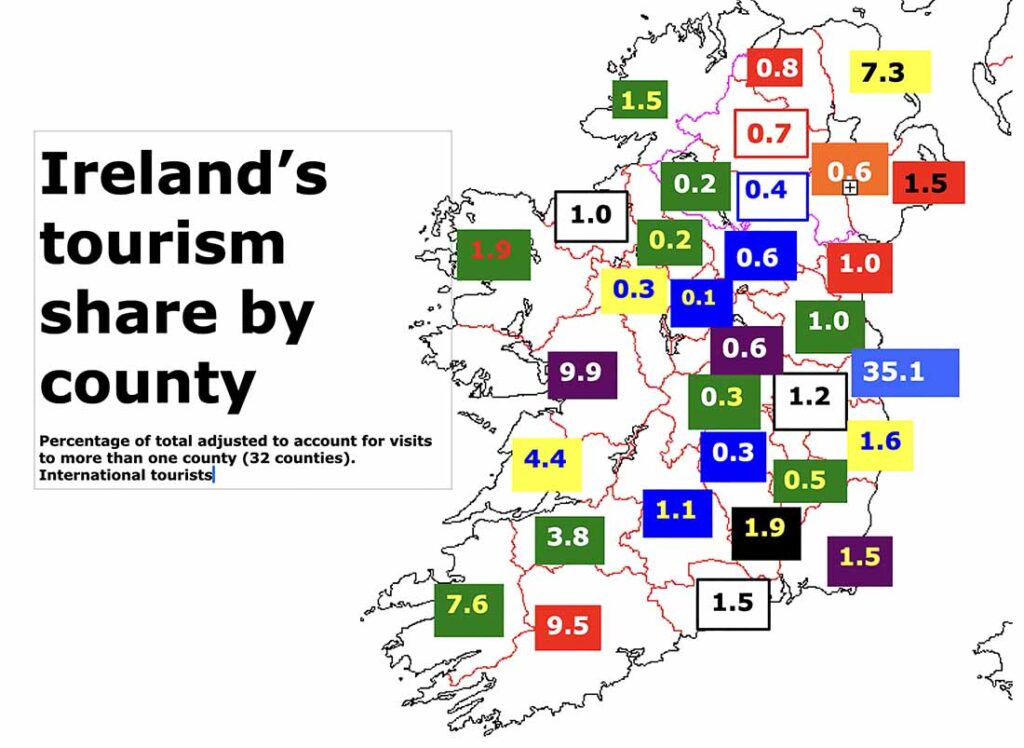
Ireland’s county Tyrone is a county of rolling landscapes and historic sites, with the Ulster American Folk Park in Omagh offering a fascinating look at emigration history through recreated villages. The Sperrin Mountains provide hiking trails with panoramic views, while the Beaghmore Stone Circles add ancient intrigue. Other attractions include the historic town of Dungannon and its castle ruins. Tyrone is Ireland’s seventh largest county by size (3,263 square km) and 11th largest by population (188,383). Population peaked at 312,956 in 1841 and reached its lowest point, 127,586 in 1936. In terms of hospitality, Tyrone is Ireland’s 24th most visited tourist county with around 68,000 international visitors per year.
Introduction – Adventure – Anthem – Archaeology – Attractions – Awards – Birdwatching – Camping – Castles – Churches – Contact list – Cycling – Dining – Equestrian – Festivals – Fishing – Folklore – Gardens – Golf – Graveyards – Happening – Haunted – Highest – Hiking – History – Holy Wells – Hotels – Hotels top 8 – Hunting & shooting – Instagrammable – Itineraries – Largest town – Luxury – MICE – Movies – Music – Name – New – Novelists – Off the beaten track – Poets – Pubs – Quotes – Random Facts – Restaurant Awards – Sacred Places – Saints – Songs – Spas – Sports – Sunsets – Sustainable – Things to do – Towns – Video – Villages – Walking – Wanderlist – Weddings – Wild swimming – Writers – 1837 – 1846– 1852 – 1909 – 1955 – 1980 –