- Saint Canice’s Well (Saint Kenny’s Well), Kilkenny City: Pattern day: October 11 (Saint Canice’s Day) and August 14, with Mass on August 14. Located near Saint Canice’s Cathedral, this well is dedicated to Kilkenny’s patron saint, Saint Canice. Housed in a small church-like structure with a bench, it’s fed by a stream and marked by a “Kenny’s Well” sign. Known for granting protection to travelers, pilgrims recite prayers but are advised to boil the water before use. Its urban setting makes it accessible, though no specific cures are noted. Bottom of a steep bank near a busy road, Kilkenny City, Co. Kilkenny.
- Saint Leonard’s Well, Dunnamaggin: Pattern day: November 6 (Saint Leonard’s Day), though patterns have lapsed. Enclosed by a circular hedge with a metal gate, this natural spring in Dunnamaggin is dedicated to Saint Leonard, a rare dedication likely introduced by Anglo-Normans. Restored by locals, it’s well-maintained with a metal cross bearing the saint’s name. Used for general healing, pilgrims performed rounds, but no specific cures are recorded. A KCLR documentary highlights its history. Dunnamaggin, Co. Kilkenny.
- Saint James’ Well, Mealoughmore: Pattern day: July 25 (Saint James’ Day), historically observed. In Mrs. Davis’ field, known as the Church Field, this well in Mealoughmore saw barefoot pilgrims perform nine rounds on Saint James’ feast day. A legend tells of a reaper breaking when hay was cut near the well, leading to the field’s protection. Used for healing, it’s now less visited but retains local folklore significance. Mealoughmore, Co. Kilkenny.
- Trinity Well, Ballyrafton: Pattern day: Trinity Sunday (Sunday after Pentecost), though patterns are rare. Near Jenkinstown Wood, off the Castlecomer-Kilkenny road, this well is named for a legend where a friar, hiding from English soldiers, was pricked by a thorn, and three drops of blood led to three trees growing, naming it the Well of the Holy Trinity. Associated with Penal Times, it’s linked to a cave and old church used by friars. No specific cures are noted. Ballyrafton, near Jenkinstown, Co. Kilkenny.
- Saint Brigid’s Well, Unknown Specific Location: Pattern day: February 1 (Saint Brigid’s Day), held until the early 19th century. A well dedicated to Saint Brigid, Kilkenny’s co-patron, was a major pilgrimage site until the 1800s. Pilgrims in holiday attire performed rounds, with the wealthy distributing “machaine” (bread of lamentation) to the poor, who prayed for deceased relatives. Rituals included grave dressing and keening. Now obscure, it reflects Brigid’s enduring legacy. Exact location unspecified, Co. Kilkenny.
- Ballavarra Spout, Ballavarra: Pattern day: Unknown, possibly tied to Saint Laurence or Saint Moling’s feast days. Blessed by Saint Laurence and Saint Moling en route to Saint Mullins, this spout in Doyle’s field near Graignamanagh is said to prevent ailments, though no cures are recorded. Not a traditional well, it’s a roadside spring with spiritual significance, now rarely visited but noted in local folklore. Ballavarra, near Graignamanagh, Co. Kilkenny.
- Saint Fhachna’s Well (Tiobra Fhachna), Tybroughney: Pattern day: Unknown, possibly linked to Saint Fhachna’s Day (date uncertain). Named for Saint Fhachna, this well in Tybroughney (Tiobra Fhachna) is near a medieval church with a carved pillar stone and font. Associated with Saint Modomnoc’s 6th-century monastery, it was used for general healing. Its historical and archaeological significance overshadows modern use, with no active patterns. Tybroughney, near Piltown, Co. Kilkenny.
- Saint Ailbe’s Well, Emly (Kilkenny Border): Pattern day: September 12 (Saint Ailbe’s Day) or within its octave, historically observed. Near the Tipperary border, this well is linked to Saint Ailbe, with rounds performed until the mid-20th century. Pilgrims visited the well and Saint Ailbe’s Cross, believed to mark the saint’s grave, for healing. Its sandstone cross and rural setting make it significant, though patterns have ceased. Emly, near Kilkenny-Tipperary border, Co. Kilkenny.
- Tobar na Súl, Near Thomastown: Pattern day: Unknown, possibly Lughnasa (August 1). Known as the “Eye Well,” this well near Thomastown was famed for curing eye ailments. Pilgrims bathed their eyes with the water and tied clooties to nearby bushes, believing ailments would fade as the rags decayed. Now obscure and likely neglected, it reflects common healing traditions. Near Thomastown, Co. Kilkenny.
- Tobar na nGealt, Near Callan: Pattern day: Unknown, possibly summer festivals. The “Well of the Insane” near Callan was believed to cure mental illnesses, tied to pre-Christian Otherworldly beliefs. Pilgrims performed rounds, recited prayers, and left clooties. Its rural setting keeps it hidden, with no modern use but strong folklore connections. Near Callan, Co. Kilkenny.
- Saint Kieran’s Well, Kilkenny City: Pattern day: March 5 (Saint Kieran’s Day), though patterns ceased by the 1800s. Near Kyteler’s Inn, this well flowed under a stone roof house with a Kilkenny marble baptismal font. Used for curative purposes until its demolition in the early 19th century for a fish market, it was tied to an ancient chapel. Its urban loss reflects Kilkenny’s changing landscape. Near Saint Kieran’s Street, Kilkenny City, Co. Kilkenny.
- Saint Rock’s Well, Kilkenny City: Pattern day: First Sunday in August, last held in 1830. Near Saint Rioch’s Church by Walkins Green, this well fed Walkins Lough. Pilgrims gathered for Saint Rock’s pattern until 1830, when drunkenness and faction fighting led Bishop Kinchella to abolish it. Covered over in the 1830s, its waters were diverted, and no trace remains. It was used for general healing. Walkins Green, Kilkenny City, Co. Kilkenny.
Practical Notes:
- Access and Condition: Many Kilkenny wells are on private land (e.g., Saint James’ Well) or lost to urban development (e.g., Saint Kieran’s, Saint Rock’s); seek permission where needed (check www.kilkennyarchaeologicalsociety.ie). Saint Canice’s and Saint Leonard’s are maintained, while others, like Tobar na Súl, are neglected or hard to locate.
- Visiting Tips: Use a map or GPS (www.ihwcbc.omeka.net or www.kilkennyheritage.ie), as signage is minimal. Wear waterproof boots for rural sites, and respect offerings like clooties or crosses. For Saint Canice’s, attend the August 14 Mass for a communal experience.
- Pattern Days: Where unknown, visits likely peaked in summer (May-August), tied to saints’ feast days or Lughnasa. Most patterns ceased by the 19th century due to church disapproval, Famine, and social changes, but Saint Canice’s remains active.
- Cultural Context: Kilkenny’s wells served as Mass sites during Penal Times, with sunwise rounds, Rosary prayers, and clooties to transfer ailments. Specialized cures (e.g., eyes, mental health) reflect pre-Christian beliefs, often enhanced by sacred trees or stones.
Holy Wells
Antrim – Armagh – Carlow – Cavan – Clare – Cork – Derry – Donegal – Down – Dublin – Fermanagh – Galway – Kerry – Kildare – Kilkenny – Laois – Leitrim – Limerick – Longford – Louth – Mayo – Meath – Monaghan – Offaly – Roscommon – Sligo – Tipperary – Tyrone – Waterford – Westmeath – Wexford – Wicklow
Sacred Places
Antrim – Armagh – Carlow – Cavan – Clare – Cork – Derry – Donegal – Down – Dublin – Fermanagh – Galway – Kerry – Kildare – Kilkenny – Laois – Leitrim – Limerick – Longford – Louth – Mayo – Meath – Monaghan – Offaly – Roscommon – Sligo – Tipperary – Tyrone – Waterford – Westmeath – Wexford – Wicklow
County Kilkenny:
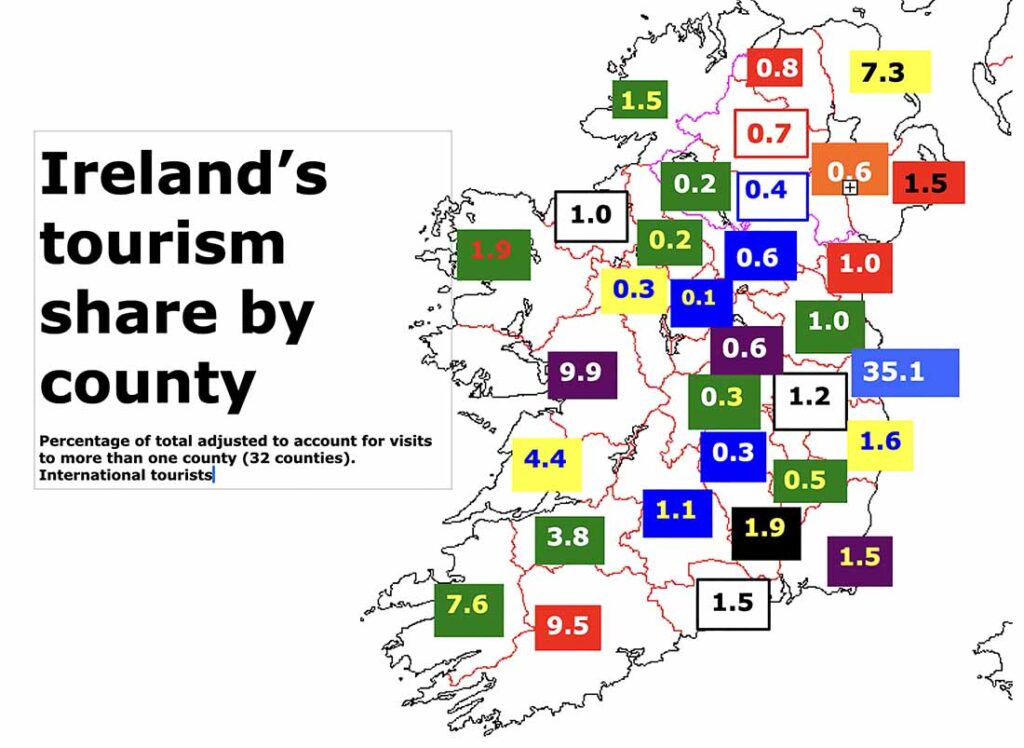
Ireland’s county Kilkenny is a county of medieval charm, with Kilkenny City’s castle and St Canice’s Cathedral showcasing well-preserved architecture and round towers. The Dunmore Cave offers intriguing limestone formations, while the Nore Valley’s walking trails provide scenic beauty. Other attractions include the historic Jerpoint Abbey’s intricate carvings. Kilkenny is Ireland’s 16th largest county by size (2,062 square km) and 21st largest by population (104,160). Population peaked at 202,420 in 1841 and reached its lowest point, 60,463 in 1966. In terms of hospitality, Kilkenny is Ireland’s eleventh most visited tourist county with around 207,000 international visitors per year.
Introduction – Adventure – Anthem – Archaeology – Attractions – Awards – Birdwatching – Camping – Castles – Churches – Contact list – Cycling – Dining – Equestrian – Festivals – Fishing – Folklore – Gardens – Golf – Graveyards – Happening – Haunted – Highest – Hiking – History – Holy Wells – Hotels – Hotels top 8 – Hunting & shooting – Instagrammable – Itineraries – Largest town – Luxury – MICE – Movies – Music – Name – New – Novelists – Off the beaten track – Poets – Pubs – Quotes – Random Facts – Restaurant Awards – Sacred Places – Saints – Songs – Spas – Sports – Sunsets – Sustainable – Things to do – Towns – Video – Villages – Walking – Wanderlist – Weddings – Wild swimming – Writers – 1837 – 1846 – 1852 – 1909 – 1955 – 1980 –