The highest point in County Dublin is Kippure, standing at 757 meters (2,484 feet). Located in the northern part of the Wicklow Mountains, near the Dublin-Wicklow border, Kippure is a prominent granite peak offering accessible hiking and panoramic views over Dublin city, Dublin Bay, and the surrounding mountains.
- Geological and Cultural Significance: Kippure is part of the Wicklow Mountains, formed from granite uplifted during the Caledonian Orogeny millions of years ago. Its rounded summit and blanket bog are typical of the range, with the River Liffey’s source on its eastern slopes. The mountain’s name, possibly derived from Irish Ciop Ór (“golden ridge”), reflects its prominence. A large RTÉ television mast, built in 1961, marks the summit, making it unmistakable. Kippure is steeped in local history, with nearby megalithic sites like Seefin and Seefingan tombs adding archaeological interest.
- Scenic Beauty: The summit offers sweeping 360-degree views, including Dublin city and its bay to the north, the Wicklow Mountains to the south, and, on clear days, the Mourne Mountains to the north or Snowdon in Wales. The contrast between urban Dublin and the wild Wicklow landscape is a unique draw.
Approaching Kippure
- Access Points: Kippure is most commonly approached from the Military Road (R115), a scenic route through the Wicklow Mountains. The primary starting point is a small parking area near Kippure Estate at the Lughnaquilla trailhead (Grid Ref: O 116 154), about 5km south of the R115-R759 junction. Another popular start is from the Bohernabreena Reservoir area near Tallaght, southwest Dublin, though this is a longer route. Both are accessible by car, but public transport is limited, with the nearest bus routes (e.g., Dublin Bus 65 to Tallaght) requiring a drive or taxi to the trailhead.
Trail Options:
- Military Road Route (Kippure Estate): The most direct route is a 6–8km round-trip hike (2–3 hours) starting at the Kippure Estate gate. A gravel track leads toward the summit, passing through boggy moorland and heather. The path is clear, following a service road for the RTÉ mast, making it suitable for novice hikers. The final ascent is gradual, with the mast guiding navigation. This route is moderately easy but can be wet and exposed.
- Bohernabreena Route: A longer, more challenging 12–14km round-trip hike (4–5 hours) starts near Bohernabreena Reservoir, following the Dublin Mountains Way or forest tracks toward Kippure’s northern slopes. This route crosses open bog and requires careful navigation, especially in poor visibility, but offers a quieter, more scenic approach through forest and moorland.
- Extended Routes: Experienced hikers may combine Kippure with nearby peaks like Seefin (621m) or Seefingan (724m), which have megalithic tombs, via ridge walks. These extend the hike to 10–15km and require good navigation skills.
- Navigation and Preparation: The Military Road route is straightforward, with the RTÉ mast as a clear landmark, but fog and low cloud can obscure visibility on the summit. Hikers should carry a map (Ordnance Survey Ireland, Discovery Series Sheet 56), compass, or GPS, especially for the Bohernabreena route or extended walks. Waterproof hiking boots, rain gear, and layered clothing are essential due to frequent rain and windy conditions. Bring water and snacks, as there are no facilities on the mountain. Dogs are allowed but should be leashed to protect livestock and wildlife. Check weather forecasts, as the summit is exposed to strong winds.
Hiking Experience:
- The Military Road route is one of the easiest county high points in Ireland, with a clear track and minimal elevation gain, making it accessible for beginners. The terrain is boggy in places, but the gravel path simplifies navigation. The RTÉ mast, while not aesthetically pleasing, is a useful guide.
- The Bohernabreena route offers a wilder experience, with forest trails, open bog, and a steeper ascent. It’s less crowded but demands more fitness and navigation skills.
- The summit is a broad, flat area with the RTÉ mast, a small trig pillar, and a windswept bog. Its accessibility makes it popular, but it’s less crowded than Wicklow’s busier peaks like Lugnaquilla.
- Views and Photography: On clear days, Kippure’s summit provides stunning views of Dublin’s skyline, including landmarks like the Poolbeg Chimneys, and Dublin Bay’s curve. To the south, the rolling Wicklow Mountains, including Lugnaquilla and Djouce, are visible. The juxtaposition of urban and wild landscapes is ideal for photography, especially at sunrise or sunset. The summit’s exposure makes it a prime spot for dramatic cloud and light effects.
- Wildlife and Nature: Kippure’s blanket bog supports heather, sphagnum moss, and cotton grass, with birds like skylarks, meadow pipits, and occasionally peregrine falcons. Deer and hares may be spotted, and grazing sheep are common. The nearby Liffey Head Bog is a Special Area of Conservation, highlighting the area’s ecological value.
- Cultural and Historical Context: Kippure lies near the source of the River Liffey, central to Dublin’s identity. Nearby megalithic tombs on Seefin and Seefingan, dating to 3,000 BC, add archaeological intrigue. The Military Road, built by the British in the early 19th century to control the Wicklow Mountains, adds historical context. The area’s proximity to Dublin makes it a blend of urban accessibility and rural heritage.
- Amenities: There are no facilities at the trailheads, so hikers must be self-sufficient. The nearest amenities are in Tallaght (supermarkets, cafés) or small villages like Glencullen, where pubs like Johnnie Fox’s offer post-hike meals. Gougane Barra or Glendalough, further south in Wicklow, provide additional attractions for a day trip.
- Seasonal Considerations: Spring (April–May) and autumn (September–October) offer vibrant heather and clear skies, ideal for hiking. Summer (June–August) is warmest (15–20°C / 59–68°F) but busier, especially on weekends. Winter (November–March) can bring snow or ice, requiring extra caution. Dublin’s 1,200–1,500 annual sunshine hours mean clear views are possible year-round, but rain is frequent, so waterproof gear is essential.
- Guided Tours: Local operators, such as those listed on visitwicklow.ie, offer guided hikes of Kippure, ideal for learning about the area’s ecology, geology, or history. The Dublin Mountains Way, a 42km trail, includes Kippure and can be explored with guides for a broader experience.
- Safety: The Military Road route is low-risk, but fog and wind can make the summit disorienting. The Bohernabreena route requires more care due to boggy terrain and faint paths. Inform someone of your plans, avoid hiking alone in poor weather, and check for updates on trail conditions, as bogs can become impassable after heavy rain.
- Accessibility: The Military Road route is suitable for beginners, with a clear path and moderate gradient. The Bohernabreena route and extended ridge walks require moderate fitness and navigation skills. The summit is not wheelchair-accessible due to uneven terrain.
Kippure is an accessible yet rewarding hike, offering a unique blend of urban and wild vistas in County Dublin. Its straightforward Military Road route makes it ideal for novice hikers, while longer approaches like Bohernabreena appeal to those seeking a challenge. The summit’s views, ecological richness, and proximity to Dublin’s cultural attractions make it a perfect day trip for visitors and locals alike. For more details, visit visitwicklow.ie or consult Kieron Gibbons’ Ireland’s County High Points – A Walking Guide.
Highest point in county
Antrim – Armagh – Carlow – Cavan – Clare – Cork – Derry – Donegal – Down – Dublin – Fermanagh – Galway] – Kerry – Kildare – Kilkenny – Laois – Leitrim – Limerick – Longford – Louth – Mayo – Meath – Monaghan – Offaly – Roscommon – Sligo – Tipperary – Tyrone – Waterford – Westmeath – Wexford – Wicklow
County Dublin:
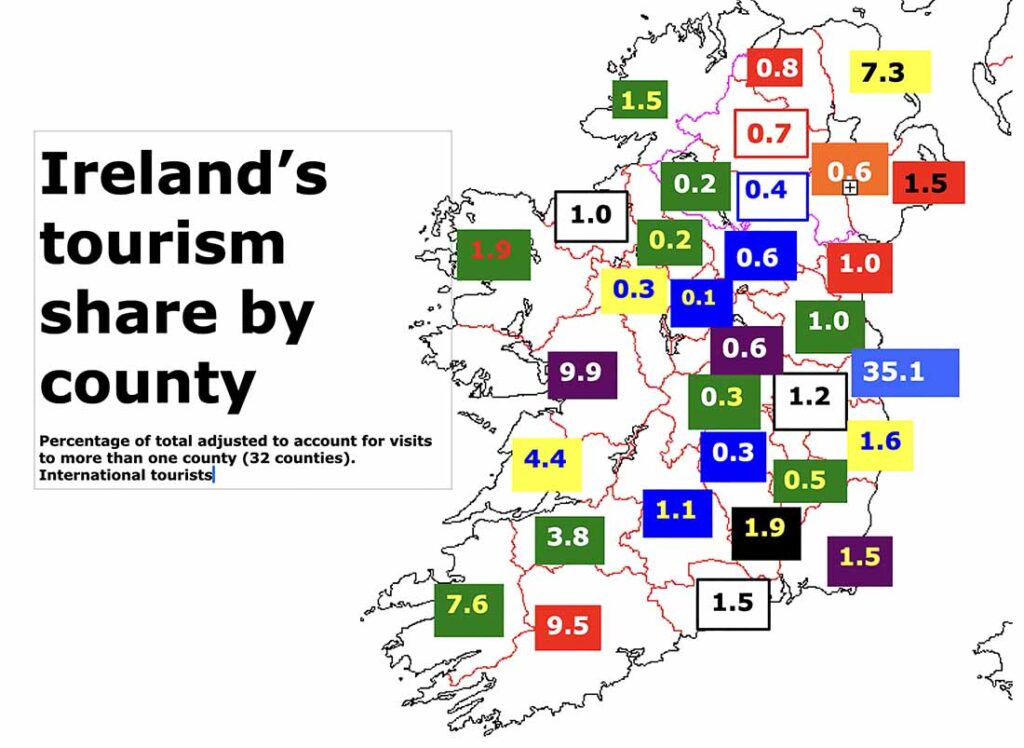
Ireland’s county Dublin combines cultural heritage with urban appeal, with Trinity College’s Book of Kells and Dublin Castle offering historical depth. The Guinness Storehouse provides a journey through Ireland’s iconic stout, while Phoenix Park’s vast green spaces are ideal for cycling. The River Liffey’s scenic walks and Kilmainham Gaol’s historical tours make Dublin a versatile destination for culture and history. Dublin is Ireland’s third smallest county by size (922 square km) and largest by population (1,458,154). Dublin is also Ireland’s most visited tourist county by a margin, with around four million international visitors per year. In terms of hospitality,
Introduction – Adventure – Anthem – Archaeology – Attractions – Awards – Birdwatching – Camping – Castles – Churches – Contact list – Cycling – Dining – Equestrian – Festivals – Fishing – Folklore – Gardens – Golf – Graveyards – Happening – Haunted – Highest – Hiking – History – Holy Wells – Hotels – Hotels top 8 – Hunting & shooting – Instagrammable – Itineraries – Largest town – Luxury – MICE – Movies – Music – New – Name – Novelists – Off the beaten track – Poets – Pubs – Quotes – Random Facts – Restaurant Awards – Sacred Places – Saints – Songs – Spas – Sports – Sunsets – Sustainable – Things to do – Towns – Video – Villages – Walking – Wanderlist – Weddings – Wild swimming – Writers – 1837 – 1846 – 1852 – 1909 – 1955 – 1980 –