- Saint Brendan’s Well (Tobar Bréanainn), Mount Brandon: Pattern day: May 16 (Saint Brendan’s Day), with Lughnasa (August 1) gatherings historically noted. Perched dramatically on the summit of Mount Brandon, this well is dedicated to Saint Brendan the Navigator. One of Kerry’s most challenging wells to reach, it’s used for general healing. Pilgrims perform rounds, leaving clooties on nearby shrubs. Its remote, windswept location ties it to ancient pilgrimage routes, though visits are now rare due to the arduous climb. Mount Brandon, Dingle Peninsula, Co. Kerry.
- Our Lady’s Well (Tobar Mhuire), Ballyheigue: Pattern day: September 8 (Nativity of Mary), with a three-day festival including open-air Mass. A major pilgrimage site in Ballyheigue, this well is dedicated to the Virgin Mary. Pilgrims perform sunwise rounds (deiseal), reciting the Rosary, and leave offerings like candles or medals. Known for healing, it draws large crowds, with historical echoes of Penal Times Mass gatherings. The well remains a focal point of community devotion. Ballyheigue, North Kerry, Co. Kerry.
- Saint Michael’s Well (Tobar Mhíchíl Naomtha), Ventry: Pattern day: September 29 (Michaelmas), though patterns have waned. Near Ventry on the Dingle Peninsula, this well, possibly originally dedicated to the Celtic goddess Mór, is now linked to Saint Michael. Built on a fulacht fia (ancient cooking site), it’s used for healing ailments like sores. Pilgrims once performed rounds at this site, leaving clooties. Its coastal setting and layered history make it unique. Ventry, Dingle Peninsula, Co. Kerry.
- Saint Finian’s Well, Glenbeigh: Pattern day: Easter Monday, with a well-attended walk and Mass. In Glenbeigh, this well is dedicated to Saint Finian, a monk linked to Lindisfarne. Known for curing general ailments, pilgrims perform rounds, often led by a piper, and leave offerings like rosaries. The well’s annual pattern includes a communal walk, reflecting strong local tradition and pride. Glenbeigh, Co. Kerry.
- Saint Erc’s Well, Glenderry: Pattern day: Unknown, possibly tied to Saint Erc’s Day (October 16). Near Ballyheigue on Kerry Head, this obscure well is linked to Saint Erc, a 5th-century bishop. Used for healing, particularly eye ailments, it was historically part of a pilgrimage circuit. Difficult to locate, it’s surrounded by farmland, with minimal modern use but significant for its early Christian ties. Glenderry, near Ballyheigue, Co. Kerry.
- Tobar na Súl, Near Listowel: Pattern day: Unknown, possibly Lughnasa (August 1). Known as the “Eye Well,” this well near Listowel is famed for curing eye ailments, a common attribute in Irish wells. Pilgrims bathed their eyes with the water and tied clooties to nearby bushes. Now neglected and surrounded by hedgerows, it retains local folklore significance. Near Listowel, North Kerry, Co. Kerry.
- Saint Fursey’s Well, Knocknadobar: Pattern day: February 16 (Saint Fursey’s Day), with historical Lughnasa gatherings. On the slopes of Knocknadobar (Mountain of the Well), this well is dedicated to Saint Fursey, a 7th-century missionary. Used for healing, pilgrims once climbed to the well during a three-day Lughnasa festival, leaving offerings at 14 Stations of the Cross. Its high altitude and scenic views make it a striking site, though visits are now rare. Knocknadobar, Iveragh Peninsula, Co. Kerry.
- Well of the Holy Cross, Caherciveen: Pattern day: September 14 (Exaltation of the Holy Cross), though patterns are minimal. In the heart of Caherciveen, this urban well is dedicated to the Holy Cross. Historically used for general healing, it’s now neglected, with few visitors. Pilgrims once performed rounds, leaving small offerings. Its central location contrasts with its forgotten state, reflecting urban decline in well devotion. Caherciveen, Co. Kerry.
- Saint Eiltín’s Well, North Kerry: Pattern day: Unknown, possibly linked to Saint Eiltín’s Day (date uncertain). A recently rediscovered well in North Kerry, dedicated to the obscure Saint Eiltín. Used for healing, it had been hidden for years, with no recorded modern rounds or offerings. Its rediscovery highlights efforts to revive Kerry’s well heritage, though it remains little-known. North Kerry, exact location unspecified.
- Tobar na nGealt, Near Tralee: Pattern day: Unknown, possibly summer festivals. The “Well of the Insane” near Tralee was believed to cure mental illnesses, with water analyzed for lithium content due to its reputed efficacy. Pilgrims performed rounds and left clooties, reflecting ancient Otherworldly beliefs. Its rural setting keeps it obscure, with minimal modern use. Near Tralee, Co. Kerry.
- Saint Crohane’s Well, Caherdaniel: Pattern day: Unknown, possibly tied to Saint Crohane’s Day (July 11). Near Caherdaniel, this well is dedicated to Saint Crohane, a local hermit. Once the center of a three-day pilgrimage, it’s used for healing ailments like sores. Pilgrims performed rounds, leaving clooties. Now quieter, it’s maintained near an old graveyard with views of the Beara Peninsula. Caherdaniel, Co. Kerry.
- Saint Killian’s Well, Tuosist: Pattern day: July 8 (Saint Killian’s Day), though patterns have largely ceased. In Tuosist, this well is dedicated to Saint Killian, a 7th-century missionary. Used for general healing, pilgrims performed rounds and left offerings like coins or rags. Its rural setting near the Cork border preserves its tranquility, but it’s now rarely visited, reflecting the decline of smaller patterns. Tuosist, South Kerry, Co. Kerry.
Access and visiting
- Access and Condition: Many Kerry wells are on private land or remote (e.g., Mount Brandon, Knocknadobar); seek permission where needed (check www.holywellscorkandkerry.com or www.deepmapskerry.ie). Some, like Our Lady’s Well, are well-maintained, while others, like Tobar na Súl, are neglected. Island or mountain wells require planning and physical fitness.
- Visiting Tips: Use a map or GPS (www.ihwcbc.omeka.net) (www.ihwcbc.omeka.net), as signage is often absent. Wear waterproof boots for boggy or coastal sites, and respect offerings like clooties or candles. For Saint Brendan’s or Saint Fursey’s, check weather conditions and consider guided tours.
- Pattern Days: Where unknown, visits likely peaked in summer (May-August), tied to saints’ feast days or Lughnasa. Patterns have declined since the 19th century due to church reforms and social changes, but Ballyheigue and Glenbeigh remain active.
- Cultural Context: Kerry’s wells were Mass sites during Penal Times, with sunwise rounds, Rosary prayers, and clooties to transfer ailments. Specialized cures (e.g., eyes, mental health) reflect pre-Christian beliefs, often enhanced by sacred trees, stones, or fulacht fia.
Holy Wells
Antrim – Armagh – Carlow – Cavan – Clare – Cork – Derry – Donegal – Down – Dublin – Fermanagh – Galway – Kerry – Kildare – Kilkenny – Laois – Leitrim – Limerick – Longford – Louth – Mayo – Meath – Monaghan – Offaly – Roscommon – Sligo – Tipperary – Tyrone – Waterford – Westmeath – Wexford – Wicklow
Sacred Places
Antrim – Armagh – Carlow – Cavan – Clare – Cork – Derry – Donegal – Down – Dublin – Fermanagh – Galway – Kerry – Kildare – Kilkenny – Laois – Leitrim – Limerick – Longford – Louth – Mayo – Meath – Monaghan – Offaly – Roscommon – Sligo – Tipperary – Tyrone – Waterford – Westmeath – Wexford – Wicklow
County Kerry:
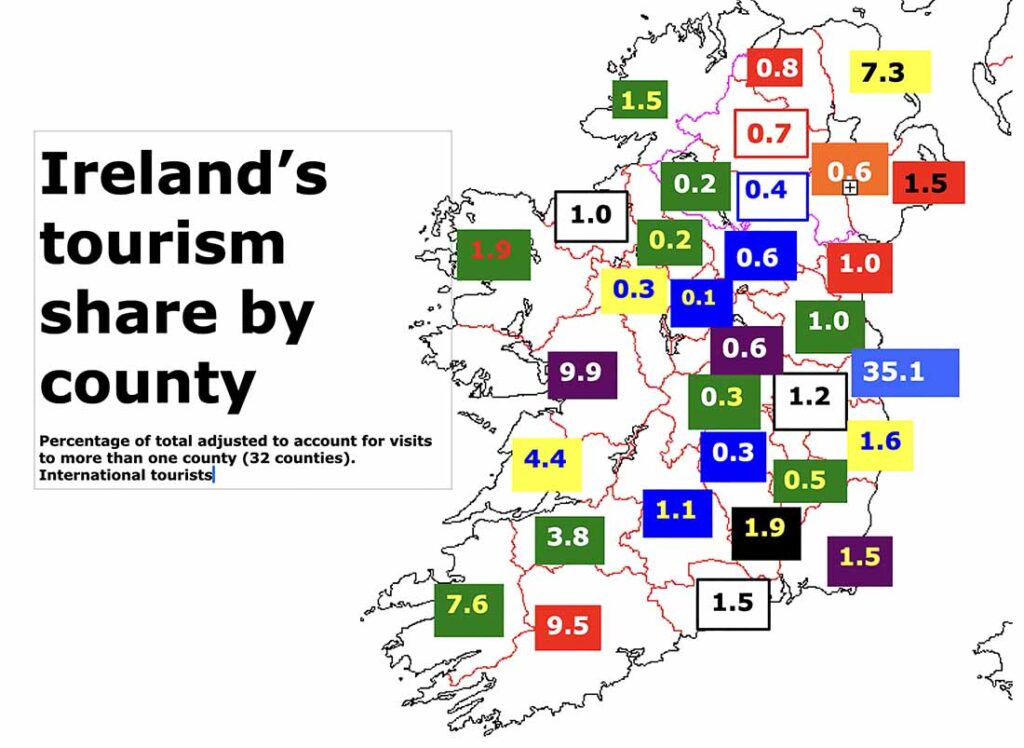
Ireland’s county Kerry is renowned for its dramatic landscapes, with the Ring of Kerry offering scenic drives past lakes and coastal cliffs. Killarney National Park features the serene Lakes of Killarney and historic Muckross House, while Dingle’s coastal trails and dolphin-watching opportunities add natural allure. Accessible by seasonal ferry, the Skellig Islands’ ancient monastic ruins make Kerry a compelling choice for outdoor adventure and history. Kerry is Ireland’s fifth largest county by size (4,701 square km) and 15th largest by population (156,458). Population peaked at 293,880 in 1841 and reached its lowest point, 112,785 in 1966. In terms of hospitality, Kerry is Ireland’s fourth most visited tourist county with around 877,000 international visitors per year.
Introduction – Adventure – Anthem – Archaeology – Attractions – Awards – Birdwatching – Camping – Castles – Churches – Contact list – Cycling – Dining – Equestrian – Festivals – Fishing – Folklore – Gardens – Golf – Graveyards – Happening – Haunted – Highest – Hiking – History – Holy Wells – Hotels – Hotels top 8 – Hunting & shooting – Instagrammable – Itineraries – Largest town – Luxury – MICE – Movies – Music – Name – New – Novelists – Off the beaten track – Poets – Pubs – Quotes – Random Facts – Restaurant Awards – Sacred Places – Saints – Songs – Spas – Sports – Sunsets – Sustainable – Things to do – Towns – Video – Villages – Walking – Wanderlist – Weddings – Wild swimming – Writers – 1837 – 1846 – 1852 – 1909 – 1955 – 1980 –