- Saint Senan (Seanán) of Scattery Island: March 8, c. 488–544: Kilrush, Inis Cathaigh (Scattery Island)Senan, patron saint of County Clare, founded a monastery on Scattery Island in the Shannon Estuary. Born in Corca Bhaiscinn (west Clare), he studied under St. Cassidan and established churches in Kilrush and Moylough. Known for miracles, including banishing a monster from Scattery, his Life highlights his asceticism and hospitality. He is patron of the Diocese of Killaloe, with his holy well and church ruins on Scattery as key pilgrimage sites.
- Saint Maccreehy (Maccreiche): April 11, c. 6th century–580: Kilmacreehy, Inagh, KilmanaheenA disciple of St. Ailbe of Emly, Maccreehy founded churches at Kilmacreehy, Inagh, and Kilmanaheen in west Clare. His Latin Life details his missionary work and miracles, noting his advanced age at death. He played a key role in Christianizing Corca Bhaiscinn, and his feast is recorded in the Martyrology of Donegal. Kilmacreehy parish preserves his legacy with a church dedicated to him.
- Saint Mainchin (Manchán) of Kilmanaheen: January 14, c. 6th century: KilmanaheenMainchin, a disciple of Maccreehy, is linked to Kilmanaheen parish in west Clare, where he founded a church. Possibly identical to St. Munchin of Limerick, he was a bishop who strengthened early Christian communities. His feast is noted in local traditions, and his work reflects Clare’s monastic network tied to west Munster. Kilmanaheen’s church site honors his contributions.
- Saint Mochulla (Mochulleus): May 15, c. 6th century: TullaMochulla, a female saint, founded a monastery at Tulla in east Clare. Her holy wells at Lough Graney, Lough Bridget, Broadford, and Miltown are pilgrimage sites. Known for her ascetic life and miracles, she is venerated in Tulla parish, with her feast recorded in the Martyrology of Oengus. Her legacy underscores the prominence of female monasticism in Clare.
- Saint Flannan: December 18, c. 7th century: Killaloe (St. Flannan’s Cathedral)Flannan, patron of the Diocese of Killaloe, was a bishop who founded a monastery at Killaloe. Son of King Turlough of Thomond, he studied under St. Blathmac and preached in Scotland and the Hebrides. Known for his missionary zeal, his cathedral and St. Flannan’s College in Ennis honor him. His holy well at Killaloe remains a pilgrimage site, and his feast is widely celebrated.
- Saint Brendan of Birr: November 29, c. 512–573: Doora-Barefield (historically linked)One of the “Twelve Apostles of Ireland,” Brendan founded a monastery at Birr, Offaly, but is linked to Clare through his missionary work in the Diocese of Killaloe, particularly Doora-Barefield parish. A friend of St. Columba, he was known for his wisdom and mediation at the Synod of Meltown. His feast is noted in the Martyrology of Donegal, reflecting Clare’s ties to broader monastic networks.
- Saint Luchtighern: April 28, c. 6th century: TomfinloughLuchtighern, son of Cuana, was abbot of Tomfinlough (Tuaimfinloch) monastery near Ennis. A disciple of St. Finnian of Clonard, he is known for his humility, as recorded in the Life of St. Finnian, where he carried a leper (St. Ciaran) on his shoulders. His feast is in the Martyrology of Oengus, and Tomfinlough’s church ruins preserve his legacy.
- Saint Blathmac: January 19, c. 7th century: KillaloeBlathmac, a monk and mentor of St. Flannan, is associated with Killaloe, where he taught at the monastic school. His feast is recorded in Irish martyrologies, and his work strengthened Killaloe’s role as a center of learning. Little is known of his life, but his influence in Clare’s ecclesiastical history is evident through his connection to Flannan.
- Saint Cronan of Roscrea: April 28, c. 6th–7th century: Inis Oírr (Aran Islands, Diocese of Killaloe)Cronan, primarily linked to Roscrea, Tipperary, is associated with Clare through his missionary work on Inis Oírr, part of the Diocese of Killaloe. He founded multiple monasteries and is known for his asceticism and charity. His feast is noted in the Martyrology of Donegal, and his influence in Clare reflects the region’s ties to Munster’s monastic tradition.
- Saint Inghean Bhaoth (Ingen Baith): December 18, c. 6th century: KilnaboyInghean Bhaoth, a female saint, founded a church at Kilnaboy (Cill Inghine Bhaoth). Daughter of a local king, she is venerated for her piety and dedication to the poor. Her feast coincides with St. Flannan’s, as noted in the Martyrology of Oengus. Kilnaboy’s church, with its Sheela-na-gig carving, and nearby holy well are pilgrimage sites.
- Saint Colman Mac Duagh: October 29, c. 560–632: Oughtmama (historically linked)Colman, born in Cork, is primarily associated with Kilmacduagh, Galway, but his missionary work extended to Oughtmama in north Clare, where he founded churches. A hermit and bishop, he lived austerely, befriending a cock, mouse, and fly, per legend. His feast is in the Martyrology of Donegal, and Oughtmama’s monastic ruins reflect his influence.
- Saint Tola: March 30, c. 7th century: Dysert O’DeaTola, a bishop, founded a monastery at Dysert O’Dea in north Clare, a significant ecclesiastical site. Known for his pastoral care, he is linked to the Tola Cross, a 12th-century high cross at Dysert. His feast is recorded in the Martyrology of Oengus, and the parish of Dysert O’Dea venerates him, with his church and holy well as pilgrimage destinations.
Saints
Antrim – Armagh – Carlow – Cavan – Clare – Cork – Derry – Donegal – Down – Dublin – Fermanagh – Galway – Kerry – Kildare – Kilkenny – Laois – Leitrim – Limerick – Longford – Louth – Mayo – Meath – Monaghan – Offaly – Roscommon – Sligo – Tipperary – Tyrone – Waterford – Westmeath – Wexford – Wicklow
Sacred Places
Antrim – Armagh – Carlow – Cavan – Clare – Cork – Derry – Donegal – Down – Dublin – Fermanagh – Galway – Kerry – Kildare – Kilkenny – Laois – Leitrim – Limerick – Longford – Louth – Mayo – Meath – Monaghan – Offaly – Roscommon – Sligo – Tipperary – Tyrone – Waterford – Westmeath – Wexford – Wicklow
Holy Wells
Antrim – Armagh – Carlow – Cavan – Clare – Cork – Derry – Donegal – Down – Dublin – Fermanagh – Galway – Kerry – Kildare – Kilkenny – Laois – Leitrim – Limerick – Longford – Louth – Mayo – Meath – Monaghan – Offaly – Roscommon – Sligo – Tipperary – Tyrone – Waterford – Westmeath – Wexford – Wicklow
County Clare:
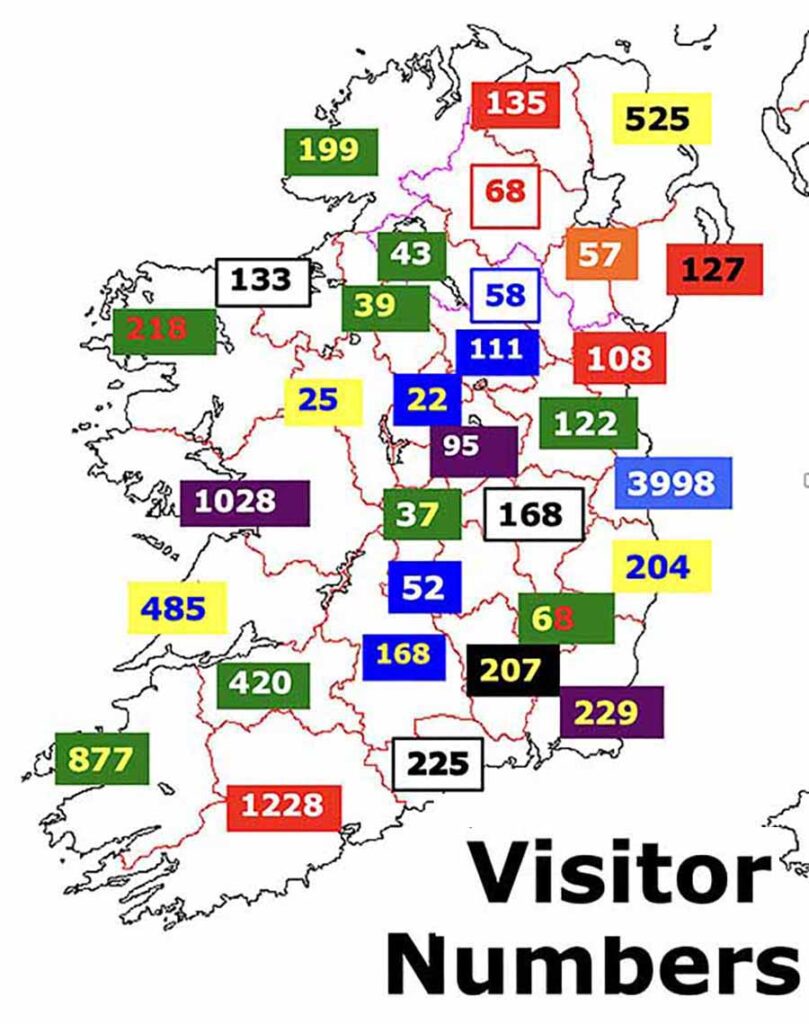
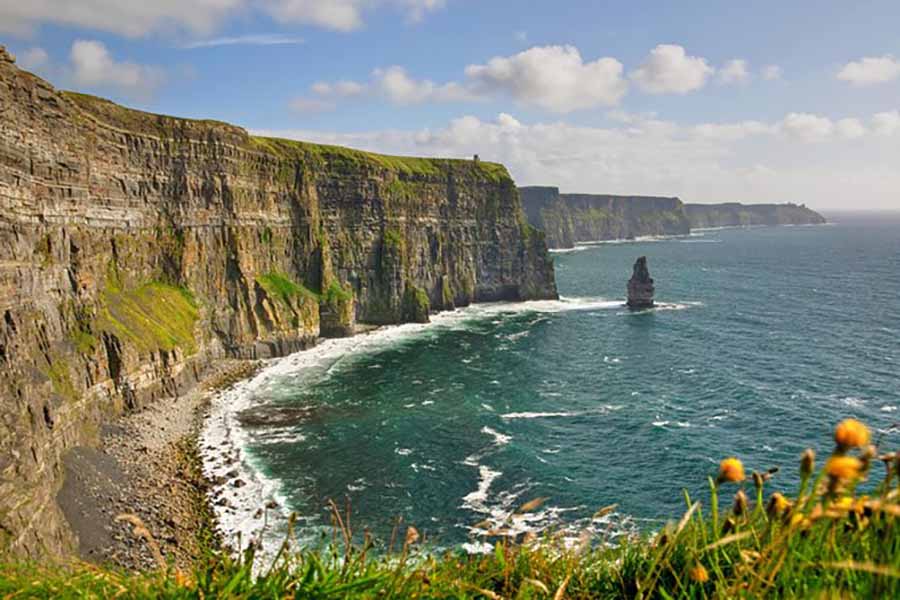
Ireland’s county Clare is renowned for its dramatic cliffs and traditional heritage, with the Cliffs of Moher offering breathtaking views over the Atlantic. The Burren’s unique limestone landscape provides hiking and rare flora, while Bunratty Castle offers medieval history with its restored interiors. Check out the traditional music scene in Doolin and the county’s coastal beaches. Clare is Ireland’s eighth largest county by size (3,188 square km) and 19th largest by population (127,938). Population peaked at 286,394 in 1841 and reached its lowest point, 73,597 in 1966. In terms of hospitality, Clare is Ireland’s sixth most visited tourist county with around 485,000 international visitors per year.
Introduction – Adventure – Anthem – Archaeology – Attractions – Awards – Birdwatching – Camping – Castles – Churches – Contact list – Cycling – Dining – Equestrian – Festivals – Fishing – Folklore – Gardens – Golf – Graveyards – Happening – Haunted – Highest – Hiking – History – Holy Wells – Hotels – Hotels top 8 – Hunting & shooting – Instagrammable – Itineraries – Largest town – Luxury – MICE – Movies – Music – New – Name – Novelists – Off the beaten track – Poets – Pubs – Quotes – Random Facts – Restaurant Awards – Sacred Places – Saints –Songs – Spas – Sports – Sunsets – Sustainable – Things to do – Towns – Video – Villages – Walking – Wanderlist – Weddings – Wild swimming – Writers – 1837– 1846 – 1852 – 1909 – 1955 – 1980 –