- Saint Finbarr (Finnbarr): September 25, c. 550–623: Cork City (St. Fin Barre’s Cathedral), Gougane BarraPatron saint of Cork, Finbarr founded a monastery at Gougane Barra, a remote lake in west Cork, before establishing a major monastic school in Cork City, now the site of St. Fin Barre’s Cathedral (Church of Ireland). Known for miracles, including parting waters, he is said to have been guided by an angel to the Lee Valley. His Life describes his asceticism and influence, with the cathedral and Gougane Barra’s oratory as pilgrimage sites.
- Saint Fachtna (Fachanan): August 14, c. 6th century: Rosscarbery (Cathedral Church of St. Fachtna)Fachtna founded a monastic school at Rosscarbery, a key center of learning in Munster. Possibly a disciple of St. Finbarr, he trained saints like St. Brendan. Known for his wisdom, he is patron of the Diocese of Ross. The Cathedral Church of St. Fachtna (Church of Ireland) in Rosscarbery honors him, and his feast is recorded in the Martyrology of Donegal. His holy well remains a local pilgrimage site.
- Saint Colman of Cloyne: November 24, c. 530–606: Cloyne (St. Colman’s Cathedral)Patron of the Diocese of Cloyne, Colman was a poet and royal bard before converting to Christianity under St. Brendan. He founded a monastery at Cloyne, which became a diocesan center. Known for his eloquence and missionary work, his feast is noted in the Martyrology of Oengus. St. Colman’s Cathedral (Church of Ireland) and a holy well in Cloyne preserve his legacy.
- Saint Ciaran of Cape Clear: March 5, c. 5th–6th century: Cape Clear Island (Sherkin and Cape Clear parish)Ciaran, possibly distinct from St. Ciaran of Saighir, is associated with Cape Clear Island, where he is venerated as a local saint. Tradition holds he was one of the pre-Patrician saints who Christianized Munster. His church and holy well on the island are pilgrimage sites, and his feast is recorded in local traditions, reflecting Cork’s coastal monastic heritage.
- Saint Nessan: December 1, c. 6th century: Mungret (historically linked to Cork’s monastic network)Nessan, a disciple of St. Finbarr, founded a monastery at Mungret, near Cork’s diocesan boundaries. Known for his ascetic life, he is venerated in Cork through his association with Finbarr’s school. His feast is noted in the Martyrology of Donegal, and his influence extends to Cork’s early Christian communities, particularly in the Diocese of Cork and Ross.
- Saint Gobnait: February 11, c. 6th century: BallyvourneyGobnait, a female saint, founded a monastery at Ballyvourney, where she is patroness. Known for her healing miracles, particularly using bees, she is linked to St. Finbarr’s school. Her holy well, statue, and church at Ballyvourney are pilgrimage sites, especially during her pattern day. Her feast is recorded in the Martyrology of Oengus, and she is a beloved figure in west Cork.
- Saint Molaga: January 20, c. 6th–7th century: Timoleague, AghacrossMolaga founded a monastery at Timoleague, where his church and holy well are preserved. Born in Fermoy, he studied under St. David in Wales and is known for miracles, including curing leprosy. His feast is noted in the Martyrology of Donegal, and Aghacross parish also claims his association. Timoleague’s Franciscan friary later honored his legacy.
- Saint Buite (Boetius): December 7, c. 5th–6th century: Buttevant (historically linked)Buite, founder of Monasterboice in Louth, is traditionally linked to Buttevant in north Cork, named after him (from French Botavant). A disciple of St. Patrick, he is known for miracles, including raising the dead. His feast is recorded in the Martyrology of Oengus, and his influence in Cork reflects the county’s ties to early Ulster monasticism.
- Saint Declan of Ardmore: July 24, c. 5th century: Youghal (historically linked to Cloyne Diocese)Declan, a pre-Patrician saint, is primarily associated with Ardmore, Waterford, but his missionary work extended to Youghal in east Cork, within the Cloyne Diocese. He founded a monastery at Ardmore and is known for converting the Déisi tribe. His feast is noted in the Martyrology of Donegal, and Youghal’s St. Mary’s Collegiate Church reflects his regional influence.
- Saint Garbhán: March 26, c. 6th century: KinsaleGarbhán, a disciple of St. Finbarr, founded a church at Kinsale, possibly Dungarvan, Waterford, due to name confusion. His feast is recorded in the Martyrology of Oengus, and his work strengthened Cork’s monastic network. Kinsale’s parish history acknowledges his role, though details are sparse, reflecting the obscurity of many local saints.
- Saint Fanahan (Fionnchú): November 25, c. 7th century: Mitchelstown (Brigown)Fanahan, a warrior-monk, founded a monastery at Brigown, near Mitchelstown, in north Cork. Known for his martial prowess and miracles, his Life describes him as a fierce defender of faith. His holy well and church at Brigown are pilgrimage sites, and his feast is noted in the Martyrology of Donegal. Mitchelstown parish venerates him as a local patron.
- Saint Colman of Kinneigh: October 27, c. 6th century: KinneighColman, distinct from Colman of Cloyne, founded a monastery at Kinneigh in west Cork, within the Diocese of Cork and Ross. Little is known of his life, but his feast is recorded in Irish martyrologies, and his church site at Kinneigh preserves his legacy. His work reflects Cork’s dense network of small monastic foundations.
Saints
Antrim – Armagh – Carlow – Cavan – Clare – Cork – Derry – Donegal – Down – Dublin – Fermanagh – Galway – Kerry – Kildare – Kilkenny – Laois – Leitrim – Limerick – Longford – Louth – Mayo – Meath – Monaghan – Offaly – Roscommon – Sligo – Tipperary – Tyrone – Waterford – Westmeath – Wexford – Wicklow
Sacred Places
Antrim – Armagh – Carlow – Cavan – Clare – Cork – Derry – Donegal – Down – Dublin – Fermanagh – Galway – Kerry – Kildare – Kilkenny – Laois – Leitrim – Limerick – Longford – Louth – Mayo – Meath – Monaghan – Offaly – Roscommon – Sligo – Tipperary – Tyrone – Waterford – Westmeath – Wexford – Wicklow
Holy Wells
Antrim – Armagh – Carlow – Cavan – Clare – Cork – Derry – Donegal – Down – Dublin – Fermanagh – Galway – Kerry – Kildare – Kilkenny – Laois – Leitrim – Limerick – Longford – Louth – Mayo – Meath – Monaghan – Offaly – Roscommon – Sligo – Tipperary – Tyrone – Waterford – Westmeath – Wexford – Wicklow
County Cork:
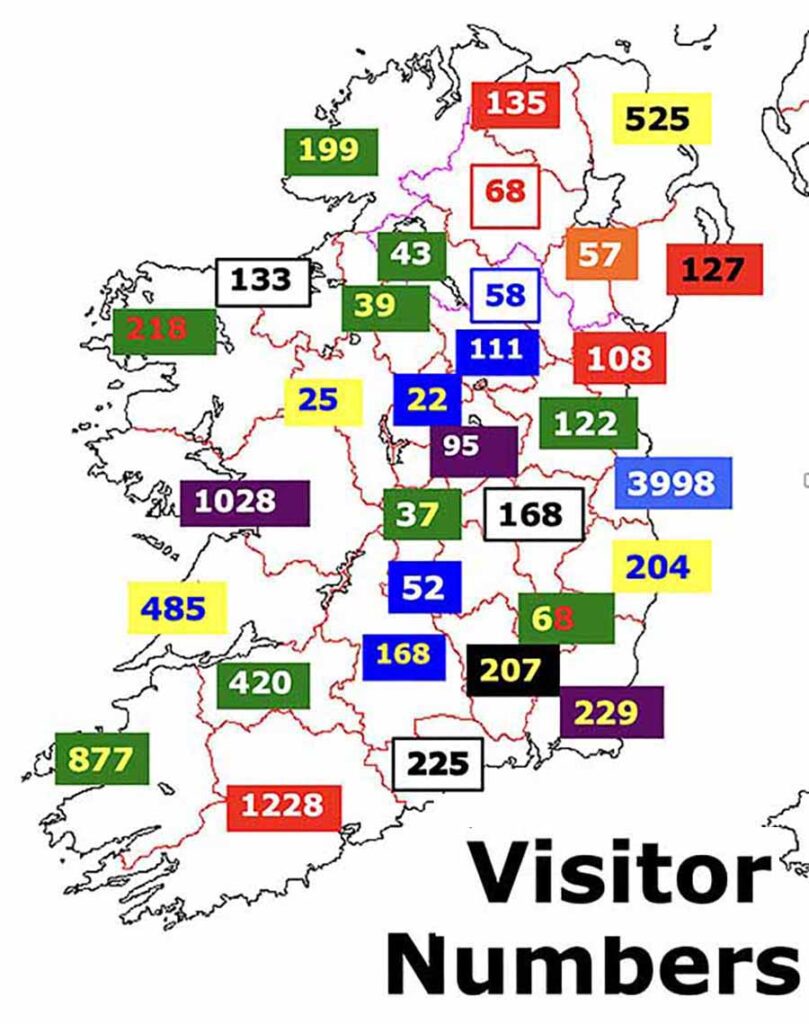
Ireland’s county Cork blends historic sites with scenic beauty, with Cork City’s English Market and St Fin Barre’s Cathedral offering cultural and architectural depth. Blarney Castle, home to the famous Blarney Stone, provides historic allure, while the coastal town of Kinsale offers sailing and seafood. Other attractions include the Beara Peninsula’s rugged trails. Cork is Ireland’s largest county by size (7,460 sq km) and third largest by population (584,156). Population peaked at 854,118 in 1841 (when Cork was Ireland’s most populous county) and reached its lowest point, 330,443 in 1961. In terms of hospitality, Cork is Ireland’s second most visited tourist county with around 1,228,000 international visitors per year.
Introduction – Adventure – Anthem – Archaeology – Attractions – Awards – Birdwatching – Camping – Castles – Churches – Contact list – Cycling – Dining – Equestrian – Festivals – Fishing – Folklore – Gardens – Golf – Graveyards – Happening – Haunted – Highest – Hiking – History – Holy Wells – Hotels – Hotels top 8 – Hunting & shooting – Instagrammable – Itineraries – Largest town – Luxury – MICE – Movies – Music – New – Name – Novelists – Off the beaten track – Poets – Pubs – Quotes – Random Facts – Restaurant Awards – Sacred Places – Saints – Songs – Spas – Sports – Sunsets – Sustainable – Things to do – Towns – Video – Villages – Walking – Wanderlist – Weddings – Wild swimming – Writers – 1837– 1846 – 1852 – 1909 – 1955 – 1980 –