Pre-1000 The Gaelic Nation
County Cork’s pre-1000 history is rooted in its role within the Eóganachta kingdoms, a powerful Munster dynasty. Archaeological sites, such as the ringforts at Garranes and the ogham stones in west Cork, indicate settlement from the Bronze and Iron Ages. The Eóganachta, based at Cashel but influential in Cork, controlled the region, with the Uí Liatháin and House of Fidgent as local sub-kingdoms. Christianity arrived by the 5th century, with Saint Finbarr founding a monastery at Cork (Gougane Barra and later Cork city) around 606 CE, establishing it as a religious centre. The Annals of Inisfallen, compiled in Cork, record early monastic activity and Viking raids on coastal sites like Youghal and Kinsale from the 9th century. Cork’s strategic ports made it a target, but inland areas remained Gaelic. Ecclesiastical sources dominate, potentially exaggerating Christian influence while marginalising pre-Christian Gaelic culture.
1000–1100: Viking Settlement and Eóganachta Decline
The 11th century saw Cork’s coastal areas shaped by Viking settlement. The Norse established a trading port at Cork city by 915, integrating it into their Dublin-Waterford network. The Annals of Inisfallen (record Viking raids and alliances with local Gaelic lords, particularly the Eóganachta, who faced challenges from the rising Dál gCais under Brian Boru. The Battle of Clontarf (1014) weakened Viking influence, but Cork remained a mixed Gaelic-Norse hub. The monastery at Cork continued as a centre of learning, producing the Annals. Norse and ecclesiastical sources dominate, potentially overshadowing Gaelic secular life.
1100–1200: Norman Invasion and Gaelic Resistance
The Norman invasion (1169–1171) transformed Cork. In 1177, Robert FitzStephen and Milo de Cogan were granted the “kingdom of Cork” by Henry II, targeting the city and surrounding areas. The Normans built castles, such as those at Bandon and Castlemartyr, to secure their hold. The Eóganachta and their sub-clans, like the MacCarthys, resisted, retreating to west Cork. The establishment of Cistercian monasteries, such as Tracton Abbey (c. 1224), introduced European influences. The Annals of Inisfallen (record Gaelic resistance, while the “Song of Dermot and the Earl” (highlights Norman conquests. Cork’s ports grew as trade hubs, but Norman records dominate, often marginalising Gaelic perspectives.
1200–1300: Anglo-Norman Consolidation and MacCarthy Power
In the 13th century, Cork was formally shired, though its boundaries included parts of modern Kerry. The Normans consolidated control, with families like the Barrys and Roches dominating east Cork. The MacCarthys, led by figures like Dermot MacCarthy (d. 1224), maintained power in west Cork, establishing Desmond as a semi-autonomous Gaelic lordship. Cork city grew as a walled port, with charters granted in 1242. Religious houses, including the Franciscan friary in Youghal, flourished. The county’s fertile lands and ports supported trade, but Norman sources overemphasise their control, requiring balance with Gaelic records.
1300–1400: Gaelic Revival and Desmond Autonomy
The 14th century saw a Gaelic revival in Cork, as Anglo-Norman power weakened post-Black Death (1348–1350). The MacCarthys, under leaders like Cormac MacCarthy (d. 1359), expanded their Desmond territory, resisting English authority. The Statute of Kilkenny (1366) had limited impact in Cork, where Gaelic law prevailed in west Cork. Cork city remained an Anglo-Norman hub, but the Barrys and Roches adopted Gaelic customs, a process of Gaelicisation.. The period saw cultural flourishing, with Gaelic poetry and music thriving. English sources portray Gaelic lords as chaotic, necessitating critical interpretation.
1400–1500: MacCarthy Dominance and English Decline
The 15th century saw the MacCarthys dominate west Cork, with their seat at Blarney Castle. The Desmond earldom, under figures like James Fitzgerald (d. 1463), extended influence into Cork, though the fungerar the county remained divided between Anglo-Irish and Gaelic lords. The Wars of the Roses (1460–1485) weakened English control, allowing Gaelic and Anglo-Irish autonomy. Cork city’s trade grew, but rural areas remained Gaelic. Gaelic sources are scarce, and English records tend to downplay local agency.
1500–1600: Tudor Reconquest and MacCarthy Resistance
The 16th century brought Tudor efforts to control Cork. The MacCarthys, under leaders like Florence MacCarthy (d. 1611), resisted, with Florence briefly uniting Desmond before his arrest in 1601. The Reformation had limited impact, as Cork remained Catholic. Early plantation efforts saw English settlers in east Cork, but west Cork stayed Gaelic. The Nine Years’ War (1594–1603) saw Cork as a supply base for English forces. The English records portray the MacCarthys as rebels, requiring careful interpretation.
1600–1700: Plantations and Confederate Wars
The 17th century saw significant English colonisation in Cork. The Munster Plantation (1580s–1600s) granted lands to English settlers, particularly in east Cork, displacing Gaelic families. The 1641 Rebellion saw Cork as a Confederate stronghold, with figures like Donough MacCarthy, Viscount Muskerry, leading Catholic forces. The Cromwellian conquest (1649–1653) led to massive land confiscations, with Cork’s fertile lands redistributed to English settlers. The Williamite War (1689–1691) solidified Colonial/protestan control, with Cork city a key English base. The Annals of the Four Masters document Gaelic losses. English sources vilify Catholic rebels, necessitating critical reading.
1700–1800: Protestant Ascendancy and Economic Growth
The 18th century saw Cork under the Colonial/Protestant Ascendancy, with Anglo-Irish landlords dominating. Cork city grew as a major port, exporting butter and beef to England and the Americas. The Penal Laws marginalised Catholics, who formed the majority in rural Cork. The county’s maritime trade, particularly in Youghal and Kinsale, flourished. The 1798 Rebellion saw limited activity in Cork, but local Catholic discontent fueled United Irishmen support. The Act of Union (1800) strengthened English control. English and colonial narratives tend to downplay native Irish or Catholic grievances.
1800–1900: Famine, Industry, and Nationalism
The 19th century was marked by hardship and transformation. The Great Famine (1845–1849) devastated Cork, reducing its population from 854,000 in 1841 to 650,000 in 1851 due to starvation, disease, and emigration. Cork city’s port facilitated mass emigration. The butter and brewing industries (e.g., Murphy’s Brewery) grew, with railways enhancing connectivity. The Gaelic Revival saw the Gaelic League promote Irish language and culture, with Cork’s poets and musicians prominent. The GAA, founded in 1884, established strong hurling and football clubs. The Home Rule movement, led locally by figures like William O’Brien, gained traction. English famine records tend to understate suffering, while corkpastandpresent.ie offers local perspectives.
1900–2025: Independence, Conflict, and Modernisation
The 20th and 21st centuries saw Cork play a central role in Ireland’s independence. The War of Independence (1919–1921) was intense in Cork, with IRA leaders like Tom Barry and Michael Collins active. The burning of Cork city (1920) by English forces was a pivotal event. The Civil War (1922–1923) saw heavy fighting, with Cork a stronghold of resistance. Post-independence, Cork’s economy diversified, with industries like Ford’s factory (1917–1984) and tourism around Blarney Castle. Cork’s GAA tradition flourished, with multiple All-Ireland hurling titles. The county became a cultural hub, with festivals like the Cork Jazz Festival. Recent decades saw tech industry growth and infrastructure improvements. Official narratives tend to overemphasise progress, overlooking rural challenges. Cork is one of 24 Irish counties that still has a smaller population than it did in 1841.
History
Antrim – Armagh – Carlow – Cavan – Clare – Cork – Derry – Donegal – Down – Dublin – Fermanagh – Galway – Kerry – Kildare – Kilkenny – Laois – Leitrim – Limerick – Longford – Louth – Mayo – Meath – Monaghan – Offaly – Roscommon – Sligo – Tipperary – Tyrone – Waterford – Westmeath – Wexford – Wicklow
County Cork:
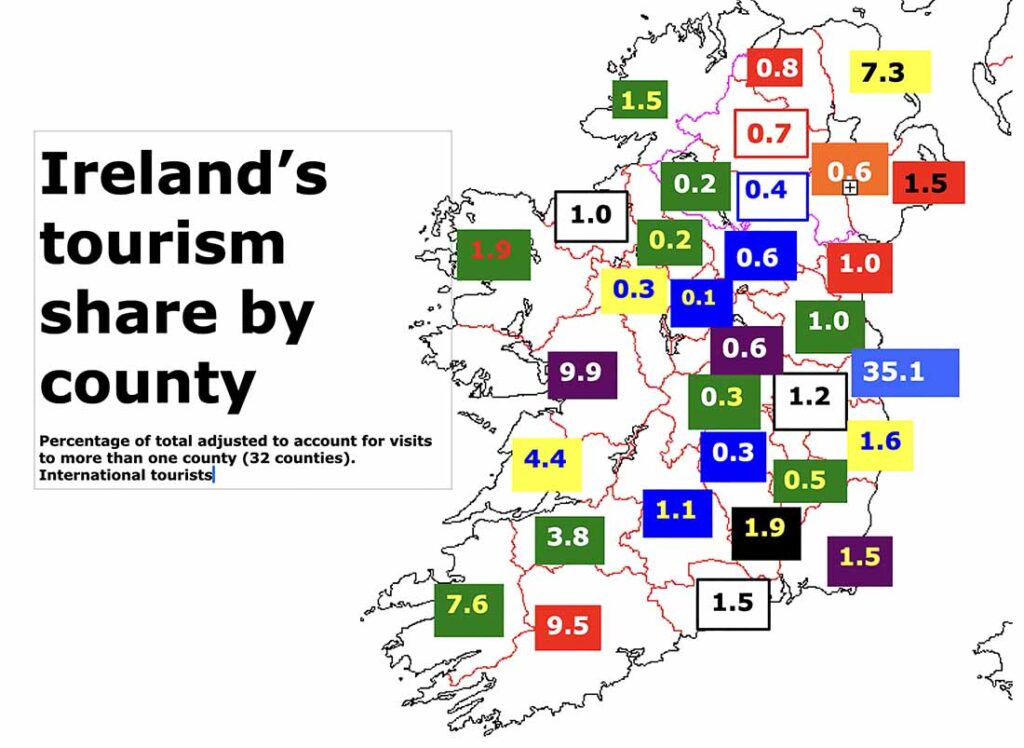
Ireland’s county Cork blends historic sites with scenic beauty, with Cork City’s English Market and St Fin Barre’s Cathedral offering cultural and architectural depth. Blarney Castle, home to the famous Blarney Stone, provides historic allure, while the coastal town of Kinsale offers sailing and seafood. Other attractions include the Beara Peninsula’s rugged trails. Cork is Ireland’s largest county by size (7,460 sq km) and third largest by population (584,156). Population peaked at 854,118 in 1841 (when Cork was Ireland’s most populous county) and reached its lowest point, 330,443 in 1961. In terms of hospitality, Cork is Ireland’s second most visited tourist county with around 1,228,000 international visitors per year.
Introduction – Adventure – Anthem – Archaeology – Attractions – Awards – Birdwatching – Camping – Castles – Churches – Contact list – Cycling – Dining – Equestrian – Festivals – Fishing – Folklore – Gardens – Golf – Graveyards – Happening – Haunted – Highest – Hiking – History – Holy Wells – Hotels – Hotels top 8 – Hunting & shooting – Instagrammable – Itineraries – Largest town – Luxury – MICE – Movies – Music – New – Name – Novelists – Off the beaten track – Poets – Pubs – Quotes – Random Facts – Restaurant Awards – Sacred Places – Saints – Songs – Spas – Sports – Sunsets – Sustainable – Things to do – Towns – Video – Villages – Walking – Wanderlist – Weddings – Wild swimming – Writers – 1837– 1846 – 1852 – 1909 – 1955 – 1980 –