- Christ Church Cathedral, Dublin: Designed by Unknown (medieval, with 19th-century restoration by George Edmund Street). Founded in 1030 by Sitric Silkenbeard, this Church of Ireland cathedral features Gothic and Romanesque elements.Originally a Catholic worship site, this cathedral was repurposed for the Anglican/Episcopalian colonial community after England’s King Henry VIII broke with the church in 1534. It was extensively restored in the 1870s and houses the tomb of Strongbow. Christchurch Place, Dublin 8.
- Saint Patrick’s Cathedral, Dublin: Designed by Unknown (medieval, with 19th-century restoration by Benjamin Lee Guinness). Built in 1191 beside a well where St Patrick baptised converts, this Church of Ireland cathedral features a Gothic nave and the longest medieval choir in Ireland. It is associated with Jonathan Swift, its former dean. St Patrick’s Close, Dublin 8. Originally a Catholic worship site, this cathedral was repurposed for the Anglican/Episcopalian colonial community after England’s King Henry VIII broke with the church in 1534.
- Saint Mary’s Pro-Cathedral, Dublin: Designed by John Sweetman. Completed in 1825, this Catholic pro-cathedral features a neo-Classical design with a Doric portico. It serves as Dublin’s Catholic cathedral pending a permanent seat for the archdiocese. Marlborough Street, Dublin 1. Designated as a pro-cathedral it is to be elevated to full cathedral status, restring Dublin’s status a s a cathedral city last held in 1537.
- Saint Audoen’s Church, Dublin: Designed by Unknown (medieval, with later additions). Built in the 12th century, this Church of Ireland church is Dublin’s oldest parish church. It features a Norman tower and a 15th-century nave, with a visitor centre showcasing its medieval history. Cornmarket, Dublin 8.
- Saint Ann’s Church, Dublin: Designed by Isaac Wills. Constructed in 1720, this Church of Ireland church features a Georgian design with a neo-Romanesque façade added in 1868. It houses a bread shelf for the poor, established in 1723. Dawson Street, Dublin 2.
- Saint Michan’s Church, Dublin: Founded in 1095, this Church of Ireland church was rebuilt in 1686. It features a 17th-century organ and crypts with mummified remains, sadly no longer open to the public after a vandalism incident. Church Street, Dublin 7.
- Saint Werburgh’s Church, Dublin: Designed by Thomas Burgh. Built in 1719, this Church of Ireland church features a Baroque design with a planned spire never completed. It houses the tomb of Lord Edward FitzGerald, a 1798 rebellion leader. Werburgh Street, Dublin 8.
- Saint Mary’s Church, Donnybrook EAS: Constructed in 1834, this Catholic church features a simple Gothic Revival design. It serves the Donnybrook parish and reflects early 19th-century Catholic architecture. Mary’s Street, Donnybrook, Dublinව.
- Saint Teresa’s Church, Raheny: Built in 1832, this Catholic church features a Gothic Revival design with a prominent tower. It serves the Raheny community and is linked to the 1798 rebellion.Main Street, Raheny.
- Saint Francis Xavier’s Church, Dublin: Designed by Augustus Welby Pugin. Completed in 1866, this Catholic church features a High Victorian Gothic design. It serves the Clontarf area and was built to replace an earlier chapel. Clontarf Road, Dublin 3.
Churches
Antrim – Armagh – Carlow – Cavan – Clare – Cork – Derry – Donegal – Down – Dublin – Fermanagh – Galway – Kerry – Kildare – Kilkenny – Laois – Leitrim – Limerick – Longford – Louth – Mayo – Meath – Monaghan – Offaly – Roscommon – Sligo – Tipperary – Tyrone – Waterford – Westmeath – Wexford – Wicklow
Holy Wells
Antrim – Armagh – Carlow – Cavan – Clare – Cork – Derry – Donegal – Down – Dublin – Fermanagh – Galway – Kerry – Kildare – Kilkenny – Laois – Leitrim – Limerick – Longford – Louth – Mayo – Meath – Monaghan – Offaly – Roscommon – Sligo – Tipperary – Tyrone – Waterford – Westmeath – Wexford – Wicklow
Sacred Places
Antrim – Armagh – Carlow – Cavan – Clare – Cork – Derry – Donegal – Down – Dublin – Fermanagh – Galway – Kerry – Kildare – Kilkenny – Laois – Leitrim – Limerick – Longford – Louth – Mayo – Meath – Monaghan – Offaly – Roscommon – Sligo – Tipperary – Tyrone – Waterford – Westmeath – Wexford – Wicklow
Saints
Antrim – Armagh – Carlow – Cavan – Clare – Cork – Derry – Donegal – Down – Dublin – Fermanagh – Galway – Kerry – Kildare – Kilkenny – Laois – Leitrim – Limerick – Longford – Louth – Mayo – Meath – Monaghan – Offaly – Roscommon – Sligo – Tipperary – Tyrone – Waterford – Westmeath – Wexford – Wicklow
County Dublin:
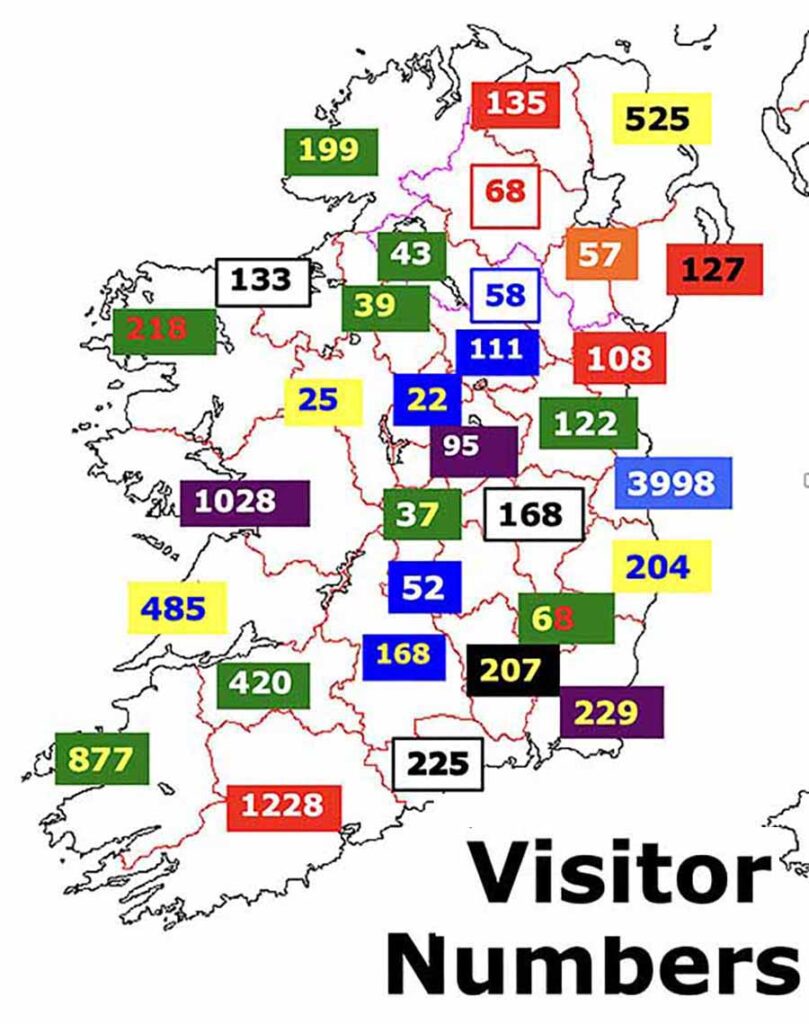
Ireland’s county Dublin combines cultural heritage with urban appeal, with Trinity College’s Book of Kells and Dublin Castle offering historical depth. The Guinness Storehouse provides a journey through Ireland’s iconic stout, while Phoenix Park’s vast green spaces are ideal for cycling. The River Liffey’s scenic walks and Kilmainham Gaol’s historical tours make Dublin a versatile destination for culture and history. Dublin is Ireland’s third smallest county by size (922 square km) and largest by population (1,458,154). Dublin is also Ireland’s most visited tourist county by a margin, with around four million international visitors per year. In terms of hospitality,
Introduction – Adventure – Anthem – Archaeology – Attractions – Awards – Birdwatching – Camping – Castles – Churches – Contact list – Cycling – Dining – Equestrian – Festivals – Fishing – Folklore – Gardens – Golf – Graveyards – Happening – Haunted – Highest – Hiking – History – Holy Wells – Hotels – Hotels top 8 – Hunting & shooting – Instagrammable – Itineraries – Largest town – Luxury – MICE – Movies – Music – New – Name – Novelists – Off the beaten track – Poets – Pubs – Quotes – Random Facts – Restaurant Awards – Sacred Places – Saints – Songs – Spas – Sports – Sunsets – Sustainable – Things to do – Towns – Video – Villages – Walking – Wanderlist – Weddings – Wild swimming – Writers – 1837 – 1846 – 1852 – 1909 – 1955 – 1980 –