- “We are the people, of the purple and gold.” — Michael Fortune, from the poem “We are Wexford”.
- “A thousand mushrooms crowd to a keyhole / In the disused shed in Co. Wexford.” — Derek Mahon, “A Disused Shed in Co. Wexford”.
- The word ‘husbandry’ comes readily to mind in any description of the south-east corner of Ireland, an area embracing the counties of Wexford and Waterford with South Kilkenny thrown in for good measure – Bryan MacMahon 1909-1998), Here’s Ireland (1971).
- Before dinner had a most delicious walk by myself along the banks of the river Slaney, which, for two or three miles out of the town, are full of beauty, and this sunny evening was quite worthy of them. It was likewise delightful to me to be aloru in such a scene, for it is only alone I can enjoy Nature thoroughly; men and women disturb such scenes dreadfully. – Thomas Moore, Diary, 25 August 1835
- “There is a county where we might seek more of stormy romance, and there is a county where prospers a shrewder economy, but no county in Ireland is fitter for freedom than Wexford. They are a peculiar people—these Wexford men. Their blood is for the most part English and Welsh, though mixed with the Danish and Gaelic, yet they are Irish in thought and feeling.” Thomas Davis.
- The delighting Wexford countryside is perhaps a shade too tamed for an eye accustomed to the savage dimensions of the western seaboard, but it is still admirable in its eastern context – Bryan MacMahon 1909-1998), Here’s Ireland (1971).
- “Few towns like Wexford Town, Loch Garman, can boast a millennium of nautical involvement in which its shallow estuary has been a gateway to waves of invaders.” — John O’Donnell
- “Wexford, my crystal city fair / Wexford, there’s no place to compare / Near or far, no matter where I roam / My heart is always with you Waterford my home.” — Traditional.
- “Were you ever in dear old Wexford, where flows the silvery Slaney…” — Traditional.
- “Let them not forget us, the weak souls among the asphodels… Even now there are places where a thought might grow, Peruvian mines, worked out and abandoned A Disused Shed in Co. Wexford.” — Derek Mahon (1941–2020), from the poem “A Disused Shed in Co. Wexford”.
- Pray observe the inhabitants about Wexford; they are old English; see what they have particular in their manners, names, and language: magpies have always been there, and no where else in Ireland, till of late years. They say the cocks and dogs go to sleep at noon, and so do the people. – Jonathan Swift Journal to Stella, July 1711
- Between the counttes of Wexford and Waterford, the sister rivers, Barrow, Nore, and Suir, now conjoined, enter the sea in estuarine pride. Not far from the point of confluence, on the Wexford side, lies the sea-coast village of Bannow where, in 1169, the Normans first landed in Ireland. – Bryan MacMahon 1909-1998), Here’s Ireland (1971).
- “Oh! ye whom business or pleasure shall henceforth lead to the county of Wexford, especially to the baronies of Forth and Bargie, should you see a tall, stout, lazy-looking fellow, with sleepy eyes and huge cocked nose, dragging his feet along as if they were clogs imposed on him by nature to restrain his motion instead of helping him forward, dawdling along the highways, or lounging about a public-house, with a green bag under his arm, beware of him, for that is Tim Callaghan!—fling him a sixpence or shilling if you will, but ask him not for music!” – Dublin Penny Journal.
- “There is an old tradition sacred held in Wexford town, / That says: ‘Upon St. Martin’s Eve no net shall be let down'” — John Boyle O’Reilly, from the poem “The Fishermen of Wexford”.
- “Wexford, indeed, is quite a model town in the Catholic Church, no people in the world, perhaps, not excepting the Romans themselves, more abundantly supplied with masses. There is a mass for workingmen at five o’clock in the morning, there are masses daily during the week at later hours, and no less than six or seven on Sundays in each of the principal chapels, or churches as they are now generally called.” –The Catholic World, April 1867 to September 1867
- One finds Wexford town still branded with the aftermath of the 1798 revolt. If there are statues they represent pikemen who so valiantly rose; if a band comes marching downstreet, it’s odds-on it’s playing The Boys of Wexford or Kelly of Killanne; if a voice is raised in erratic porter melody, it’s probable that the ballad lauds the priest-rebel ‘Father Murphy of the County Wexford’ who ‘swept o’er the land like a mighty wave’, and if a seanchaf is in yarning form, he’ll likely tell of the rebel duckshooting lads from the dunes who filled their satchels with grain and chewed it in lieu of battle commissariat – Bryan MacMahon 1909-1998), Here’s Ireland (1971).
- “Look out for hirelings, King George of England/ Search every kingdom where breathes a slave,/ For Father Murphy of County Wexford/ Sweeps o’er the land like a mighty wave” _ PJ McCall, lyrics of Boolavogue.
- “I was the worst barman who ever lived. My pints of Guinness were unholy.” — Colm Tóibín (b. 1955), in his first job Enniscorthy, County Wexford.
Famous quotes from Ireland’s counties
Antrim – Armagh – Carlow – Cavan – Clare – Cork – Derry – Donegal – Down – Dublin – Fermanagh – Galway – Kerry – Kildare – Kilkenny – Laois – Leitrim – Limerick – Longford – Louth – Mayo – Meath – Monaghan – Offaly – Roscommon – Sligo – Tipperary – Tyrone – Waterford – Westmeath – Wexford – Wicklow
Musicians
Antrim – Armagh – Carlow – Cavan – Clare – Cork – Derry – Donegal – Down – Dublin – Fermanagh – Galway – Kerry – Kildare – Kilkenny – Laois – Leitrim – Limerick – Longford – Louth – Mayo – Meath – Monaghan – Offaly – Roscommon – Sligo – Tipperary – Tyrone – Waterford – Westmeath – Wexford – Wicklow
Novelists
Antrim – Armagh – Carlow – Cavan – Clare – Cork – Derry – Donegal – Down – Dublin – Fermanagh – Galway – Kerry – Kildare – Kilkenny – Laois – Leitrim – Limerick – Longford – Louth – Mayo – Meath – Monaghan – Offaly – Roscommon – Sligo – Tipperary – Tyrone – Waterford – Westmeath – Wexford – Wicklow
Poets
Antrim – Armagh – Carlow – Cavan – Clare – Cork – Derry – Donegal – Down – Dublin – Fermanagh – Galway – Kerry – Kildare – Kilkenny – Laois – Leitrim – Limerick – Longford – Louth – Mayo – Meath – Monaghan – Offaly – Roscommon – Sligo – Tipperary – Tyrone – Waterford – Westmeath – Wexford – Wicklow
Writers
Antrim – Armagh – Carlow – Cavan – Clare – Cork – Derry – Donegal – Down – Dublin – Fermanagh – Galway – Kerry – Kildare – Kilkenny – Laois – Leitrim – Limerick – Longford – Louth – Mayo – Meath – Monaghan – Offaly – Roscommon – Sligo – Tipperary – Tyrone – Waterford – Westmeath – Wexford – Wicklow
County Wexford:
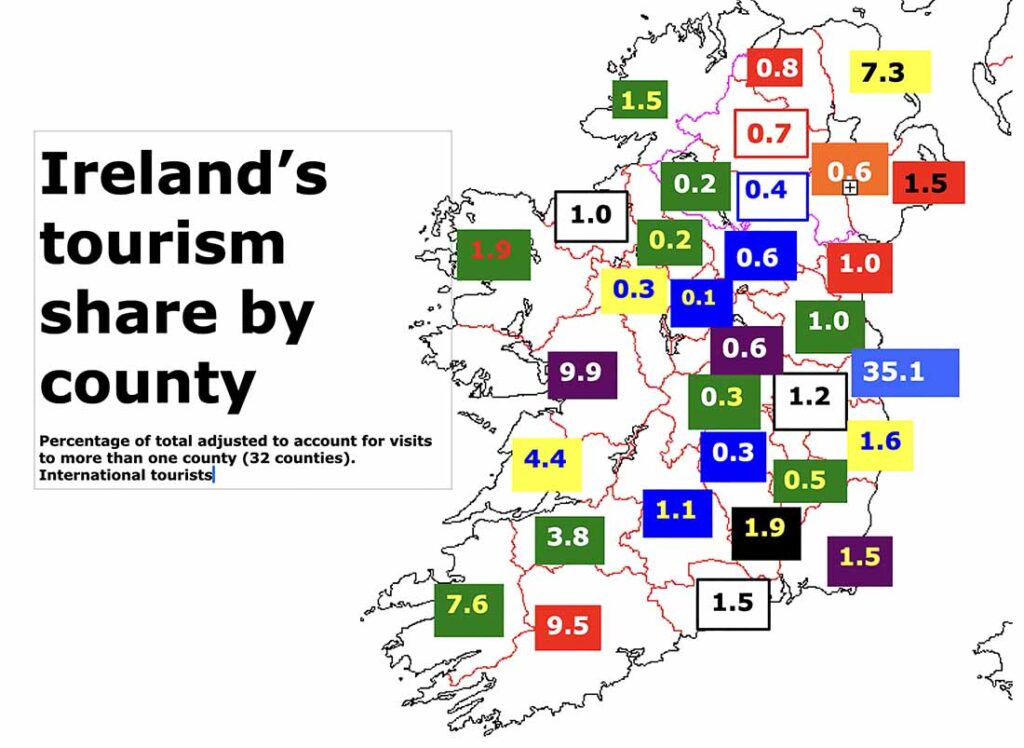
Ireland’s county Wexford combines coastal beauty with historic sites, with the Hook Lighthouse, one of the world’s oldest, offering scenic coastal views. The Irish National Heritage Park recreates ancient and medieval settlements, while Wexford’s beaches, like Curracloe, provide sandy shores for walking. Other attractions include the historic town of Enniscorthy and its castle. Wexford is Ireland’s 13th largest county by size (2,351 square km) and 14th largest by population (163,919). Population peaked at 202,033 in 1841 and reached its lowest point, 83,308 in 1961. In terms of hospitality, Wexford is Ireland’s eighth most visited tourist county with around 229,000 international visitors per year.
Introduction – Adventure – Anthem – Archaeology – Attractions – Awards – Birdwatching – Camping – Castles – Churches – Contact list – Cycling – Dining – Equestrian – Festivals – Fishing – Folklore – Gardens – Golf – Graveyards – Happening – Haunted – Highest – Hiking – History – Holy Wells – Hotels – Hotels top 8 – Hunting & shooting – Instagrammable – Itineraries – Largest town – Luxury – MICE – Movies – Music – Name – New – Novelists – Off the beaten track – Poets – Pubs – Quotes – Random Facts – Restaurant Awards – Sacred Places – Saints – Songs – Spas – Sports – Sunsets – Sustainable – Things to do – Towns – Video – Villages – Walking – Wanderlist – Weddings– Wild swimming – Writers – 1837 – 1846– 1852 – 1909 – 1955 – 1980 –