- “”From Bantry Bay up to Derry Quay / And from Galway to Dublin town, like the star fo the county Down.”
- “I have seen landscapes, notably in the Mourne Mountains and southwards which under a particular light made me feel that at any moment a giant might raise his head over the next ridge. I yearn to see County Down in the snow, one almost expects to see a march of dwarfs dashing past. How I long to break into a world where such things were true.’ – C. S. Lewis”
- The spokes that radiate through the hills from Hilltown, each in its own idiom, offers new and delightful prospects of excursion through the Mourne mountains. – Bryan MacMahon 1909-1998), Here’s Ireland (1971).
- The county Down is remarkable for its inequality of surface; for although the mountains are chiefly confined to the southern district, where they are magnificent, the lesser hills are abundant in all parts; hence it is said to have derived its ancient name. Dunum, “ which signifies a hill, or a hilly country – Samuel Carter Hall and Anna Maria Hall, Ireland, its scenery and character (1841-43)
- “Sweet Dromore, where they keep no Sunday, / And every day like an Easter Monday.” – Traditional.
- Let Down be famous for care-tilled earth, / for the little green hills and the harsh grey peaks, / the rocky bed of the Lagan’s birth, / the white farm fat in the August weeks.” — John Hewitt.
- “But for all that I’ve found there I might as well be / Where the Mountains of Mourne sweep down to the sea.” — Percy French (from The Mountains of Mourne)
- “For I alone / Have loved their loneliness; / None else hath known / Nor seen the goodliness / Of the green hills of Down.” — C.S. Lewis (from The Hills of Down)
- “So I’ll wait for the wild rose that’s waiting for me / Where the Mountains of Mourne sweep down to the sea.” — Percy French
- A land that ftoweth with milk and honey, a fertile soil truly if there be any in Europe, whether it be manured to com or left to grass. There is timber, stone, plaster, and slate commodious for building everywhere: abun dant, a country full of springs, rivers, and lakes, both small and great, full of excellent fish and fowl. – Thomas Smith,, c. 1571
- I’ve never gone to Donaghadee,/ That vague far town by the sea; In Donaghadee I shall never be/ Then why do I sing of Donaghadee. – Thomas Hardy, ‘Donaghadee’, Human Shows, 1925
- “In front of me, a lake lies like a mirror, and I break its surface, wash my face in its salty, ice cold water.” — Moyra Donaldson (from the poem ‘Nest’, set at Mahee Island/Nendrum).
- “And the sea-lough’s green mirror, / To the drumlins that dip to the shore” — John Hewitt.
- “Slieve Donard’s summit, a deafening hush / Time stands still no need to rush. / Absorb the view, take in the sights / And Wow! how Percy French was right! — Social media.
- All creeds lay claim to Downpatrick, a town that has its later history indicated in the nomenclature of its five quarters, now streets-Irish Quarter, English Quarter, Scotch Quarter, Windmill Quarter and Barracks Quarter – Bryan MacMahon 1909-1998), Here’s Ireland (1971).
- High Church; low steeple; Dirty town, proud people – Jonathan Swift’s couplet on Newry .
Famous quotes from Ireland’s counties
Antrim – Armagh – Carlow – Cavan – Clare – Cork – Derry – Donegal – Down – Dublin – Fermanagh – Galway – Kerry – Kildare – Kilkenny – Laois – Leitrim – Limerick – Longford – Louth – Mayo – Meath – Monaghan – Offaly – Roscommon – Sligo – Tipperary – Tyrone – Waterford – Westmeath – Wexford – Wicklow
Musicians
Antrim – Armagh – Carlow – Cavan – Clare – Cork – Derry – Donegal – Down – Dublin – Fermanagh – Galway – Kerry – Kildare – Kilkenny – Laois – Leitrim – Limerick – Longford – Louth – Mayo – Meath – Monaghan – Offaly – Roscommon – Sligo – Tipperary – Tyrone – Waterford – Westmeath – Wexford – Wicklow
Novelists
Antrim – Armagh – Carlow – Cavan – Clare – Cork – Derry – Donegal – Down – Dublin – Fermanagh – Galway – Kerry – Kildare – Kilkenny – Laois – Leitrim – Limerick – Longford – Louth – Mayo – Meath – Monaghan – Offaly – Roscommon – Sligo – Tipperary – Tyrone – Waterford – Westmeath – Wexford – Wicklow
Poets
Antrim – Armagh – Carlow – Cavan – Clare – Cork – Derry – Donegal – Down – Dublin – Fermanagh – Galway – Kerry – Kildare – Kilkenny – Laois – Leitrim – Limerick – Longford – Louth – Mayo – Meath – Monaghan – Offaly – Roscommon – Sligo – Tipperary – Tyrone – Waterford – Westmeath – Wexford – Wicklow
Writers
Antrim – Armagh – Carlow – Cavan – Clare – Cork – Derry – Donegal – Down – Dublin – Fermanagh – Galway – Kerry – Kildare – Kilkenny – Laois – Leitrim – Limerick – Longford – Louth – Mayo – Meath – Monaghan – Offaly – Roscommon – Sligo – Tipperary – Tyrone – Waterford – Westmeath – Wexford – Wicklow
County Down:
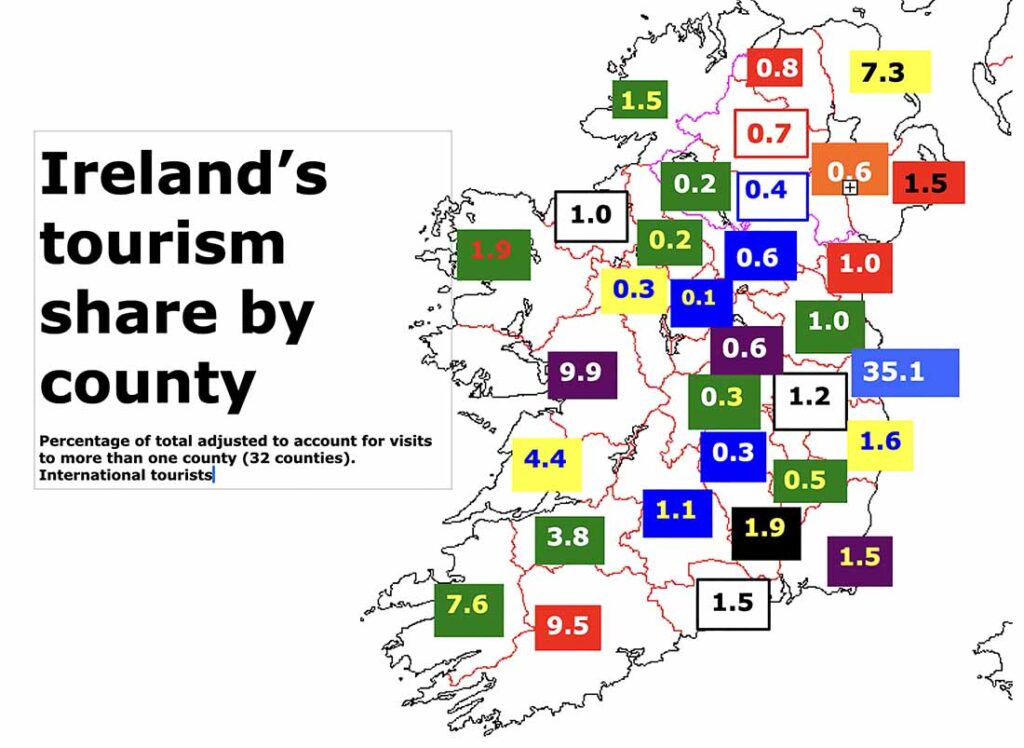
Ireland’s county Down offers a mix of historic sites and scenic landscapes, with Downpatrick’s Saint Patrick Centre and cathedral providing insights into Ireland’s patron saint. The Mourne Mountains offer hiking trails with sweeping views, while Strangford Lough provides kayaking and wildlife spotting. Other attractions include the historic Tollymore Forest Park. Down is Ireland’s 12th largest county by size (2,447 square km) and fourth largest by population (553,261). Population peaked at 361,446 in 1841 and reached its lowest point, 204,303, in 1911. In terms of hospitality, Down is Ireland’s 18th most visited tourist county with around 127,000 international visitors per year.
Introduction – Adventure – Anthem – Archaeology – Attractions – Awards – Birdwatching – Camping – Castles – Churches – Contact list – Cycling – Dining – Equestrian – Festivals – Fishing – Folklore – Gardens – Golf – Graveyards – Happening – Haunted – Highest – Hiking – History – Holy Wells – Hotels – Hotels top 8 – Hunting & shooting – Instagrammable – Itineraries – Largest town – Luxury – MICE – Movies – Music – New – Name – Novelists – Off the beaten track – Poets – Pubs – Quotes – Random Facts – Restaurant Awards – Sacred Places – Saints – Songs – Spas – Sports – Sunsets – Sustainable – Things to do – Towns – Video – Villages – Walking – Wanderlist – Weddings – Wild swimming – Writers – 1837 – 1846 – 1852 – 1909 – 1955 – 1980 –