- Saint Patrick: March 17, c. 385–461, St. Patrick’s Cathedral (Catholic and Church of Ireland), Armagh City, Eamhain Mhacha (Navan Fort), Ireland’s patron saint, Patrick was a Roman youth from a neighbouring country enslaved in Ireland before escaping and returning as a missionary. He established Armagh as the ecclesiastical capital around 445 AD, founding the “Great Stone Church” (Damhliagh Mór) on the Hill of Armagh, now the site of St. Patrick’s Church of Ireland Cathedral. His Confession describes his trials, including 12 life-threatening incidents. Armagh’s primacy, recognized by the 7th century, is tied to his legacy, with relics like his bell and crozier preserved. Local tradition links him to the Church of the Relics and Navan Fort.
- Saint Brigid of Kildare: February 1, c. 451–525, Killeavy (Killeavy Old Church)One of Ireland’s three patron saints, Brigid, daughter of a Leinster king and a Christian slave, is traditionally linked to Armagh through her influence in Killeavy, where she is said to have founded a convent. Known for her generosity to the poor and miracles, she converted a dying man with a rush cross. Her cult spread widely, and tradition claims she is buried alongside St. Patrick in Downpatrick, though her primary foundation was in Kildare. Armagh’s Killeavy parish honors her legacy.
- Saint Columba (Columcille): June 9, 521–597, Armagh City (shared burial tradition)The third of Ireland’s patron saints, Columba, born in Donegal, was a monk and missionary who founded Iona’s monastery in Scotland. Tradition links him to Armagh through his burial alongside St. Patrick and St. Brigid in Downpatrick, per legend. A descendant of Niall of the Nine Hostages, he wrote an illustrated psalter, sparking the first copyright dispute at the Battle of Cul Dremhe (561). His influence in Armagh reflects its role as a spiritual hub.
- Saint Oliver Plunkett: July 1, 1625–1681, St. Patrick’s Cathedral, Armagh; Drogheda (near Armagh border)Born in Meath, Plunkett was appointed Archbishop of Armagh and Primate of Ireland in 1669. He reorganized the Catholic Church, established a Jesuit school in Drogheda, and confirmed thousands despite Penal Laws persecution. Falsely accused of treason, he was executed in London in 1681, the last Catholic martyr in England. Beatified in 1920 and canonized in 1975, he was the first new Irish saint in nearly 700 years. Armagh’s cathedral venerates his relics.
- Saint Moninne (Monenna): July 6, c. 5th century–518, Killeavy (Killeavy Old Church)Moninne, one of Ireland’s earliest female saints, founded a convent at Killeavy, Armagh, on Slieve Gullion’s slopes. Originally named Darerca or Bline, she took the name Moninne to honor St. Ninian. Her convent was a significant early Christian center, and she is known for her ascetic life and miracles. Her feast is celebrated in the Armagh Archdiocese, and Killeavy’s church ruins remain a pilgrimage site.
- Saint Malachy: November 3, 1094–1148, St. Patrick’s Cathedral, Armagh. Born in Armagh, Malachy (Máel Máedóc Ua Morgair) was a reformer who became Archbishop of Armagh (1129–1137) and Bishop of Down. He restored ecclesiastical discipline, introduced Roman liturgy to Ireland, and founded Mellifont Abbey. Known for his visions, including the alleged “Prophecy of the Popes,” he died in St. Bernard’s arms at Clairvaux, France. Canonized in 1190, he is a key figure in Armagh’s medieval history.
- Saint Richard FitzRalph: June 27, c. 1300–1360, St. Patrick’s Cathedral, Born in Dundalk (near Armagh), FitzRalph was Archbishop of Armagh (1346–1360) and a prominent theologian known as “Armachanus.” He lectured at Oxford, debated mendicant orders, and wrote works like Defensio Curatorum. His reforms strengthened Armagh’s primacy, and his scholarly influence extended to Europe. His feast is observed in the Armagh Diocese, reflecting his local legacy.
- Saint Buithe (Boetius): December 7, c. 5th–6th century, Monasterboice (historically linked to Armagh Diocese), Buithe, founder of Monasterboice (near Armagh’s diocesan border), is traditionally associated with Armagh through its ecclesiastical network. A disciple of St. Patrick, he is credited with miracles, including raising a king’s daughter from death. His monastery was a center of learning, and his feast is noted in early Irish martyrologies, with ties to Armagh’s early Christian heritage.
- Saint Trea: August 3, c. 5th century, Ardtrea (Artrea)Trea, a female hermit, lived near Ardtrea in Armagh after being converted by St. Patrick. She founded a church at Ardtrea, where she lived in seclusion, known for her piety and miracles. Her life is recorded in the Tripartite Life of St. Patrick, and her feast is celebrated locally, with Ardtrea’s parish church honoring her legacy.
- Saint Saran: January 21, c. 5th century, Clonoe, DonaghmoreSaran, a contemporary of St. Patrick, is linked to churches in Clonoe and Donaghmore in the Armagh Diocese. Tradition holds he was a missionary bishop who worked to spread Christianity in the region. His life is obscure, but his veneration in local parishes reflects Armagh’s early Christian foundations, as noted in martyrologies.
- Saint Colman of Armagh: October 27, c. 6th century, Armagh City, KilmoreColman, a lesser-known saint, is associated with Armagh’s early monastic community and possibly Kilmore parish. Tradition suggests he was a monk under St. Patrick’s influence, contributing to local evangelization. His feast appears in Irish calendars, and his legacy is tied to Armagh’s role as a spiritual center.
- Saint Fiacc: October 12, c. 5th century, Armagh (Diocese of Armagh)Fiacc, a poet and convert of St. Patrick, became a bishop and is linked to Armagh through its early Christian network. Traditionally associated with Leinster (Sletty), his missionary work extended to Armagh’s diocese. He is credited with composing a metrical life of St. Patrick, and his feast is noted in the Martyrology of Donegal.
Saints
Antrim – Armagh – Carlow – Cavan – Clare – Cork – Derry – Donegal – Down – Dublin – Fermanagh – Galway – Kerry – Kildare – Kilkenny – Laois – Leitrim – Limerick – Longford – Louth – Mayo – Meath – Monaghan – Offaly – Roscommon – Sligo – Tipperary – Tyrone – Waterford – Westmeath – Wexford – Wicklow
Sacred Places
Antrim – Armagh – Carlow – Cavan – Clare – Cork – Derry – Donegal – Down – Dublin – Fermanagh – Galway – Kerry – Kildare – Kilkenny – Laois – Leitrim – Limerick – Longford – Louth – Mayo – Meath – Monaghan – Offaly – Roscommon – Sligo – Tipperary – Tyrone – Waterford – Westmeath – Wexford – Wicklow
Holy Wells
Antrim – Armagh – Carlow – Cavan – Clare – Cork – Derry – Donegal – Down – Dublin – Fermanagh – Galway – Kerry – Kildare – Kilkenny – Laois – Leitrim – Limerick – Longford – Louth – Mayo – Meath – Monaghan – Offaly – Roscommon – Sligo – Tipperary – Tyrone – Waterford – Westmeath – Wexford – Wicklow
County Armagh:
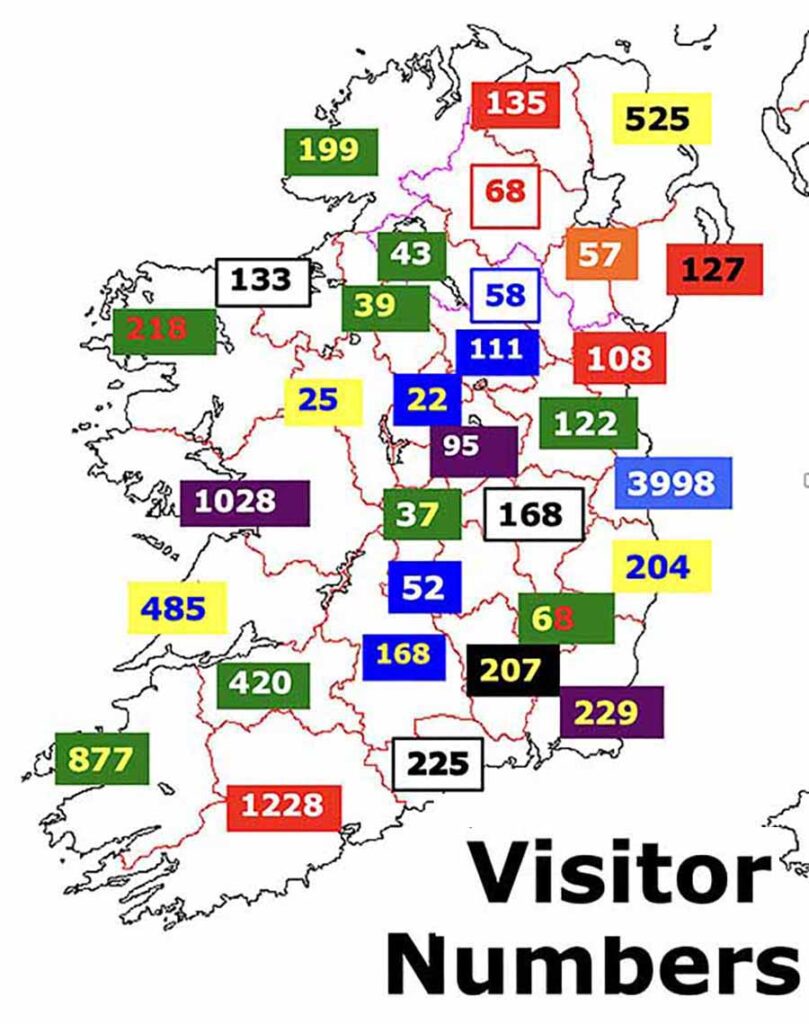
Ireland’s County Armagh is steeped in history and natural beauty, with the Navan Fort, an ancient ceremonial site, offering archaeological intrigue. The Armagh Observatory and Planetarium provide stargazing opportunities, while the city’s two cathedrals reflect its ecclesiastical heritage. Other attractions include the nearby Slieve Gullion Forest Park with its hiking trails and panoramic views. Armagh is Ireland’s fifth smallest county by size (1,253 square km) and tenth largest by population (194,394). Population peaked at 232,393 in 1841 and reached its lowest point, 108,815, in 1937. In terms of hospitality, Armagh is Ireland’s 26th most visited tourist county with around 57,000 international visitors per year.
Introduction – Adventure – Anthem – Archaeology – Attractions – Awards – Birdwatching – Camping – Castles – Churches – Contact list – Cycling – Dining – Equestrian – Festivals – Fishing – Folklore – Gardens – Golf – Graveyards – Happening – Haunted – Highest – Hiking – History – Holy Wells – Hotels – Hotels top 8 – Hunting & shooting – Instagrammable – Itineraries – Largest town – Luxury – MICE – Movies – Music – New – Name – Novelists – Off the beaten track – Poets – Pubs – Quotes – Random Facts – Restaurant Awards – Sacred Places – Saints – Songs – Spas – Sports – Sunsets – Sustainable – Things to do – Towns – Video – Villages – Walking – Wanderlist – Weddings – Wild swimming – Writers – 1837– 1846 – 1852 – 1909 – 1955 – 1980 –