Pre-1000 The Gaelic Nation
County Dublin’s pre-1000 history centres on its strategic coastal location at the mouth of the River Liffey. Archaeological evidence, such as the passage tombs at Newgrange (partly in Dublin’s historical extent) and ringforts, indicates settlement from the Neolithic period. The area was part of the house of Dúnchada and house of Fergus territories, sub-dynasties of the kings of Leinster, the house of Dunlaing. Christianity arrived by the 5th century, with Saint Patrick reputedly baptising converts at a well near Trinity College. Monasteries, such as those at Swords and Clondalkin, emerged as early Christian centres. The Annals of Ulster (record Viking raids from the 9th century, with the Norse establishing a longphort (fortified port) at Dublin (Dyflin) by 841, making it a major trading hub. Gaelic sources are sparse, and ecclesiastical records dominate, potentially exaggerating Christian influence while marginalising pre-Christian culture.
1000–1100: Viking Dublin and Gaelic Influence
In the 11th century, Dublin emerged as a thriving Viking-Gaelic city under Norse kings like Sitric Silkenbeard (d. 1042). The Battle of Clontarf (1014), led by Brian Boru, weakened Norse control, but Dublin remained a key port, with trade links to Scandinavia and England. The Annals of Inisfallen (detail Dublin’s role in Leinster politics, with Gaelic kings like Diarmait Mac Murchada vying for control. The city’s Christ Church Cathedral, founded c. 1030, became a religious focal point. Dublin’s mixed Norse-Gaelic culture thrived, but sources focus on elite conflicts, limiting insights into daily life.
1100–1200: Norman Conquest and Urban Growth
The Norman invasion (1169–1171) transformed Dublin. In 1170, Richard de Clare (Strongbow) captured the city, making it the centre of Anglo-Norman power. The Normans fortified Dublin Castle (c. 1204) and expanded Christ Church and St. Patrick’s Cathedrals. The Synod of Cashel (1172) aligned Dublin’s church with Roman reforms, establishing its archbishopric. The “Song of Dermot and the Earl” (details Norman conquests, while the Annals of the Four Masters (record Gaelic resistance under Rory O’Connor. Dublin became a walled city, with a charter granted in 1172. Norman sources dominate, often marginalising Gaelic narratives.
1200–1300: Anglo-Norman Consolidation and Civic Development
In the 13th century, Dublin was formally shired, with boundaries extending beyond the modern county. The Normans developed Dublin as Ireland’s administrative capital, with Dublin Castle housing the justiciar. The city’s port and markets grew, with guilds regulating trade. St. Patrick’s Cathedral (founded 1191) and the Dominican priory at St. Saviour’s (1224) enhanced ecclesiastical status. The Annals of Loch Cé (mention Dublin’s role in Anglo-Norman governance, but Gaelic clans, like the O’Byrnes, resisted in the Wicklow Mountains. The “Kildare Poems” (reflect Anglo-Norman culture, but Gaelic sources are sparse, requiring critical reading to uncover local resistance.
1300–1400: Gaelic Revival and English Decline
The 14th century saw a Gaelic revival in Dublin’s hinterlands, as Anglo-Norman control weakened post-Black Death (1348–1350). Gaelic clans, such as the O’Tooles and O’Byrnes, raided the Pale, the English-controlled area around Dublin. The Statute of Kilkenny (1366) aimed to curb Gaelicisation but was only partially effective in Dublin, where Anglo-Irish families like the Fitzgeralds adopted Gaelic customs. Dublin city remained a loyal English stronghold, with its walls expanded. The Annals of the Four Masters (record Gaelic incursions. English sources portray Gaelic dynasties as threats, necessitating careful interpretation.
1400–1500: Fitzgerald Dominance and the Pale
In the 15th century, Dublin was the heart of the Pale, a fortified English enclave. The Fitzgeralds of Kildare, under leaders like Gerald Fitzgerald (d. 1513), dominated Irish governance, with Dublin Castle as their base. The Wars of the Roses (1460–1485) weakened English control, allowing Anglo-Irish autonomy. Poynings’ Law (1494) subordinated the Irish Parliament, held in Dublin, to Westminster. The city’s trade and religious institutions thrived, with Trinity College’s precursor emerging. Gaelic sources are limited, and English records tend to downplay local agency outside the Pale.
1500–1600: Tudor Reconquest and Reformation
The 16th century saw Dublin as the centre of Tudor reconquest. The Fitzgerald rebellion (1534), led by Silken Thomas, briefly challenged English rule but was crushed, ending Kildare dominance. Henry VIII’s declaration of Ireland as a kingdom (1542) strengthened Dublin’s role as the administrative capital. The Reformation had limited impact, as Dublin remained Catholic, although both of the Catholic cathedrals, Saint Patrick’s and Christ Church, were repurposed as Episcopalian/Anglican churches serving the colonial regime. Early plantations targeted Dublin’s hinterlands, displacing Gaelic clans. English records dominate, portraying Gaelic and Old English as rebels, requiring balance.
1600–1700: Plantation, Rebellion, and English Control
The 17th century saw Dublin solidify as England’s Irish stronghold. The Ulster Plantation (1609) had indirect effects, but Dublin’s hinterlands saw land confiscations. The 1641 Rebellion saw Confederate forces challenge English control, though Dublin remained secure under the Pale’s defenses. The Cromwellian conquest (1649–1653) reinforced English authority, with Dublin as a military base. The Williamite War (1689–1691) saw Dublin loyal to William III, with the Battle of the Boyne (1690) fought nearby. The Annals of the Four Masters document Catholic losses. English sources vilify rebels, necessitating critical interpretation.
1700–1800: Protestant Ascendancy and Urban Expansion
The 18th century saw Dublin as Ireland’s cultural and political capital under the Colonial/Protestant Ascendancy. The Penal Laws marginalized Catholics, though Dublin’s Catholic merchant class grew. The city’s Georgian architecture, including Leinster House and the Custom House, reflected prosperity. Trinity College (founded 1592) and the Irish Parliament thrived. The 1798 Rebellion saw limited activity in Dublin, but figures like Theobald Wolfe Tone were active nearby. The Act of Union (1800) abolished the Irish Parliament, shifting power to London. Dublin’s port and brewing industry (e.g., Guinness, 1759) grew. English and colonial narratives tend to downplay native Irish or Catholic grievances.
1800–1900: Famine, Reform, and Nationalist Awakening
The 19th century saw Dublin navigate hardship and growth. The Great Famine (1845–1849) impacted rural Dublin, reducing the county’s population from 405,000 in 1841 to 366,000 in 1851, though the city’s economy mitigated effects. Dublin’s port and industries, like Guinness, drove growth, with railways enhancing connectivity. The Gaelic Revival saw the Gaelic League promote Irish culture, with figures like Douglas Hyde active. The GAA, founded in 1884, established Dublin teams. The Home Rule movement, led by Charles Stewart Parnell, galvanized Catholic Dublin, though Colonial/protestan unionism persisted. The 1803 Emmet Rebellion was a key event. English famine records tend to understate suffering.
1900–2025: Independence, Urbanisation, and Globalisation
The 20th and 21st centuries saw Dublin as Ireland’s revolutionary and modern hub. The 1916 Easter Rising, centred in Dublin, was a defining moment, with figures like Patrick Pearse and James Connolly leading the charge. The War of Independence (1919–1921) and Civil War (1922–1923) saw intense fighting in Dublin, including the burning of the Custom House. Post-independence, Dublin became the capital of the Irish Free State, later the Republic. The city’s economy boomed, with tech industries in “Silicon Docks” and tourism around Trinity College and Temple Bar. Dublin’s GAA teams won multiple All-Ireland titles. Official narratives tend to overemphasise progress, overlooking social inequalities. Dublin is one of just EIGHT Irish counties that has a larger population than it did in 1841.
History
Antrim – Armagh – Carlow – Cavan – Clare – Cork – Derry – Donegal – Down – Dublin – Fermanagh – Galway – Kerry – Kildare – Kilkenny – Laois – Leitrim – Limerick – Longford – Louth – Mayo – Meath – Monaghan – Offaly – Roscommon – Sligo – Tipperary – Tyrone – Waterford – Westmeath – Wexford – Wicklow
County Dublin:
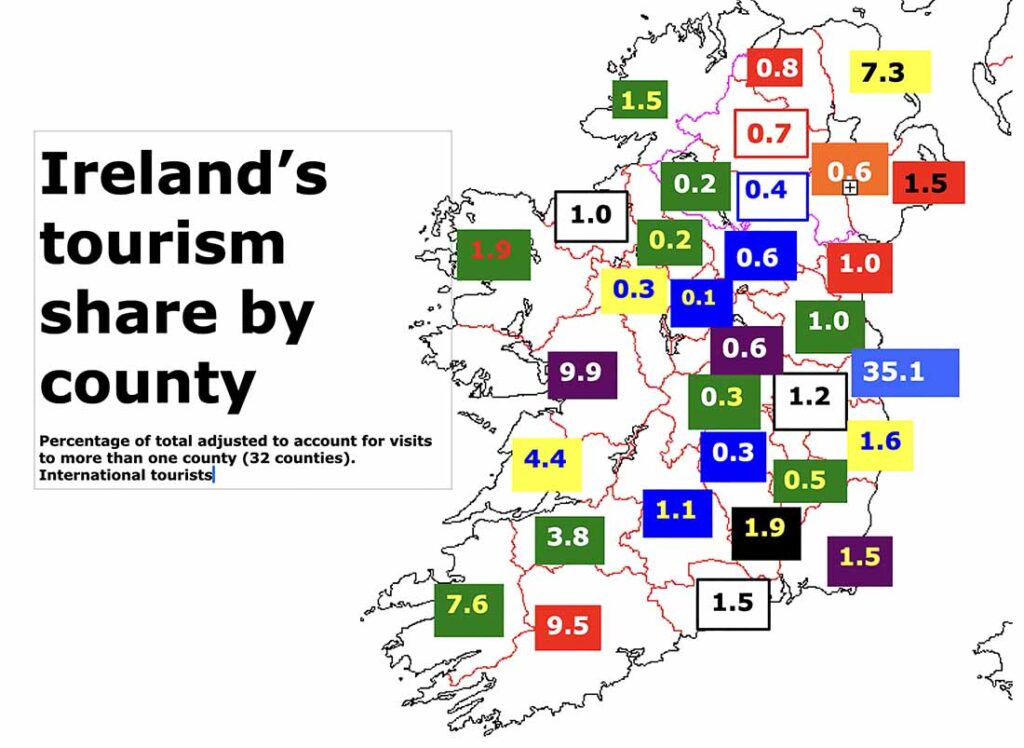
Ireland’s county Dublin combines cultural heritage with urban appeal, with Trinity College’s Book of Kells and Dublin Castle offering historical depth. The Guinness Storehouse provides a journey through Ireland’s iconic stout, while Phoenix Park’s vast green spaces are ideal for cycling. The River Liffey’s scenic walks and Kilmainham Gaol’s historical tours make Dublin a versatile destination for culture and history. Dublin is Ireland’s third smallest county by size (922 square km) and largest by population (1,458,154). Dublin is also Ireland’s most visited tourist county by a margin, with around four million international visitors per year. In terms of hospitality,
Introduction – Adventure – Anthem – Archaeology – Attractions – Awards – Birdwatching – Camping – Castles – Churches – Contact list – Cycling – Dining – Equestrian – Festivals – Fishing – Folklore – Gardens – Golf – Graveyards – Happening – Haunted – Highest – Hiking – History – Holy Wells – Hotels – Hotels top 8 – Hunting & shooting – Instagrammable – Itineraries – Largest town – Luxury – MICE – Movies – Music – New – Name – Novelists – Off the beaten track – Poets – Pubs – Quotes – Random Facts – Restaurant Awards – Sacred Places – Saints – Songs – Spas – Sports – Sunsets – Sustainable – Things to do – Towns – Video – Villages – Walking – Wanderlist – Weddings – Wild swimming – Writers – 1837 – 1846 – 1852 – 1909 – 1955 – 1980 –