- “Raised on songs and stories, heroes of renown, the passing tales and glories thagt once was Dublin town.” – Pete Sant John
- “For myself, I always write about Dublin, because if I can get to the heart of Dublin I can get to the heart of all the cities of the world. In the particular is contained the universal.” — James Joyce (1882–1941), explaining his obsession with Dublin in his fiction.
- Leafy-with-love banks and the green waters of the canal, pouring redemption for me.” — Patrick Kavanagh (referring to the Grand Canal).
- “Dublin dwindles so beautifully; there is no harsh separation between it and the country.” — George A. Moore.
- This town of Dublin is rather ill-inhabited than seated; the people of good natural abilities, but corrupted some with a wild, some with a loose life; and, indeed, there is almost nothing in this country but it is either savage or wanton. They have hitherto wanted nothing more than to be kept in fear, which (by God’s grace} they shall not want hereafter. They are inclined, more than any nation I have seen to superstitions, which surely have crept in between ignorance: and liberty. In their hospitalities there is fully as much unhandsomeness as plenty. For their general parts, their bodies are active, and their minds are rather secret than nimble. – Henry Wotton, Letter to John Donne 1599
- This is the chief city and seat of Ireland, a famous town for merchandise, the chief court of Justice, in munition strong, in buildings gorgeous, in citizens populous, seated it is in a right delectable and wholesome place: for to the South we have hills mounting up aloft, Westward an open champion ground, and on the East the sea at hand and in sight: The River Liffey running down at North-East affordeth a safe harbour for ships. By the river side, are certain wharfs or quays, as we term them, whereby the violent force of the water might be restrained. – William Camden, Britain, 1610 (Philemon Holland’s translation)
- No men in Dublin go to taverns who are worth sitting with. – Jonathan Swift, Letter to Charles Ford,16 August 1725
- This town … I believe is the: most disagreeable place in Europe:, at least to any but those who have been accustomed to it from their youth, and in such a case I suppose ir might be tolerable. – Jonathan Swift, Letter to Knightly Chctwodc, 23 November 1727
- Dublin is the most hospitable city I ever passed through. – Mary Wollstonecraft, Letters Written During a Short Residence in Sweden 1796
- As a child, places like Malahide, Swords, Rush, Lusk, Skerries and indeed the territory of Fingal as a whole, were quite familiar. Until comparatively recent times, this, an essentially garden area for Dublin City, was relatively unspoiled – Bryan MacMahon 1909-1998), Here’s Ireland (1971).
- Ireland will be the richest country in the world for its capital is always doubling (dublin). – Washington Irving, in notes of his expenses, 1805
- Och, Dublin City, there is no doubting/, Bates every city upon the say/’Tis there you’ll sec O’Connell spouting/ An’ Lady Morgan making tay/ For ’tis the capital of the finest nation/ Wid charming peasantry on a fruitful sod/ Fighting like divils for conciliation/ An’ hatin’ each other for the love of God – Cjharles Lever, 1820s
- A handsomer town, with fewer people in it, it is impossible to see on a summer’s day. – W.M. Thackeray, The Irish Sketch Book of 1842, 1843
- You see more ragged and wretched people here than I ever saw anywhere else, the women are really very handsome, quite in the lowest class.. – Queen Victoria pf England, Letter to her uncle, 6 August 1849
- Sad reflections upon Dublin, and the animosities that reign in its hungry existence – Not now the ‘Capital’ of Ireland (has Ireland any Capital?) or where is its future Capital to be? Perhaps Glasgow or Liverpool is its real ‘capital city’ just now! – Thomas Carlyle, Rnniniscmm of My Irish Journey in1849, 1882
- My intention was to write a chapter of the moral history of my country and I chose Dublin for the scene because that city seemed to me the centre of paralysis. – James Joyce, Letter to Grant Richards, 5 May 1905
- When you remember that Dublin has been a capital for thousands of years, that it is the ‘second’ city of the British Empire, that it is nearly three times as big as Venice it seems strange that no artist has given it to the world. – James Joyce, Letter to Stanislaus Joyce, 18 September 1905
- There are few cities in the world so auspiciously situated as the city of Dublin. The ocean rolls its waves within ten miles of the quays; the bay is at once safe, commodious, and magnificent, with every variety of coast, from the soft beach of sand to the rough sea promontory, from the undulating slope to the terrific rock; and several lighthouses guide the vessels into harbour. On one side is the rich pasture-land of Meath; on the other the mountains and valleys of Wicklow. A noble river flows through it. Breezes from the ocean and the hills both contribute to keep it healthy. Scenery of surpassing beauty is within an hour’s walk of its crowded streets. But no description of Dublin can so aptly and pithily characterise it as the few quaint lines of old Stanihurst, who says, in tracing its origin to the sea-king Avellanus, and giving him credit for wisdom in selecting so advantageous a site — ” The seat of this city is of all sides pleasant, comfortable, and wholesome: if you would traverse hills, they are not far off; if champaign ground, it lieth of all parts; if you be delighted with fresh water, the famous river called the Liffey runneth fast by; i f you will take a view of the sea, it is at hand.” – Samuel Carter Hall and Anna Maria Hall, Ireland, its scenery and character (1841-43)
- The Greek geographer, Ptolemy, in 140 A.O., marks the place, calling it Eblana. The Danes were there in the 9th century, brazenly setting up a primitive ship-fort, to be followed by the Anglo-Normans. For the English the G-ity was, for centuries, the capital of an enclave or Pale; later Dublin knew a soupc;:ono f Jews, a dash of Huguenots, and finally the Irish tribesmen who exultantly poured down from the Wicklow hills to recover what they had always claimed as their own – Bryan MacMahon 1909-1998), Here’s Ireland (1971).
- “Dublin, with its bustling streets and lively quays, presents a scene of such variety that the traveller is at once overwhelmed and enchanted by its pulse.” – John Gamble (1770-1831).
- I should like to put a cordon round Dublin; round up every male person in it between the ages of 15 and 30; force them to read it; and ask them whether on reflection they could see anything amusing in all that foul mouthed, foul minded derision and obscenity…. I Have walked those streets and known those shops and have heard and taken part in those conversations. I caped from them to England at the age of twenty; and forty years later have learnt from the books of Mr Joyce that Dublin is still what it was, and young en· are still drivelling in slackjawed blackguardism ust as they were in 1870. It is, however, some consolation to find that at last somebody has felt deeply about it to face the horror of writing it all down arid using his literary genius to force people to face it. In Ireland they try to make a cat cleanly by rubbing its nose in its own filth. Mr. Joyce has tried the same treatment on the human subject. I hope it may prove successful. – George Bernard Shaw, Letter to Sylvia Beach, 10 October 1921
- You may travel from Clare to the County Kildare/ From Francis Street back to the Coombe/ But where would you find a fine widow like me/ Biddy Mulligan the pride of the Coombe, me boys,/ Biddy Mulligan the pride of the Coombe. – Song written by Séamus Kavanagh for Jimmy ODea.
- “It is a cliche but nonetheless true, to say that Dublin is a city of ghosts: the ghost of the poet, James Clarence Mangan, dying in degradation in Cuffe Street, the ghost of Buck Whaley betting his fellow bucks-you can see the gaunt ruins of their Hellfire Club on the slope of a mountain south of the city-that he would travel to 20 Dublin Jerusalem and play handball against the walls of the Temple, the ghost of Lord Edward Fitzgerald wrestling for his life with Major Sirr in Thomas Street, the ghost of Dean Swift balanced between genius and insanity and the ghost of Zozimus, a Dublin balladsinger addicted to grandiosities in verse. – Bryan MacMahon 1909-1998), Here’s Ireland (1971)..” – Bryan MacMahon (1909-1998).
- “My words lick around cobbled quays, go hunting lightly as pampooties over the skull-capped ground.” — Seamus Heaney (from Viking Dublin: Trial Pieces).
- “I want to give a picture of Dublin so complete that if the city suddenly disappeared from the earth it could be reconstructed out of my book.” — James Joyce (1882–1941.
- “A good puzzle would be cross Dublin without passing a pub.” — James Joyce (1882–1941).
- “They sat in the upstairs living room, a place furnished, one way or another, from the stages of Dublin, so you were always sitting in character, you were just not sure which one.” – Anne Enright (b1962).
- “When you travel from Cork to Dublin, you don’t just change counties, you change universes. In Cork, we talk proper; in Dublin, they think they’re speaking the Queen’s English, but it’s just noise!” – Niall Tóibín (1929-2019).
- “Dublin is not only the capital of a nation, but the capital of an idea.” –
- “All the world’s a stage and most of us are desperately unrehearsed.” — Sean O’Casey (1880–1964).
- Grafton Street on Saturday morning is a pleasant place of perambulation. Fully at ease with the world. – Bryan MacMahon 1909-1998), Here’s Ireland (1971).
- Grafton Street’s a wonderland/There is magic in the air/ There’s diamonds in the lady’s eyes/ And gold dust in her hair/ And if you don’t believe me come and meet me there/ In Dublin on a sunny summer morning – Dublin Saunter, written by songwriter Leo Maguire (1903–1985) and famously performed by Noël Purcell (1900-1985).
- “There’s no place on earth like Dublin, and no place I’d rather be when I’m not there.” – Brendan Behan (1923-1964).
- Triniry College, it is a paradise in the oriental sense of the word, that is to say, a place surrounded by a high wall. – Walter Starkie, 1938
- “Dublin University contains the cream of Ireland – rich and thick.” — Samuel Beckett (1906–1989).
- Here lies the body of Jonathan Swift, DD, dean of this cathedral, where burning indignation can no longer lacerate his heart. Go, traveller, and imitate if you can a man who was an undaunted champion of liberty.” – Jonathan Swift (1667-1745) epitaph, written by himself, on his tomb in St. Patrick’s Cathedral, Dublin
- “I live in Dublin, God knows why. It’s a big con job. We have sold the myth of Dublin as a sexy place incredibly well; because it is a dreary – dreary little dump most of the time.” – Roddy Doyle (b1958).
- Behold a proof of Irish Sense! Here Irish wit is seen/ When nothing’s left that’s worth defence We build a magazine. – Jonathan Swift, Epigram, c. 1737
- Merrion Square, the Harley Street of Dublin, which the wags called ‘The Valley of the Shadow of Death.’ – Oliver Stjohn Gogarty, It Isn’t this Time of Year at all,
- 1954
- Georgian Dublin has been preserved by a cocoon of poverty. – Desmond Guinness (1931-2020), Georgian Dublin, 1979
- Along Dublin Bay, on a sunny July morning, the public gardens along the Dalkey tramline look bright as a series of parasols. – Elizabeth Bowen (1899-1973)
- It is a city where you can see a sparrow fall to the ground, and God watching it.– Conor Cruise O’Brien.
- ‘Enjoy yourself now!’ everybody says in Dublin, and they mean enjoy yourself notwithstanding. – Jan Morris, Trawls, 1976
- The most important week in Ireland is the week of the Dublin Horse Show. The best hunters, the best draught horses, and the nippiest harness ponies in the world are on show. Grafton Street becomes a garden of girls – Donn Byrne (1899-1928)
- The most instantly talkative city in Europe. – V.S. Pritchett, ‘Conversation’,
- “Dublin is a city that rewards detours. So when you get lost on cobblestone streets (and everyone does), resist the urge to map yourself back on course and poke around little cafes and shops first.” Oliver St John Gogarty (1878-1957).
- “Dublin was a small town in those days, even the bullies were small, but the gossip was stupendous, and I know it wasn’t healthy but I do miss it. We have all got very disconnected since, which is to say, sane.” – Anne Enright (b1962).
- “When I die I want to decompose in a barrel of porter and have it served in all the pubs in Dublin.” — JP Donleavy.
- “I’ve wandered North, and I have wonder South/ Through Stoney Barter and Patrick’s Close/ Up and around, by the Gloucester Diamond/ And back by Napper Tandys’ house/ Auld age has laid her hands on me/ Cold as a fire of ashy coal/ But, there is the love of me Spanish Lady, a maid so sweet about the soul
- “When I die Dublin will be written in my heart.” — James Joyce (1882–1941
- “Australia was grand, but I spent half the time explaining to them what a Dublin mammy is like.” – Maureen Potter (1925-2004).
Famous quotes from Ireland’s counties
Antrim – Armagh – Carlow – Cavan – Clare – Cork – Derry – Donegal – Down – Dublin – Fermanagh – Galway – Kerry – Kildare – Kilkenny – Laois – Leitrim – Limerick – Longford – Louth – Mayo – Meath – Monaghan – Offaly – Roscommon – Sligo – Tipperary – Tyrone – Waterford – Westmeath – Wexford – Wicklow
Musicians
Antrim – Armagh – Carlow – Cavan – Clare – Cork – Derry – Donegal – Down – Dublin – Fermanagh – Galway – Kerry – Kildare – Kilkenny – Laois – Leitrim – Limerick – Longford – Louth – Mayo – Meath – Monaghan – Offaly – Roscommon – Sligo – Tipperary – Tyrone – Waterford – Westmeath – Wexford – Wicklow
Novelists
Antrim – Armagh – Carlow – Cavan – Clare – Cork – Derry – Donegal – Down – Dublin – Fermanagh – Galway – Kerry – Kildare – Kilkenny – Laois – Leitrim – Limerick – Longford – Louth – Mayo – Meath – Monaghan – Offaly – Roscommon – Sligo – Tipperary – Tyrone – Waterford – Westmeath – Wexford – Wicklow
Poets
Antrim – Armagh – Carlow – Cavan – Clare – Cork – Derry – Donegal – Down – Dublin – Fermanagh – Galway – Kerry – Kildare – Kilkenny – Laois – Leitrim – Limerick – Longford – Louth – Mayo – Meath – Monaghan – Offaly – Roscommon – Sligo – Tipperary – Tyrone – Waterford – Westmeath – Wexford – Wicklow
Writers
Antrim – Armagh – Carlow – Cavan – Clare – Cork – Derry – Donegal – Down – Dublin – Fermanagh – Galway – Kerry – Kildare – Kilkenny – Laois – Leitrim – Limerick – Longford – Louth – Mayo – Meath – Monaghan – Offaly – Roscommon – Sligo – Tipperary – Tyrone – Waterford – Westmeath – Wexford – Wicklow
County Dublin:
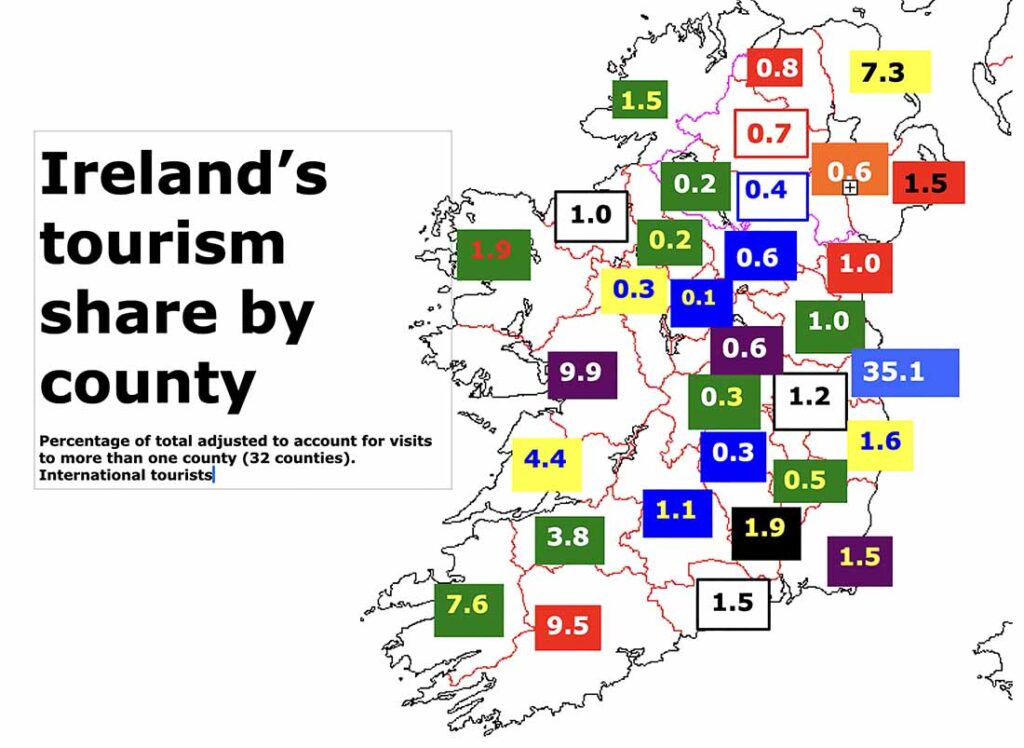
Ireland’s county Dublin combines cultural heritage with urban appeal, with Trinity College’s Book of Kells and Dublin Castle offering historical depth. The Guinness Storehouse provides a journey through Ireland’s iconic stout, while Phoenix Park’s vast green spaces are ideal for cycling. The River Liffey’s scenic walks and Kilmainham Gaol’s historical tours make Dublin a versatile destination for culture and history. Dublin is Ireland’s third smallest county by size (922 square km) and largest by population (1,458,154). Dublin is also Ireland’s most visited tourist county by a margin, with around four million international visitors per year. In terms of hospitality,
Introduction – Adventure – Anthem – Archaeology – Attractions – Awards – Birdwatching – Camping – Castles – Churches – Contact list – Cycling – Dining – Equestrian – Festivals – Fishing – Folklore – Gardens – Golf – Graveyards – Happening – Haunted – Highest – Hiking – History – Holy Wells – Hotels – Hotels top 8 – Hunting & shooting – Instagrammable – Itineraries – Largest town – Luxury – MICE – Movies – Music – New – Name – Novelists – Off the beaten track – Poets – Pubs – Quotes – Random Facts – Restaurant Awards – Sacred Places – Saints – Songs – Spas – Sports – Sunsets – Sustainable – Things to do – Towns – Video – Villages – Walking – Wanderlist – Weddings – Wild swimming – Writers – 1837 – 1846 – 1852 – 1909 – 1955 – 1980 –